Which Creature Truly Holds the World's Deadliest Grip? The Surprising Champion Revealed

Ask most wildlife enthusiasts to name the creature with the most punishing physical grip, and answers gravitate instantly toward silverback gorillas or predatory raptors. Primates boast thick digital flexors capable of snapping timber, while eagles drop from high canopies to lock their talons into prey with hydraulic authority. Biomechanical surveys published by researchers worldwide tell a far more startling story about mechanical leverage. Absolute grip force does not belong to warm-blooded mammals roaming dense jungles, but rather to an armored terrestrial arthropod that prowls remote tropical atolls.
Comparative field data gathered across zoological expeditions, highlighted recently in a comprehensive analysis by the BBC Wildlife Magazine Report on extreme animal power, demonstrates that raw squeezing capacity relies more on rigid lever mechanics than sheer muscular bulk. While mammalian muscle tissue tires and stretches, calcified exoskeletons channel force without structural flexion. Understanding which animal truly possesses the deadliest grip requires looking past pop-culture mythology and examining empirical pressure sensors, tendon elasticity, and mechanical advantage.
📌 Key Takeaways:
- The Unrivaled Champion: The coconut crab (Birgus latro) wields the strongest verified grip force on land, exerting up to 3,300 Newtons of pinching power that outperforms virtually all terrestrial predators relative to size.
- The Primate Reality Check: Gorilla grip strength reaches an estimated 4,000 to 8,000 Newtons across their entire hand, yet pound for pound, primates lose dramatically to arthropods and raptors due to muscular compliance.
- Avian Precision: Apex birds of prey like the harpy eagle generate over 500 crushing force PSI through ratchet-locking tendon structures designed to shatter bone instantly.
- Mechanics Over Mass: Rigid chitinous levers and apodeme leverage allow invertebrates to produce crushing claw power that eclipses the bite forces of most mid-sized carnivores.
The Primate Myth and What Field Dynamometers Actually Reveal
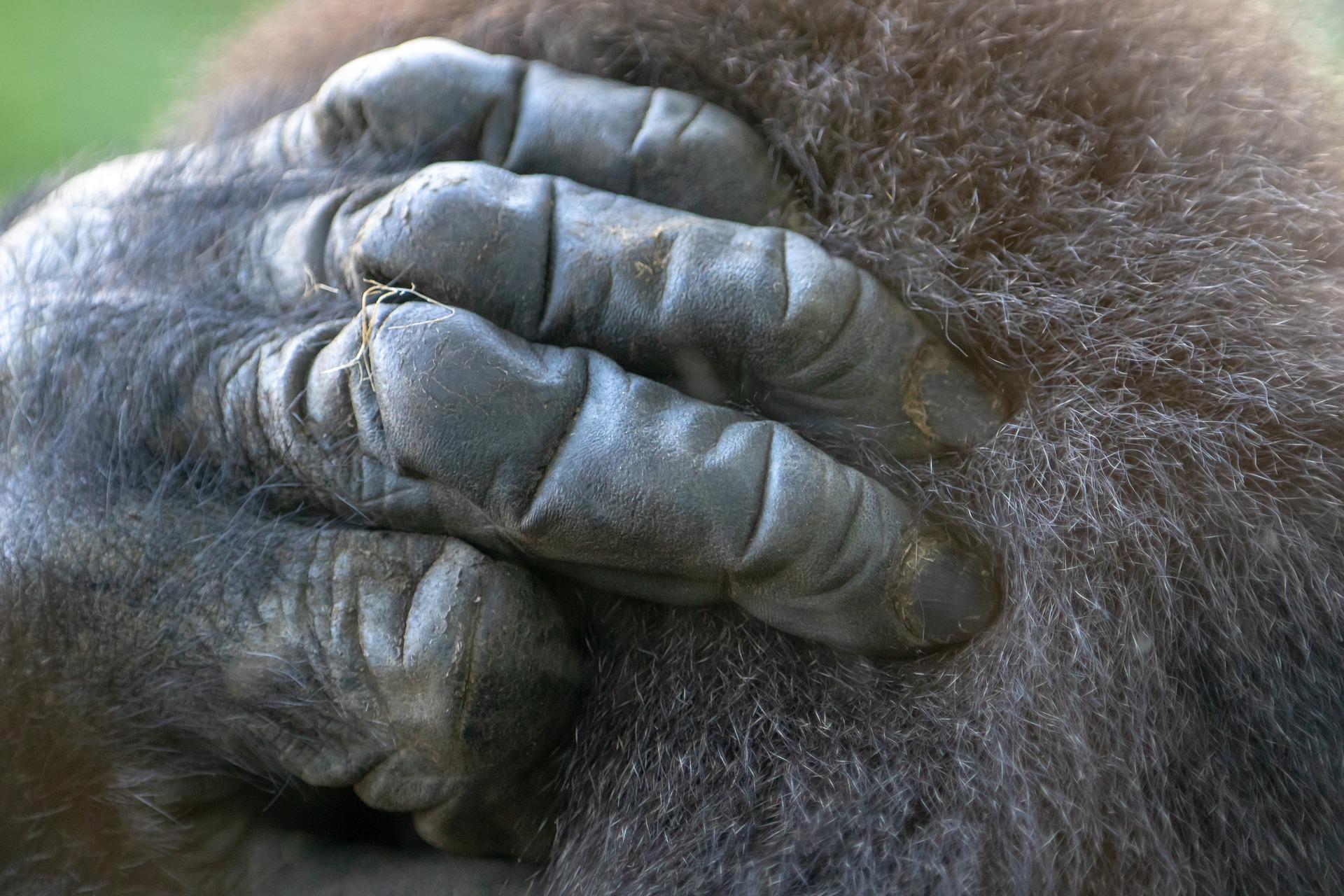
Folklore frequently credits large apes with bone-pulverizing hand strength capable of mangling steel bars. An adult male silverback gorilla weighs upwards of 400 pounds and commands dense, slow-twitch muscle fibers optimized for arboreal climbing and terrestrial knuckle-walking. Primatologists calculate estimated primate hand force based on tendon cross-sections, muscle volume, and isometric pull tests. These anatomical models suggest a gorilla can exert between 4,000 and 8,800 Newtons of total compressive force when flexing all four fingers against an object. That matches roughly 900 to 1,900 pounds of force distributed across the palm.
Humans pale in comparison. A healthy adult male produces an average grip between 450 and 600 Newtons on an industrial Jamar dynamometer. Elite powerlifters rarely exceed 1,300 Newtons. Yet mammalian anatomy features a built-in biological shock absorber: fleshy dermal pads and flexible tendons dissipate peak kinetic energy. A gorilla's hand is engineered for balance, locomotion, and foliage harvesting rather than concentrated pinpoint pressure. While their total pulling strength can easily rip heavy branches apart, primates do not concentrate their force into a singular, unyielding point of impact.
Birgus Latro and the Crushing Claw Mechanics of the Coconut Crab
True biological grip records sit on the beaches of the Indo-Pacific. Birgus latro, commonly known as the coconut crab, is the largest terrestrial arthropod on Earth. Growing up to 9 pounds with a leg span approaching 3 feet, this solitary crustacean uses its massive chelae to crack thick-hulled coconuts, crack tortoise carapaces, and strip flesh from dead carrion. For decades, naturalists traded unverified stories about the creature's claw strength. Definitive evidence arrived when researchers at the Okinawa Churashima Foundation strapped sensitive load cells onto 29 wild specimens.
The field trials produced stunning figures. The measured coconut crab pinch force topped out at 1,765 Newtons for mid-sized specimens, scaling directly with body mass. Biomechanical extrapolation determined that a maximum-sized 4-kilogram crab produces an astonishing 3,300 Newtons (roughly 742 pounds of force) at the tip of its primary claw. In terms of birgus latro grip pressure, this localized mechanical bite easily crushes hard biological materials without structural recoil. Unlike primate muscles that burn glycogen rapidly during sustained contractions, crustacean claw mechanics employ an apodeme-lever system. Long apodeme tendons inside the claw amplify muscle tension against a rigid calcified hinge, locking the claw shut with minimal metabolic expenditure.
Talon Pressure: How Raptors Shatter Skulls Mid-Flight
Avian predators take a radically different approach to grip dynamics, relying on geometric alignment and mechanical locking systems. Forest-dwelling raptors such as the harpy eagle, African crowned eagle, and Eurasian eagle-owl do not merely grab their quarry; they crush central nervous systems on contact. A female harpy eagle commands rear hallux talons measuring up to 5 inches long, larger than the claws of a grizzly bear. When dropped onto sloths or howler monkeys, those talons drive deep into flesh under intense kinetic deceleration.
Raptor talon grip strength is augmented by specialized ridges on the underside of their digits, known as the digital tendon locking mechanism. Tiny ratchet-like grooves lock the flexor tendons into place once contracted, allowing the bird to exert between 400 and 530 crushing force PSI without continuous muscular strain. The grip operates like an industrial vise. It will not yield until the prey ceases struggling, producing enough focused trauma to puncture mammalian skulls and cause instantaneous asphyxiation or circulatory collapse.
Measured Grip and Pinch Power Across the Animal Kingdom
Comparing physical grip across disparate biological classes requires balancing absolute force with surface contact geometry and relative body mass. Mammals deliver sweeping whole-hand force; crustaceans deliver hyper-focused point loads; birds of prey exploit puncture mechanics.
| Species & Appendage | Peak Measured Force | Primary Biomechanical Mechanism | Relative Grip Category |
|---|---|---|---|
| Coconut Crab (Chela) | 1,765, 3,300 N (~742 lbf) | Apodeme lever ratio in rigid chitinous frame | Highest absolute claw force on land |
| Mountain Gorilla (Hand) | 4,000, 8,800 N (Estimated) | Thick flexor digitorum muscle mass | Highest absolute mammalian hand grip |
| Harpy Eagle (Talons) | 400, 530 PSI (~500, 1,100 N) | Ratchet tendon lock and focal puncture load | Deadliest avian impact grip |
| Tasmanian Giant Crab (Claw) | 3,000, 3,500 N | Heavy calcified dactylus lever closure | Deep-sea crushing specialist |
| Human Athlete (Hand) | 450, 1,300 N | Opposable thumb precision & forearm flexion | Dexterity-focused baseline |
Grip Mechanics Versus Bite Force in Apex Predators
When measuring kinetic output in nature, biologists often juxtapose appendage grip against cranial torque. An animal bite force comparison demonstrates that vertebrates prioritize jaw mechanics over manual grasping. A saltwater crocodile slams its jaws shut with 16,400 Newtons of force, while an adult jaguar crushes bone with roughly 4,500 Newtons. Jaws benefit from massive temporalis muscles anchored to an immobile skull base. Limb appendages, by contrast, must remain mobile enough to walk, swim, or manipulate tools.
Apex predator grip mechanics reflect this evolutionary compromise. Big cats use retractile claws not to crush, but to hook, anchor, and drag prey into their lethal jaw perimeter. Bears employ immense forelimb strength, delivering paw swipes capable of generating over 4,000 pounds of instantaneous momentum, yet their paws are configured as broad distribution pads rather than pinching instruments. Crustaceans stand as the lone evolutionary exception where limbs evolved into primary crushing mechanisms that out-pinch the bite forces of most canines and leopards.
Pound-for-Pound Grip Records in the Invertebrate World
Scaling body mass shifts the narrative entirely away from large vertebrates. The strongest animals pound for pound occupy undergrowth leaf litter and forest soils. While the coconut crab holds the land crown for raw single-appendage force, relative pulling strength reaches astronomical heights in smaller insects. As detailed in the BBC Wildlife report on world records, the horned dung beetle (Onthophagus taurus) can pull an unbelievable 1,141 times its own body weight. If an adult human possessed comparable relative pulling mechanics, they could hoist six double-decker buses simultaneously.
Similarly, the mantis shrimp generates hyper-specialized appendage snap acceleration exceeding 10,000 g, producing cavitation bubbles that boil water at room temperature. But for sustained static clamping, the coconut crab remains peerless. When a 4-kilogram crab exerts 3,300 Newtons, it generates a force-to-weight ratio roughly 90 times its own body mass from a single appendage. Mammals cannot mirror these ratios because muscular volume scales cubically while cross-sectional strength scales quadric-linearly, leaving heavy quadrupeds at an inescapable thermodynamic disadvantage.
Frequently Asked Questions (FAQ)
Q1: Can a coconut crab's claw crush human fingers or hands?
A1: Yes. With verified pinch forces scaling up to 3,300 Newtons (over 700 pounds of force), a large coconut crab can easily crush human finger bones and sever soft tissue. Once locked, their apodeme lever mechanism maintains tension, requiring careful manual manipulation or gentle physical stimulation to force the crab to release.
Q2: Why is a gorilla's grip force often listed higher than a coconut crab's?
A2: The distinction lies between total hand force and pinpoint crushing power. A gorilla uses an entire hand with five broad digits to exert between 4,000 and 8,800 Newtons across a wide surface area. A coconut crab concentrates up to 3,300 Newtons into the tiny tip of a rigid claw, creating exponentially higher localized pressure per square millimeter.
Q3: Which bird possesses the highest talon grip pressure?
A3: The harpy eagle ranks at the top of avian grip measurements, producing over 500 PSI of crushing pressure. Its rear hallux talons can exceed 5 inches in length, driven by a mechanical ratchet tendon system capable of breaking bones on direct contact.
The Biomechanical Trade-Offs of Extreme Squeezing Power
Extreme grip strength is an expensive biological investment. Species that possess unmatched crushing forces do so by trading away dexterity, tactile sensitivity, and speed. A coconut crab's claws cannot manipulate delicate vegetation or handle intricate feeding rituals; they function strictly as heavy-duty hydraulic clamps designed to crack shells and deter competitors. Primates evolved away from rigid clamping mechanisms millions of years ago, trading raw crushing potential for precision grip, fine motor skills, and hand flexibility.
Nature consistently optimizes form for ecological survival rather than raw numerical supremacy. The coconut crab retains the crown for the world's most concentrated grip force because its survival depends on cracking nature's toughest organic vaults on barren coral islands. Where mammals rely on jaws, social hunting, and strategic leverage, the armored crustacean relies on 3,300 Newtons of unyielding mechanical leverage. In the global contest of physical grip, chitinous levers hold the decisive edge over warm-blooded muscle.
