Behind the Balance Sheets: Estimating the Real Annual Incomes of Southern All Stars Members
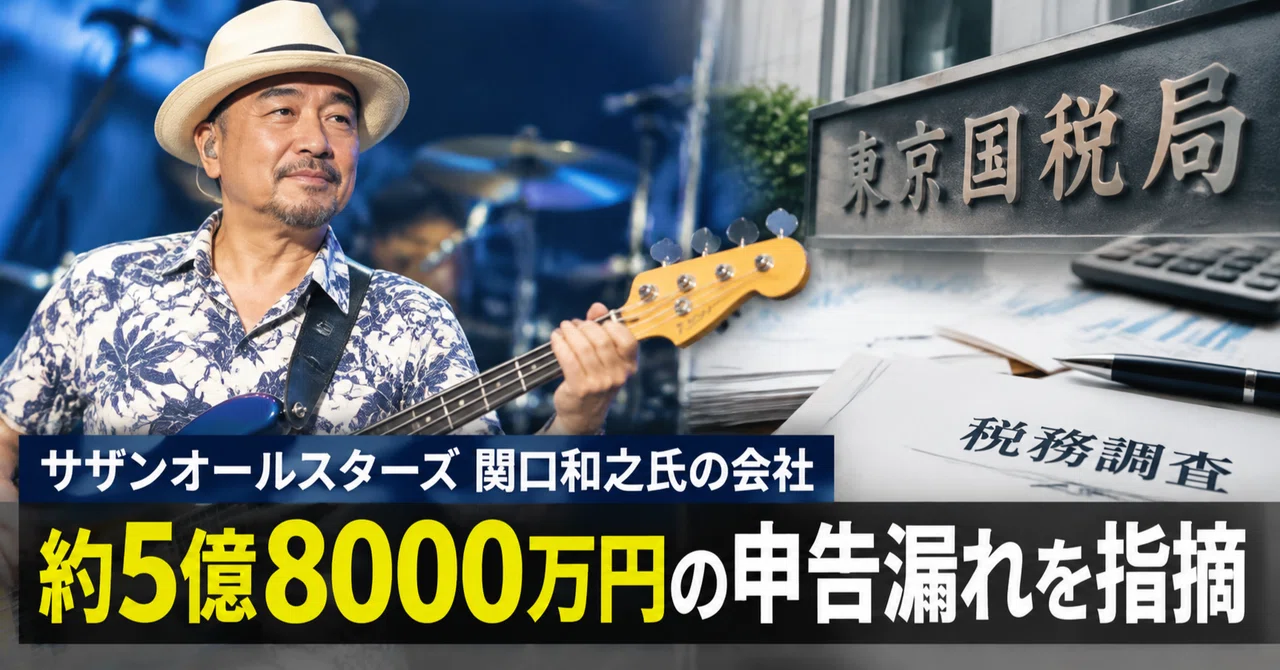
When the Tokyo Regional Taxation Bureau concluded an intensive audit of a boutique music enterprise in late 2024, the findings did more than expose an aggressive corporate tax shelter. They opened a rare window into the financial mechanics of Japan’s most enduring commercial rock act. According to an investigative note Report detailing corporate filings and tax assessments, bass player Kazuyuki Sekiguchi’s private asset-management company failed to declare roughly ¥586.5 million in income across three fiscal years. For an industry accustomed to keeping its ledger books firmly out of the public eye, the enforcement action underscored an open secret in Tokyo’s music scene: veteran arena acts do not operate like traditional bands. They function as confederations of discreet holding companies.
Decades of sold-out dome tours, massive catalog consumption, and long-standing management contracts with entertainment powerhouse Amuse Inc. have yielded multi-million-dollar annual paydays for Southern All Stars. Yet their wealth is neither pooled equally nor earned through straightforward salary distributions. By cross-referencing public tax enforcement records, agency earnings filings, and songwriting royalty distributions, we can map the financial gulf separating frontman Keisuke Kuwata from his bandmates, illuminating how rock royalty in Japan actually generates and manages its fortunes.
📌 Key Takeaways:
- The Corporate Anchor: A 2024, 2026 Tokyo tax audit against bassist Kazuyuki Sekiguchi’s firm revealed a ¥586.5 million income omission, resulting in a ¥53 million tax penalty.
- The Royalty Divide: Songwriting and publishing rights via JASRAC grant frontman Keisuke Kuwata an estimated ¥800 million to ¥1.2 billion annually, towering over the performance-driven income of non-writing band members.
- Corporate Shielding: Long-term members use private corporate structures to collect touring retainers, licensing fees, and retail sales, sheltering income under corporate tax rates rather than Japan's top 55% marginal personal rate.
The Nohohon Audit That Lifted the Corporate Veil
In early October, tax enforcement reports verified that Nohohon Inc., a Tokyo-based music and instrument sales company headed by 70-year-old bassist Kazuyuki Sekiguchi, was hit with an official reassessment by the Tokyo Regional Taxation Bureau. The audit covered three fiscal periods ending in September 2023. Examiners determined the company had improperly recorded losses totaling ¥586.5 million by purchasing shares from an entity affiliated with its own certified tax accountant and writing down the value. The tax authorities rejected the deductible losses, slapping the firm with roughly ¥53 million in back corporate taxes and underreporting penalties.
Sekiguchi maintained that the corporate transactions followed the direct advice of his licensed tax advisor. But the sheer scale of the undeclared sum caught industry observers off guard. In Japan, bass players in legacy groups rarely command the kind of personal wealth associated with western rock stars. That a single band member’s subsidiary held hundreds of millions of yen in investable liquidity shows the enduring profitability of the Southern All Stars enterprise. The group has survived for nearly five decades at the top of the domestic charts, turning longevity into institutional equity.
The Frontman Monopoly: How Keisuke Kuwata Dominates Royalties
Every calculation of Southern All Stars’ member earnings must confront a fundamental reality of the Japanese recording industry: the gap between performer rights and author rights. Bandleader Keisuke Kuwata is not merely the public face and lead singer; he is the sole composer and lyricist for the overwhelming majority of the Southern All Stars catalog, as well as an extensive, highly lucrative solo repertoire.
In Japan, the Japanese Society for Rights of Authors, Composers and Publishers (JASRAC) collects and distributes music publishing royalties with algorithmic precision. Whenever classics like "Tsunami," "Manatsu no Kajitsujin," or "Itoshi no Ellie" play on commercial radio, stream on digital platforms, feature in television commercials, or ring through karaoke parlors nationwide, the songwriting royalties flow directly to Kuwata and his associated publishing entities. Non-writing members do not receive a fraction of these author collections.
Public tax figures from Japan’s pre-2005 Choja Banzuke (the publicly published high-income taxpayer register) consistently ranked Kuwata among the top earners nationwide, frequently reporting personal income exceeding ¥800 million to ¥1 billion annually during peak release cycles. In 2026, streaming catalog values and perpetual licensing provide Kuwata an estimated baseline publishing income of ¥500 million to ¥700 million every year before playing a single live show. When factoring in his solo releases, brand commercial appearances, and Amuse executive-level distributions, his total annual income easily runs between ¥1.2 billion and ¥1.8 billion in active touring years.
Touring Revenues and the Amuse Performance Engine
The playing field levels out only when the band convenes for live tours. Southern All Stars is managed by Amuse Inc., one of Japan’s premier publicly traded entertainment agencies. While early-career artists at Japanese talent agencies historically operated on fixed monthly salaries, veteran acts of Southern All Stars' stature negotiate profit-sharing performance contracts or run their touring payments through their respective corporate entities.
A standard Southern All Stars dome tour fills hundreds of thousands of seats across Tokyo, Osaka, Nagoya, Fukuoka, and Sapporo. Ticket prices for modern arena-level J-rock tours average between ¥11,000 and ¥15,000 per head. When counting gross ticket receipts, VIP packages, and arena merchandise sales, a single 15-to-20-date tour run easily grossed over ¥6 billion to ¥8 billion. After deducting arena venue rentals, stage production costs, insurance, and Amuse’s management commission (customarily estimated at 30% to 50% of net touring margins), a multi-billion yen pool remains for the performers.
This touring margin is distributed among the active core lineup: Keisuke Kuwata, keyboardist and vocalist Yuko Hara, bassist Kazuyuki Sekiguchi, drummer Hiroshi Matsuda, and percussionist Hideyuki "Kegani" Nozawa. For the non-frontman members, an active national tour represents the single largest injection of liquid capital into their balance sheets, adding ¥80 million to ¥180 million per member in a tour year.

The Estimated 2026 Earnings Breakdown: Member by Member
Because Japan ceased the mandatory publication of individual tax returns in 2005 to protect personal privacy, current individual incomes must be derived by modeling reported corporate tax actions, agency annual reports, JASRAC tier estimates, and live attendance metrics. The numbers clarify the substantial disparity inside the band.
| Member & Core Role | Primary Revenue Streams | Estimated Annual Income (Off-Tour Year) | Estimated Annual Income (Touring Year) |
|---|---|---|---|
| Keisuke Kuwata(Lead Vocals, Guitar, Songwriter) | JASRAC publishing royalties, solo albums, commercial endorsements, touring profits | ¥600M, ¥900M ($4.0M, $6.0M) | ¥1.2B, ¥1.8B ($8.0M, $12.0M) |
| Yuko Hara(Keyboards, Vocals) | Tour performance fees, solo catalog publishing, book royalties, joint marital holdings | ¥60M, ¥100M ($400K, $670K) | ¥150M, ¥250M ($1.0M, $1.7M) |
| Kazuyuki Sekiguchi(Bass, Ukulele Specialist) | Tour performance split, instrument sales (Nohohon), solo ukulele projects, event production | ¥40M, ¥70M ($270K, $470K) | ¥120M, ¥200M ($800K, $1.3M) |
| Hiroshi Matsuda(Drums, Percussion) | Tour performance split, master rights performance royalties, studio retainers | ¥30M, ¥50M ($200K, $330K) | ¥100M, ¥160M ($670K, $1.1M) |
| Hideyuki "Kegani" Nozawa(Percussion) | Tour performance split, neighboring rights royalties, media appearances | ¥30M, ¥50M ($200K, $330K) | ¥100M, ¥160M ($670K, $1.1M) |
The numbers reflect a standard industrial hierarchy. Kuwata operates in an economic bracket shared only by Japan’s elite pop icons like Eikichi Yazawa, Masaharu Fukuyama, or Tsuyoshi Nagabuchi. Meanwhile, his bandmates live comfortably in the upper-middle tiers of high-net-worth professionals, their base earnings buoyed by their corporate structures and sporadic stadium cash injections.
Why J-Rock Veterans Rely on Corporate Asset Management
In Japan, individual income tax tops out at a punishing 45%, with an additional 10% in local inhabitants tax, pushing total marginal personal taxation to 55% for high earners. Corporate tax rates, by contrast, sit effectively around 30% to 34% for small and mid-sized enterprises. For career musicians with substantial, fluctuating paychecks, establishing a private company (often categorized as an asset-holding or music production vehicle) is an essential financial defensive measure.
Sekiguchi’s firm, Nohohon Inc., is a case study in how these corporate vehicles function. The entity handles his independent artistic efforts, such as his solo ukulele releases, instrument distribution, and festival organizing, while also receiving performance disbursements from band activities. These corporate setups allow artists to legitimately write off gear, production spaces, transportation, and administrative overhead against gross income.
The danger comes when asset holding companies cross the line from standard expense accounting into aggressive tax sheltering. The Tokyo Regional Taxation Bureau looks closely at private firms tied to entertainment figures, specifically checking for transactions engineered to create synthetic tax losses. The ¥586.5 million stock transaction at Nohohon crossed that line in the eyes of tax inspectors, turning a legitimate tax shield into a public and costly enforcement action.
Frequently Asked Questions (FAQ)
Q1: Does Southern All Stars split their live concert earnings equally among all members?
A: No. While all active members receive a direct share of the net performance revenue negotiated through Amuse Inc., payments are typically weighted by seniority, participation level, and historical contract tiers. Keisuke Kuwata receives a substantially higher payout due to his status as the primary musical architect and artistic director.
Q2: Why is the gap between Keisuke Kuwata's income and other members so wide?
A: Songwriting royalties. Under Japanese copyright law and JASRAC protocols, composition and lyric rights generate residual income every time music is streamed, sold, covered, or broadcast. Because Kuwata wrote almost the entire catalog, these multi-million-dollar royalties accrue entirely to him, bypassing the rest of the band.
Q3: Did Kazuyuki Sekiguchi face criminal charges over the tax audit?
A: No. The action by the Tokyo Regional Taxation Bureau was an administrative correction (kosei shobun) involving disallowed deductible losses, not a criminal evasion indictment. Sekiguchi's company was assessed underreporting penalties and back taxes totaling roughly ¥53 million, which were settled following the ruling.
The Reality of Legacy Music Economics in Japan
The popular image of an arena rock band suggests equal partners sharing the spoils of stadium runs and platinum records. The tax data and balance sheets from Southern All Stars paint a very different, corporate reality. The band functions as an elite business collective centered around a solitary creative hub.
Keisuke Kuwata remains the financial engine, turning four decades of composition into a self-sustaining royalty empire that generates generational wealth. For the remaining members, life inside Japan’s biggest rock group offers steady work, periodic eight-figure arena bonuses, and the resources to run private passion companies. But as recent corporate audits demonstrated, navigating high finance and aggressive tax shelters carries public risks that music fame cannot soften.