Down to One Person: The Shocking World of Surnames on the Brink of Total Extinction
Somewhere in a regional records office or a quiet suburban apartment sits an individual whose death will erase an entire branch of linguistic history. They hold a single-bearer surname: a family name carried by exactly one living human being on Earth. When that person dies, the lineage does not merely pause; centuries of etymological migration, regional record-keeping, and genealogical identity vanish from the public record forever.
Across the globe, demographic shifts and compounding mathematical laws are quietly purging the diversity of human naming traditions. In countries like Japan, the United Kingdom, Italy, and China, thousands of ancient surnames now teeter on the absolute threshold of extinction, reduced from thriving village communities to solitary pensioners.
📌 Key Takeaways:
- The Single Bearer Reality: Official census data and genealogical registries confirm hundreds of distinct surnames currently survive through just one living individual.
- The Mathematical Trap: The Galton-Watson probability model proves that patrilineal naming conventions inevitably collapse into a handful of dominant names over generations.
- Global Pressure Points: Legal marital naming mandates in Japan and strict civil registration databases in Western Europe are rapidly accelerating the rate of surname loss.
The Mathematical Law That Wipes Out Family Names
The disappearance of family names is not a random historical accident. It is governed by a proven mathematical phenomenon first identified in 1874 by Victorian polymath Sir Francis Galton and mathematician Henry William Watson. The Galton-Watson branching process proved that in any culture where family names pass patrilineally from father to child, a surname faces a statistically inevitable risk of total extinction whenever a generation produces no male heirs who reproduce.
Over centuries, this mathematical reality creates a brutal funnel effect. Common surnames inevitably absorb population share, while low-frequency names drop to zero. In China, where naming systems have operated for over four millennia, approximately 86% of the country's 1.4 billion people share just 100 surnames. Surnames like Wang, Li, and Zhang each claim nearly 100 million individuals. Meanwhile, thousands of indigenous, phonetically unique minority surnames have been entirely erased from civil registries.
The same mathematical attrition plays out relentlessly in Western demographic registries. When an English family bearing the surname Sallowpond or Pussycats had daughters who married and took their husbands' names, or when the final male bearer died without children, the name was struck from the census surname frequency registries permanently.
Living on Borrowed Time: The World's Solitary Names
Determining the exact count of one-person surnames requires sifting through national civil rolls and rare family names registry databases. In the United Kingdom, historical records maintained by the General Register Office show that dozens of names that appeared in the 1881 British Census have dwindled down to a single elderly bearer or disappeared entirely during the mid-2020s.
Surnames such as Miracle, Relish, MacCunn, and Tatam have appeared in genealogical audits with fewer than five registered individuals across England and Wales. In certain instances, demographic researchers have tracked specific branches down to an individual survivor. In the case of historic British names like Fernsby, widely cited by onomastic scholars as one of the rarest family names in the English-speaking world, decades of registry tracking showed fewer than two dozen verified instances, with localized census sweeps in certain regions identifying solitary family pods before international dispersal made them functionally endangered.
A similar phenomenon exists in Italy, where hyper-localized regional surnames derived from specific hamlets or long-forgotten medieval professions have been whittled down to a lone resident in a mountain village. In Piedmont and Friuli, municipal birth registries record dozens of surnames held by solitary septuagenarians living in depopulated valleys. When that final resident passes away, the municipality closes the registry ledger for that name permanently.
Demographic Collapse and the Vanishing Surnames of Japan
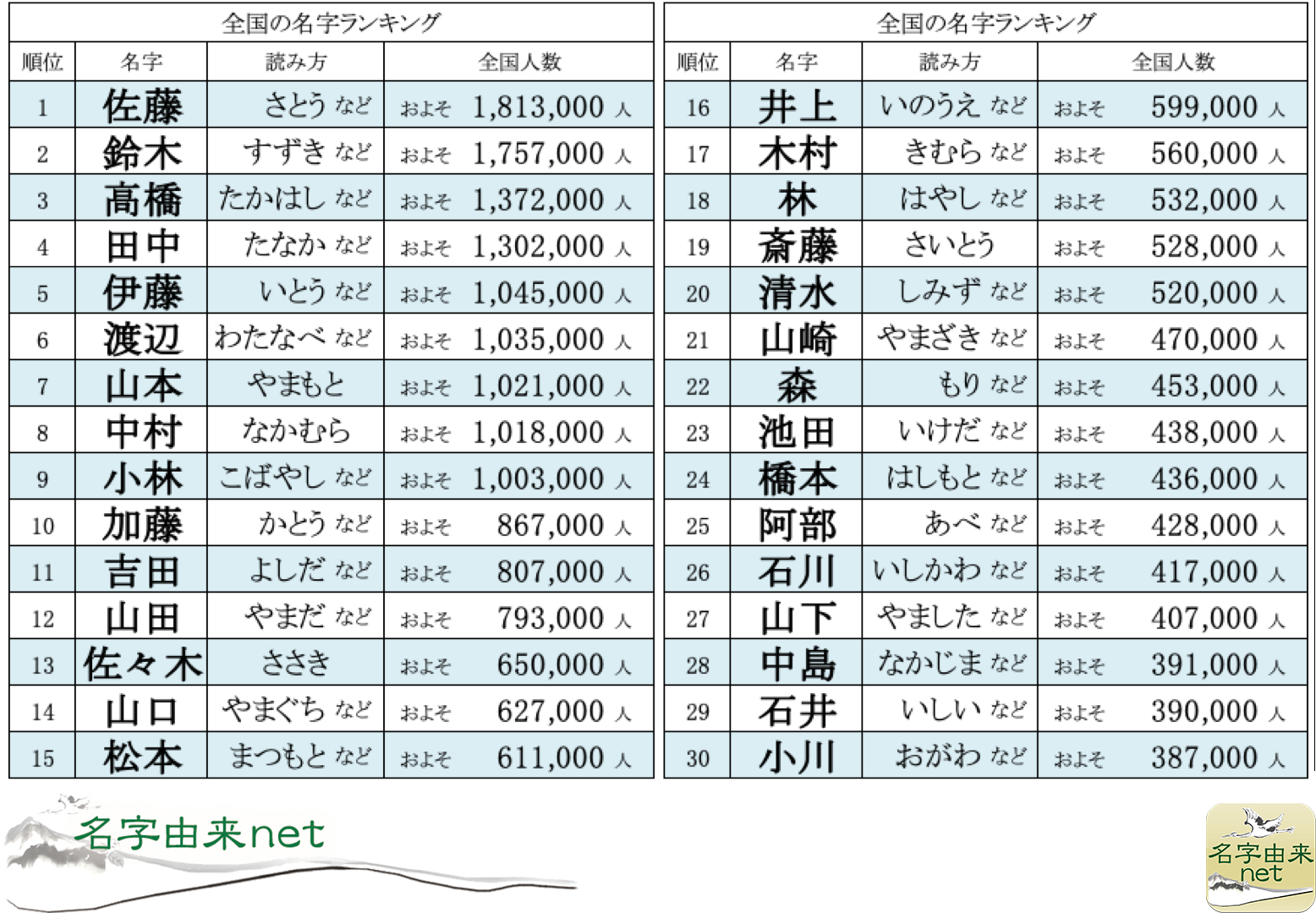
Nowhere is the crisis of surname extinction more acute than in Japan. The country maintains roughly 130,000 distinct surnames, an extraordinary level of variety generated after the 1875 Meiji government decree (the Heimin Myoji Kyoyurei), which mandated that all commoners adopt and register surnames. Japanese surnames frequently draw on ultra-specific geographical features, producing micro-surnames that historically belonged to only a few households in a single farming or fishing village.
Today, Japan's twin crises of rapid population contraction and an unyielding legal requirement, Article 750 of the Civil Code, which obliges married couples to select a single surname, are decimating this linguistic heritage. In practice, approximately 95% of married couples adopt the husband’s surname, compounding the loss of rare maternal lineages.
Renowned onomastic researcher Hiroshi Takahashi, who has spent decades analyzing Japanese naming registers, has cataloged hundreds of surnames that belong to only one household or a single registered citizen. Names such as Kanagashira (written with kanji characters meaning golden head), Hyakumanben (meaning one million prayers), and Tsukumo (written with specialized kanji for ninety-nine) exist at the edge of the official family register (koseki). In many cases, these names are borne by elderly individuals living in rural prefectures whose adult children either took different names upon marriage or had no offspring.
A 2024 demographic projection by Professor Hiroshi Yoshida at Tohoku University underscored the mathematical end state of this system: if Japan retains its mandatory single-surname law and current fertility trends persist, the surname "Sato" could theoretically account for 100% of the population within five centuries. The rich regional archive of tens of thousands of one-person surnames will be extinguished long before then.

Mapping the Decline: How Rarest Surnames Compare Across Regions
Tracking endangered last names requires contrasting legal frameworks, historical origins, and modern demographic dynamics across different global regions. The rate of surname attrition reflects both cultural inheritance practices and state regulation.
| Region / Jurisdiction | Primary Driver of Extinction | Current Status (2024, 2026) |
|---|---|---|
| Japan | Mandatory single-surname marriage law combined with steep fertility decline | Hundreds of Meiji-era names reduced to 1, 5 individuals; accelerating disappearance in rural prefectures |
| United Kingdom | Centuries of patrilineal attrition and voluntary name-changing | Over 200 historically recorded surnames down to solitary bearers; dozens extinct since 2000 |
| China | 4,000+ years of Galton-Watson sorting and state digital ID character restrictions | Fewer than 6,000 active surnames nationwide; ancient minority characters forced into standardized pinyin |
| Southern Europe (Italy/Spain) | Rural depopulation and hyper-localized toponymic origins | Hamlet-specific surnames dying out as younger generations migrate to urban metros and drop double surnames |
Digitization and the Administrative Death of Unusual Names
Beyond natural demographic attrition, the modern bureaucratic state has introduced an artificial vector of surname extinction: digital standardization. For centuries, eccentric, hyphenated, or phonetically irregular family names survived in handwritten local ledgers. Today, government databases, banking portals, and international airline booking systems enforce strict standardized character sets.
In mainland China, the National Citizen Identity Information Center database initially struggled to process rare Chinese characters (rare hanzi) used in the surnames of certain ethnic minorities and rural families. In numerous documented cases, individuals bearing rare ancestral surnames, such as characters composed of ancient animal radicals or archaic stroke combinations, were legally forced to simplify or alter their family names simply to obtain a national resident identity card, open a bank account, or board high-speed rail lines.
In the Western world, hyphenated names or names featuring apostrophes, diacritics, and irregular capitalization face persistent systemic erasure from software fields. Many individuals bearing rare hyphenated lineages choose to drop the less common half of their surname to avoid friction with passport systems, payroll processors, and credit reporting agencies. The pressure to conform to administrative infrastructure quietly prunes unusual surnames from the legal record decades ahead of natural biological lineage death.
The Cultural Consequences of Monolithic Naming
The extinction of least common family names is more than a genealogical curiosity. It represents a permanent reduction in cultural, linguistic, and historical resolution. Surnames act as linguistic fossils. They preserve archaic dialects, dead occupations, medieval trade relationships, and ultra-specific topographical markers that have long vanished from contemporary maps and dictionaries.
When an obscure occupational surname like Sumpter (a medieval packhorse driver) or a topographic name like Bythewood collapses into extinction, an intact thread linking modern citizens to twelfth-century land management disappears. In Japan, where some single-bearer surnames derive from specific rock formations or historical shrine assignments in vanished hamlets, the death of a name erases the only surviving civic memory of that settlement's original founding family.
Sociological surveys conducted among genealogy communities across the UK and the United States reveal a profound psychological burden carried by the final bearers of dying names. Active discussions across genealogy forums highlight individuals who express acute grief over being "the last of the line." Many young adults describe feeling pressured to have children solely to pass down a name, while others struggle with the reality that their marriage choices directly trigger the bureaucratic termination of a centuries-old moniker.
Frequently Asked Questions (FAQ)
Q1: What is the rarest surname currently registered in the world?
A1: There is no single "rarest" surname because hundreds of surnames hold the equal distinction of having literally one living bearer. In specialized registries across Japan, Italy, and the UK, multiple names exist that are legally registered to only a solitary individual, meaning they share the title of the world's least common name.
Q2: Why do countries with old naming traditions have so few unique surnames?
A2: The longer a culture operates under a strictly patrilineal surname system, the more names go extinct due to the Galton-Watson probability law. Countries like China and Korea, which adopted patrilineal surnames thousands of years ago, have consolidated into a small pool of dominant names, whereas countries that adopted surnames relatively recently (such as Japan in 1875) retain far higher diversity.
Q3: Can a person legally revive an extinct family name?
A3: In many Western jurisdictions, including the United States, Canada, and the United Kingdom, common law and deed poll statutes allow individuals to legally change their surname to an extinct ancestral family name if they choose. In countries with strict civil registries like Japan, Germany, or China, reviving an extinct surname is exceptionally difficult and strictly restricted by statutory civil codes.
The Looming Horizon for Global Surname Demographics
Humanity is heading toward a significantly more uniform naming environment. As birth rates continue to decline across industrial and post-industrial economies, the mathematical velocity of surname extinction will increase sharply. The genealogical branching process that previously required three centuries to extinguish a family name now completes the task in three generations.
Preserving the surviving single-bearer surnames demands structural shifts: modernizing civil registration software to accommodate rare and historical characters, and reforming rigid marital naming statutes to give couples freedom to preserve vulnerable maternal and minority heritages. Without these changes, the vast archive of global family names will contract into a homogenized handful of corporate-friendly labels, leaving thousands of unique linguistic lineages locked forever in historical censuses.