Former Military Commander Hosts Real-Time Survival Masterclass on Emergency Water Filtration
Military Survival Tactics Meet Field Engineering: Inside the Emergency Water Masterclass
A glass of stagnant river water thick with brown silt, organic muck, and microbial hazards can kill an untrained civilian within seventy-two hours. Transforming that sludge into crystal-clear, potable drinking water requires an uncompromising grasp of physical separation and chemical adsorption. During an intensive survival training initiative reported by the Japanese national wire service 時事ドットコム, a former Japan Ground Self-Defense Force (JGSDF) special forces commander demonstrated precisely how elite tactical operators isolate drinkable fluids under extreme operational collapse.
The masterclass, hosted as part of the "Fuwari Survival Course" in late May, bridged the divide between field expedients and engineered equipment. As urban disaster planning shifts from passive reliance on municipal infrastructure toward self-reliant resilience, the techniques demonstrated during this training offer an empirical blueprint for emergency water purification when municipal taps run dry.
📌 Key Takeaways:
- The Dual-Path Strategy: Improvised sand and charcoal filtration removes turbidity and heavy suspended solids, but biological safety requires secondary mechanical purification or heat disinfection.
- Tactical Instruction Origin: A former JGSDF special operations leader guided civilian trainees through real-time mud-to-water conversion, highlighting the portable disaster gear manufactured by survival hardware brand Greeshow.
- The Limiting Factor: DIY field survival filters lack the micron-level pore density required for complete pathogen removal, making secondary treatment mandatory for non-negotiable gut defense.
The Anatomy of an Improvised Gravity Column
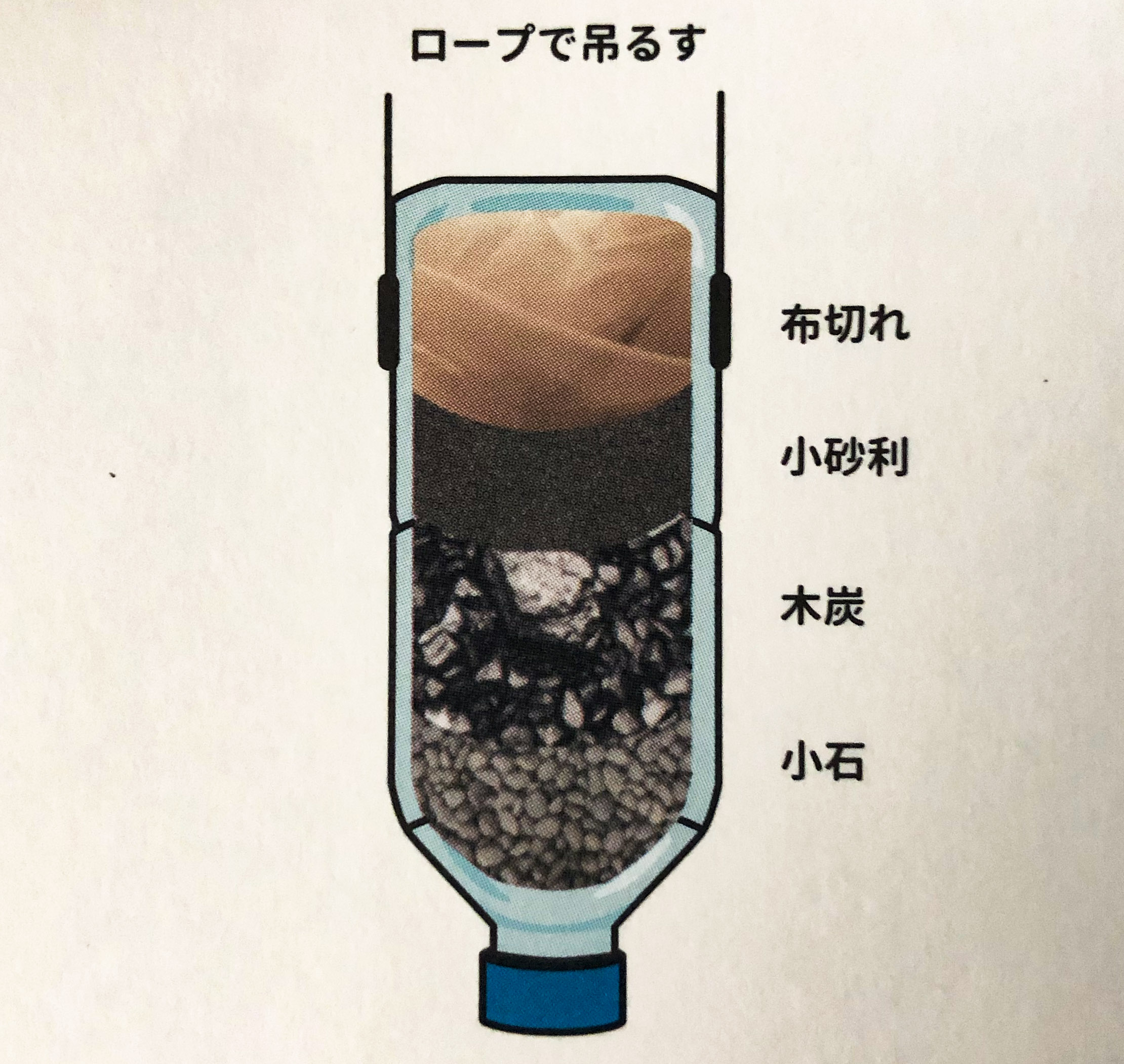
When disaster severs the power grid and municipal water mains fracture, finding surface runoff is easy. Purifying it is another story. Military survival doctrine relies on a multi-tiered sediment pre-filter constructed inside an inverted plastic container, bamboo stalk, or field cylinder. The objective centers on turbidity reduction: eliminating suspended soil, algae, and macroscopic contaminants before applying secondary chemical or thermal purification.
Building a dependable DIY survival water filter demands exact layering. At the inverted apex, the narrow mouth of a bottle, pack sterile cloth, cotton balls, or unbleached moss to keep your media inside. Directly above sits a densely packed layer of crushed charcoal. In an off-grid scenario, pull coals from an extinguished campfire, smash them into coarse gravel and powder, and pack them tight.
Above the charcoal, alternate layers of fine sand, coarse sand, and washed gravel. The gravel traps floating twigs, leaf mulch, and large grit. The sand layers act as high-density physical barriers, seizing fine clay and silt through mechanical straining. By the time water drips down to the carbon core, the fluid has shed roughly 90% of its visual turbidity, allowing the internal carbon matrix to process dissolved organic compounds without clogging instantly.
Charcoal Science: Crushed Ash Versus Industrial Activated Carbon
A dangerous myth circulates across survival blogs: the belief that crushed campfire charcoal behaves identically to commercial activated charcoal. It does not. Campfire coals contain thousands of microscopic blind pores, offering modest surface area for physical absorption. Industrial activated charcoal undergoes high-temperature steam treatment or chemical activation, expanding its internal pore network exponentially. A single gram of high-grade activated carbon features a surface area exceeding 1,000 square meters.
In a crude wilderness column, campfire charcoal will catch chemical tannins, reduce swamp odors, and pull out trace agricultural residues. Yet it cannot trap microscopic biological threats. Viruses such as Norovirus measure between 0.02 and 0.04 microns; bacteria like Escherichia coli measure between 0.5 and 2.0 microns; protozoan cysts like Giardia lamblia span 8 to 14 microns. These organisms flow through loose sand, gravel, and primitive carbon channels with zero resistance.
Treating an improvised column as a standalone water purification engine invites waterborne disease. The field rig serves strictly as a mechanical clarifier. It produces clear water, not biologically sterile water.
Field Methodology: Improvised Assemblies Versus Tactical Hollow-Fiber Gear
The Fuwari masterclass demonstrated both ends of the survival spectrum: hand-built organic filters and modern tactical micro-filtration pumps. The table below details how distinct field methods perform across operational parameters.
| Purification Method | Primary Mechanism | Turbidity Removal | Pathogen Clearance Rate |
|---|---|---|---|
| DIY Sand/Charcoal Column | Gravity depth filtration & raw carbon adsorption | High (Removes visible silt and floating solids) | Very Low (Bacteria and viruses bypass entirely) |
| Rolling Boil (Thermal) | Thermal cellular denaturation (100°C for 1, 3 min) | None (Boils mud directly without clarifying) | Near-Total (Kills bacteria, cysts, and viruses) |
| Hollow-Fiber Membrane (e.g., Greeshow) | 0.01-micron absolute physical pore exclusion | Near-Total (Requires sediment pre-filter to stop clogging) | 99.9999% of bacteria, protozoa, and microplastics |
| Chemical Disinfection (Chlorine/Iodine) | Oxidative cellular membrane disruption | None (Suspended organic matter neutralizes chemical potency) | Moderate to High (Ineffective against *Cryptosporidium* oocysts) |

Special Forces Doctrine: The Two-Tiered Purification Protocol
In contested operational zones, elite forces avoid drawing attention with smoke signatures. Boiling water over open flame remains the gold standard for pathogen destruction, but it requires fuel, creates smoke, and takes time to cool. Conversely, mechanical portable disaster gear works instantly, operates quietly, and leaves zero thermal footprint.
During the Fuwari practical exercises, the former JGSDF special forces commander drilled participants on an essential sequence: pre-filtration followed by mechanical separation. Running soupy river water directly into an advanced 0.01-micron hollow-fiber unit fouls the membrane within minutes, spiking internal pressure and dropping flow rates to a useless trickle.
The tactical solution pairs improvised earth engineering with calibrated mechanical systems. Trainees set up a gravity-fed sand and gravel filtration column to catch coarse particulate matter. Once the raw fluid ran clear, they passed it through a Greeshow tactical filter pump. This sequence safeguards the hollow-fiber unit from premature fouling while delivering potable drinking water that exceeds World Health Organization microbial standards.
Off-Grid Implementation: Pitfalls and Decision Matrices
Building a resilient water safety system requires an objective assessment of environmental risks and hardware limitations. The ideal purification method shifts based on available resources, operational speed, and local contaminants.
Raw Water Source
│
▼
[Visual Turbidity High?]
├── YES ──► Pass through Sand / Gravel / Cloth Pre-Filter
└── NO ──► Direct to Secondary Stage
│
▼
[Secondary Disinfection]
├── Boiling (1, 3 min) ────────► Eliminates Pathogens (Retains Chemicals)
├── 0.01μm Membrane Filter ───► Eliminates Pathogens (Instant Potable)
└── Chemical Tablets ─────────► Ineffective if organic load is high
Avoid relying on improvised sand-and-charcoal columns when water sources border industrial agricultural runoffs or urban chemical spills. Primitive carbon setups cannot scrub heavy concentrations of dissolved synthetic nitrates, heavy metals, or organophosphate pesticides. Under those conditions, only multi-stage reverse osmosis or laboratory-grade activated carbon blocks with ion-exchange resins offer adequate protection.
Equally critical is understanding when to avoid portable hollow-fiber gear. Sub-zero temperatures destroy these units. If water freezes inside the microscopic capillaries of a hollow-fiber cartridge, expanding ice fractures the internal plastic walls. The filter will still pump freely, but water passes through unseen internal tears, letting dangerous bacteria flow directly into your canteen. In sub-freezing survival conditions, keep your filter cartridge tucked inside an internal jacket pocket against body heat.
Frequently Asked Questions (FAQ)
Can an improvised sand and charcoal filter make floodwater completely safe to drink?
No. A gravel, sand, and campfire charcoal column clears out mud, silt, and coarse debris while absorbing some basic organic odors. It cannot block bacteria, protozoan parasites, or viruses. Clarified water from an improvised filter must be brought to a rolling boil for at least one minute (three minutes at altitudes above 2,000 meters) or run through a verified 0.01- to 0.1-micron portable survival filter before drinking.
What is the best order of layers when building an emergency bottle filter?
Orient the container with the spout facing down. Place clean cloth or cotton at the bottom to prevent the filtration media from spilling into your clean cup. Next, add a thick layer of finely crushed charcoal. Follow that with a layer of fine sand, then coarse sand, and cap the top with clean gravel or pebbles. The gravel strips out large organic debris first, preventing the sand and charcoal beneath from clogging immediately.
Why is hollow-fiber membrane filtration preferred over chemical tablets in disaster kits?
Hollow-fiber filters mechanically exclude microorganisms instantly without altering water taste or requiring a 30- to 240-minute contact dwell time. Chemical treatments, such as chlorine dioxide or iodine, lose their sanitizing power in murky water because suspended organic debris consumes the free oxidizers before they can kill pathogens. Hollow fibers also block chemical-resistant protozoa like *Cryptosporidium*, which routinely survive standard chlorine tablets.
The Evolution of Civilian Preparedness
The tactical masterclass organized around former JGSDF survival doctrine marks a shift in how modern households handle crisis planning. Disasters across the globe show that centralized municipal infrastructure remains deeply vulnerable to seismic events, severe flooding, and sudden power failures.
Understanding the mechanics of a DIY survival water filter provides critical insurance when supply chains fracture. Yet pairing that knowledge with reliable, field-tested micro-filtration hardware eliminates the margin of error that turns an emergency into an acute medical crisis. Field water purification is not a craft project; it is an unforgiving application of physics, chemistry, and biology where your margins are measured in microns and your health depends on clean execution.