How Remote Work and Instant Messaging Reshaped Japanese Business Phrases
A quiet crisis plays out across Tokyo office monitors thousands of times every morning. An employee receives a brief directive on Slack or Microsoft Teams from a team lead: “Please review the attached proposal before the 2:00 PM sprint.” Before typing, the employee pauses, fingers hovering over the keyboard. Is shochishimashita sufficient, or does it sound too blunt? Would kashikomarimashita feel ridiculously theatrical for a direct message, yet safer than risking offense? As analyzed in an operational breakdown by the フォーブスジャパン Report, selecting between these two core acknowledgments is no longer just a question of traditional grammar, but a high-stakes calculation of hierarchy, digital cadence, and corporate culture.
The rapid migration toward asynchronous corporate communication has altered the foundations of Japanese business etiquette. For decades, polite email formulas buffered interpersonal relationships with standardized, elaborate courtesy. Instant messaging stripped those safety cushions away. In their place, a battleground emerged between two humble phrases that define how modern workers signal compliance, respect, and speed.
📌 Key Takeaways:
- Linguistic Distinctiveness: While both phrases communicate agreement, shochishimashita conveys clear comprehension of instructions, whereas kashikomarimashita expresses deep deference and formal compliance with a customer or superior's request.
- The Chat Catalyst: Enterprise messaging platforms like Slack, Teams, and LINE Works forced a clash between traditional multi-layered email greetings and real-time operational efficiency.
- The Generational Settlement: Companies in 2026 increasingly codify internal chat guidelines, designating shochishimashita for internal superiors and reserving kashikomarimashita for external clients and formal business partners.
The Sudden Fall of 'Ryokai Desu' Across Japanese Offices
To understand the tension between kashikomarimashita and shochishimashita, one must first trace the dramatic exile of ryokai desu. For decades, ryokai, derived from military and technical vocabulary signifying message comprehension, served as the standard shorthand acknowledgment among coworkers. It was fast, clear, and functional.
Around the early 2010s, business etiquette consultants and HR training manuals began pushing a rigid new rule: ryokai inherently implies judgment from a position of authority. Addressing a senior manager with ryokai desu, these manuals insisted, was equivalent to patting a boss on the shoulder. Industry retrospectives documented by J-Cast News track how online business manner guides rapidly turned ryokai desu into an office taboo.
The verdict stuck. Almost overnight, entry-level hires learned that using ryokai desu with a manager could derail their performance reviews. That linguistic vacuum created an immediate migration. Employees needed an indisputably respectful substitute. They turned in droves to shochishimashita for day-to-day work and kashikomarimashita for serious client correspondence.
Keigo Mechanics: Deference Versus Comprehension
Japanese honorific language operates on fine-grained distinctions between social distance and relative elevation. Both expressions belong to kenjougo (humble language), which lowers the speaker's status to elevate the listener, yet their etymological weight remains sharply divergent.
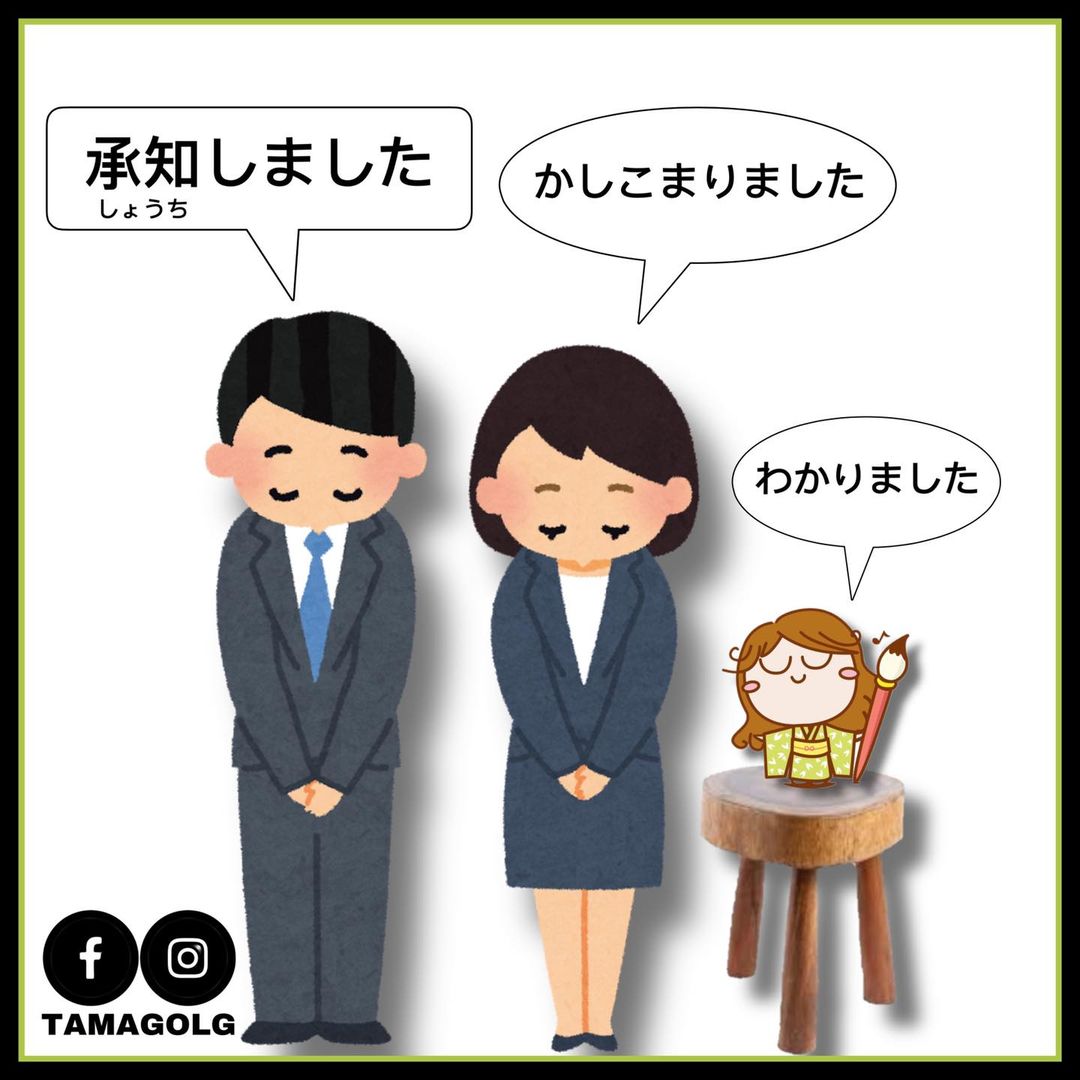
Shochishimashita pairs the noun shouchi (承知), combining characters that denote "accepting" and "knowing," with the polite past-tense verb shimashita. At its core, the phrase means: "I have understood the facts and accept the task." It is an intellectual acknowledgment. It tells the counterparty that their message arrived intact, their reasoning is grasped, and the required action will follow.
Kashikomarimashita draws from the classical verb kashikomaru (畏まる), meaning to sit with reverent posture, feel deep awe, or submit obediently before authority. When an employee writes kashikomarimashita, they are not merely acknowledging information; they are adopting an attitude of humility. The phrase carries centuries of service heritage, making it the bedrock of Japanese hospitality, retail, and external commerce.
Using kashikomarimashita within an informal internal chat channel can make the speaker seem unnervingly subservient. Using shochishimashita with an angry enterprise client can make the vendor seem cold and detached. Navigating that line requires constant situational awareness.
The Asynchronous Office: How Chat Platforms Fractured Email Rituals
Traditional business emails in Japan follow an ironclad formula: company name, department, addressee name with honorific, an opening weather or health pleasantry (osewa ni natte orimasu), the substantive message, and a closing bow. This system allowed little ambiguity. You picked your register at the start of the relationship and never deviated.
Chat threads broke this template completely. When a project manager drops a link into a project channel asking for a quick peer review, responding with five lines of formal email phrasing clogs the screen. Speed became a primary virtue. Workers faced an immediate dilemma: maintain full keigo rigor at the expense of agility, or slash formalities and risk sounding curt.
| Expression | Linguistic Category | Primary Recipient | Chat Appropriateness |
|---|---|---|---|
| 了解です (Ryokai desu) | Teineigo (Polite colloquial) | Peers, subordinates, close team members | Acceptable internally; strictly avoided upward |
| 承知しました (Shochishimashita) | Kenjougo (Standard humble) | Internal superiors, project leads, close clients | Default standard across corporate chat tools |
| かしこまりました (Kashikomarimashita) | Kenjougo (Elevated humble) | VIP clients, external partners, senior executives | Used for major assignments and external threads |
| Emoji Reactions (👍 / 🙇 / 承) | Non-verbal shorthand | Internal team members of all ranks | Standardized internally to reduce notification fatigue |
As documented in workplace linguistic tracking by Japanese media outlets such as Excite, the boundary line settled around utility. Teams realized that typing sixteen syllables of extreme deference every twenty seconds during an active incident response undermined operational focus.
Client Messaging Versus Internal Channels: Where Friction Emerges
The sharpest friction does not happen within insular engineering teams. It occurs at the messy intersection where external clients join shared communication spaces like Slack Connect or direct LINE channels.
When external clients communicate via chat, the implicit expectations of email linger. A client executive who writes an urgent revision request at 4:30 PM expects to feel the weight of their commercial authority acknowledged. Replying with a breezy shochu desu or a generic emoji reaction creates immediate friction.
Seasoned account managers adhere to a strict rule of thumb: external clients receive kashikomarimashita whenever a request directly involves billing, deliverables, or schedule shifts. The phrase serves as a contractual stamp. It assures the client that their directive has been received with genuine care.
Inside internal channels, however, overuse of kashikomarimashita creates psychological distance. Team leads often view excessive deference from direct reports as defensive or stiff, preferring the crisp efficiency of shochishimashita.
The Codification of Chat Etiquette Across Modern Firms
To stop employees from agonizing over every typed interaction, forward-thinking organizations are stepping in with formal communication charters. The era of leaving chat manners to unspoken social intuition is drawing to a close.
Technology firms and modern domestic conglomerates now include explicit digital etiquette modules during onboarding. These guidelines encourage teams to replace written receipt notices with stamp reactions for routine broadcast announcements. A thumbs-up or an acknowledgment stamp (such as a custom shouchi stamp) completely removes the ambiguity between ryokai and shochishimashita.
When text is required, these internal manuals establish clear baselines:
- Routine team coordination uses shochishimashita.
- Messages directed toward executive leadership or corporate clients default to kashikomarimashita.
- Peers working within sprint channels have explicit permission to use informal responses or emoji receipts without fear of professional reprimand.
By establishing clear norms, companies eliminate the cognitive fatigue of micro-negotiating respect levels on every direct message.
Frequently Asked Questions (FAQ)
Q1: Why is "ryokai desu" considered rude to superiors if it ends with the polite "desu"?
A1: Adding *desu* makes an expression grammatically polite (*teineigo*), but it does not make it humble (*kenjougo*). Historically, *ryokai* carries an evaluative nuance, signifying that someone in authority approves or confirms a situation. Because it lacks a humble linguistic mechanism to lower the speaker relative to the listener, Japanese business etiquette manuals classify it as inappropriate when addressing senior personnel or clients.
Q2: Can I use "shochishimashita" with an external client?
A2: Yes, in routine project communications where you have established an ongoing, collaborative working relationship. However, if the client is issuing a formal request, making a significant complaint, or belongs to an executive tier, *kashikomarimashita* remains the safer, more respectful choice to avoid appearing overly casual.
Q3: Are emoji reactions acceptable when a manager assigns a task on Slack or Teams?
A3: It depends entirely on the organization's stated culture. While agile tech startups frequently prefer a checkmark or bow emoji to prevent unnecessary notifications, traditional corporate environments still expect a brief written confirmation like *shochishimashita* accompanied by the expected completion timeline.
The Pragmatic Future of Modern Business Japanese
Workplace language in Japan is not decaying; it is adapting to the demands of real-time collaboration. The decades-long contest between kashikomarimashita and shochishimashita reveals an office culture learning to balance historic hierarchies with digital speed.
Keigo has always been a functional toolkit designed to minimize social friction and create predictable working environments. As direct messaging platforms handle an ever-larger share of everyday operations, the definitions of professional respect continue to evolve. True courtesy in the modern workplace no longer means choosing the most elaborate honorific every single time. It means choosing the precise phrase that honors the relationship while letting the work move forward without delay.