Nissan Elgrand Redesign Fact-Check: Real Features Behind Leaked Concepts

For more than three years, automotive forums and Japanese scoop publications circulated speculative renders of Nissan’s reimagined flagship minivan. Grainy spy captures from the Tochigi proving grounds and dramatic CGI mockups teased an aggressive, ultra-futuristic posture designed to wrest control of the executive transport sector away from Toyota. Following its official debut on July 16, 2026, the fourth-generation Nissan Elgrand has moved from rendering software to Tokyo tarmac, marked by immediate commercial adoption as detailed in an official レスポンス Report confirming the luxury minivan’s rollout across the high-end Uber Premium fleet.
Sixteen years had passed since the third-generation (E52) model entered production in 2010, leaving Nissan sidelined while the Toyota Alphard and Vellfire dominated corporate fleets, VIP shuttles, and wealthy family garages across Asia. The newly launched production model puts an end to speculative scoop cycles. Comparing the early scoop renders with the production vehicle uncovers how Nissan balanced dramatic styling promises against real-world engineering constraints, vehicle packaging necessities, and steep commercial demands.
📌 Key Takeaways:
- The Production Reality: Early speculative scoop renders predicted scissor doors and glass-roof monoliths, but the finalized 4th-generation Elgrand adopted a towering, boxier roofline that returns to the upright packaging ethos of the first two generations.
- Powertrain Architecture: Rumors of an experimental solid-state battery electric setup were false; Nissan engineered an advanced second-generation e-POWER system paired with electronic e-4ORCE all-wheel drive.
- Market Traction and Delivery: Priced between ¥6,897,000 and ¥7,579,000, demand quickly pushed wait times to 5 to 6 months, buoyed by enterprise fleet contracts with services like Uber Premium and Hinomaru Kotsu.
How Early Scoop Renders Distorted Nissan’s True Design Intent
Automotive render artists spent years projecting extreme styling cues onto the Elgrand program. Concept sketches circulating in 2024 and 2025 envisioned a hyper-low roofline, narrow split-level matrix lighting, and massive geometric grilles influenced by Nissan’s Hyper Tourer concept. Those digital illustrations depicted a vehicle resembling a lowered aerodynamic sport wagon rather than an executive minivan.
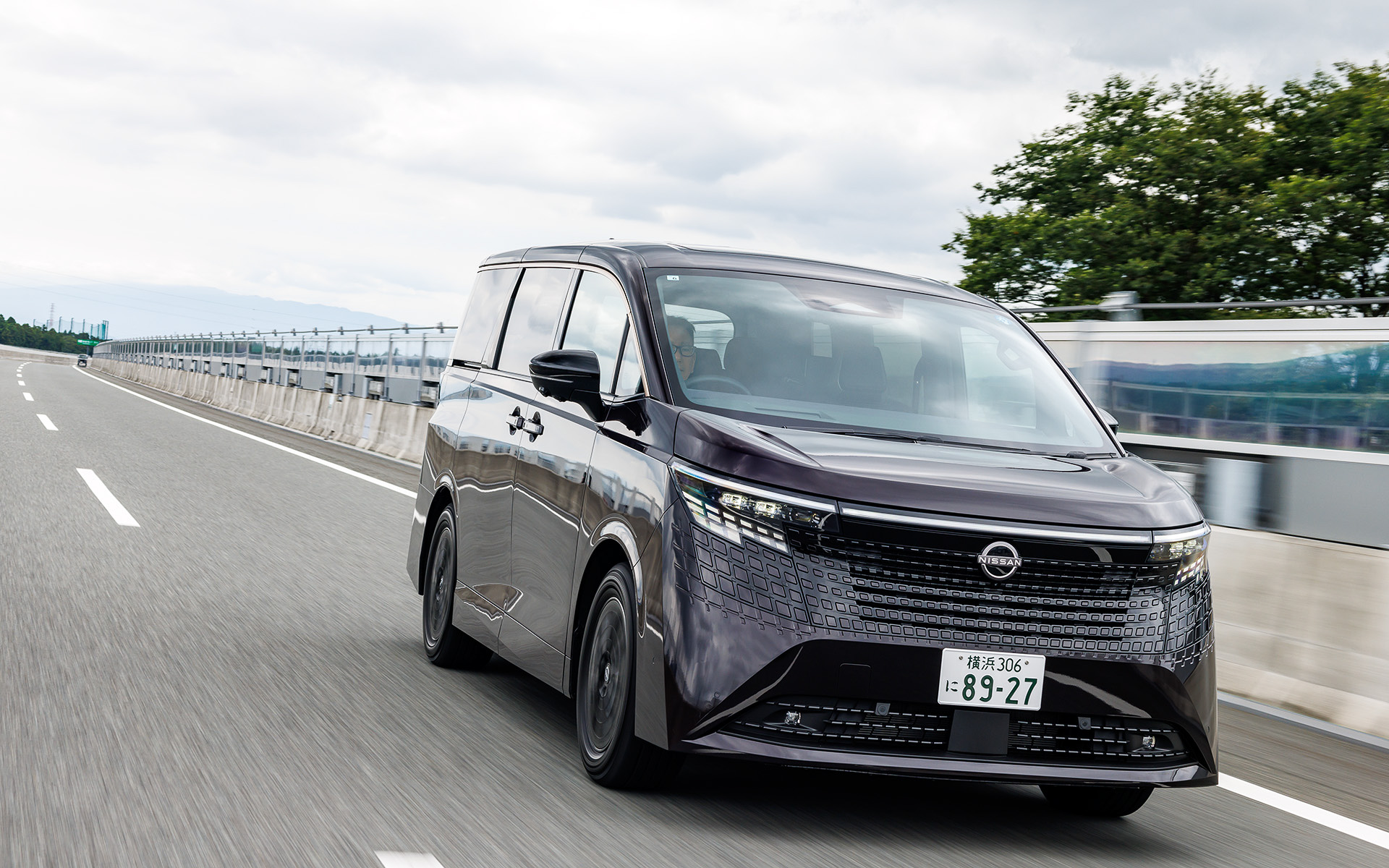
The physical production vehicle delivered a sharp course correction. Chief designers rejected the low-slung, station-wagon proportions that hobbled cabin space in the previous E52 generation. Instead, the fourth-generation model embraces an imposing two-box silhouette with an elevated roofline, prioritizing upright passenger volume and expansive headroom.
The signature front fascia integrates a digital interpretation of Nissan's traditional grille framework. Parametric LED running lamps integrate directly into horizontal chrome slats that run seamlessly into the hood edge. The flared rear fenders seen in clandestine prototype spy shots did make it into serial assembly, giving the vehicle a planted, muscular road presence without compromising sliding door clearance or second-row step-in heights.
Scoop Rumors vs. Production Reality: Verified Technical Specifications
Automotive media speculated extensively about engine displacement, battery chemistry, and structural platforms throughout the development phase. The following breakdown separates early scoop reports from Nissan’s verified production specifications.
| Vehicle Metric | Scoop Renders & Rumors (2024, 2025) | Verified Production Model (2026) |
|---|---|---|
| Powertrain | Dedicated BEV or 2.0L Turbo Hybrid | 1.5L VC-Turbo e-POWER with dual e-4ORCE motors |
| Overall Height | Sub-1,850 mm low-profile profile | 1,935 mm high-roof upright architecture |
| Chassis Baseline | Modified D-Platform carryover | All-new high-rigidity CMF-C/D MPV platform |
| Pricing Tiers | ¥5,000,000, ¥9,500,000 speculative range | ¥6,897,000, ¥7,579,000 base to flagship |
| Delivery Timeline | Immediate launch stock expected | 5, 6 months backlog reported by August 2026 |
Chassis Dynamics and Behind-the-Wheel Public Road Impressions
Prototypes running laps at the Tochigi proving ground in August 2025 hid significant structural upgrades beneath heavy vinyl cladding. Engineers spent the subsequent months refining suspension compliance at Oppama before authorizing public road test drives in late summer 2026. Automotive journalists noted an unexpected dynamic character during initial seat time.
Most luxury Japanese MPVs suffer from chassis shudder and side-to-side passenger roll over broken asphalt. Nissan engineered this new floorpan with continuous structural adhesive bonding and multi-link rear suspension geometry. The setup prevents vertical pitching over freeway expansion joints. Cabin decibel readings drop markedly compared to the aging E52, aided by active noise cancellation speakers mounted directly inside the executive headrests.
The variable-compression turbocharged three-cylinder operates exclusively as a quiet electrical generator for front and rear traction motors. When passing at highway speeds, the internal combustion unit spins up smoothly without the strained drone commonly heard in planetary gear e-CVT rivals. Pitch control algorithms engage the rear electric motor to dip the tail slightly under hard braking, keeping rear-seat occupants level and comfortable.
Commercial Fleets and Uber Premium Validate the Executive Cabin
Showroom orders alone do not cement a luxury MPV’s reputation in Japan; corporate fleet adoption dictates long-term prestige. On August 24, 2026, Uber Japan alongside transport giant Hinomaru Kotsu announced the addition of the new Elgrand to the Uber Premium dispatch fleet across central Tokyo.
Corporate purchasers targeting executive transit bypassed standard configurations for the seven-seat layout. Second-row captain chairs feature power ottomans, integrated pneumatic pressure-point massage functions, and deployable work tables wired with fast-charging USB-C ports. Operators running shuttles through the Marunouchi and Roppongi business districts praise the flat cabin floor and wider door apertures, which speed up curb pickups during rush hours.
The commercial rollout quickly affected private order banks. By mid-August 2026, Nissan dealers logged factory delivery wait times expanding to 5 to 6 months. Fleet demand consumed an estimated 25 percent of the initial Oppama assembly allocation, tightening supply for retail buyers seeking top-tier trim variants.
Challenging Toyota Alphard’s Monopoly in the Luxury MPV Arena
Toyota held a near-monopoly on the Japanese executive transporter market for more than a decade. The Alphard and Vellfire became default symbols of executive status across Asian metropolitan centers, leaving Nissan’s aging lineup far behind. This redesigned Elgrand was engineered to break that status quo.
Nissan targeted driver engagement to carve out market share. Toyota prioritizes soft, isolated chauffeur dynamics. Nissan engineers deliberately dialled more feedback into the steering rack, creating an alternative for high-net-worth owners who alternate between being driven on weekdays and driving themselves on weekends. The lower center of gravity afforded by underfloor battery placement cuts high-speed body roll without requiring stiff, jarring dampers.
Production allocations remain the primary hurdle for Nissan. Toyota's established manufacturing capacity allows it to supply broader commercial networks across Southeast Asia, China, and Australasia. While the Elgrand has unsettled the Japanese domestic market, sustained export success hinges on how quickly Nissan can ramp up assembly line capacity while managing its six-month domestic delivery queue.
Frequently Asked Questions (FAQ)
Q1: What is the verified retail price range for the fourth-generation Nissan Elgrand?
A1: Official Japanese retail pricing ranges from ¥6,897,000 to ¥7,579,000 across standard and flagship e-POWER e-4ORCE model grades.
Q2: How long is the current customer wait time for a factory-ordered Elgrand?
A2: As of late summer 2026, factory delivery timelines sit at approximately 5 to 6 months due to high private demand alongside commercial orders for services like Uber Premium.
Q3: Does the new Elgrand offer a fully electric (BEV) option as suggested by concept leaks?
A3: No. The production vehicle is powered exclusively by Nissan's second-generation e-POWER series-hybrid architecture, using a 1.5-liter VC-Turbo generator paired with twin electric motors and e-4ORCE all-wheel drive.
Market Realities for Nissan’s Flagship Minivan
The gap between speculative renders and physical vehicles reveals how modern automotive programs must compromise. The fourth-generation Nissan Elgrand discarded the extreme, low-slung concept styling seen in leaked drawings to focus on real interior space, refined road manners, and enterprise-grade cabin durability.
Fleet adoption by services like Uber Premium and immediate six-month delivery wait lists demonstrate that Nissan’s sixteen-year wait produced a capable executive contender. Breaking Toyota’s dominance requires steady assembly volume and prompt overseas distribution. For buyers in Tokyo and beyond, the new Elgrand proves that Nissan can still build a commanding, driver-focused flagship MPV.