The 100-Yen DIY Trend Exploding Online: Why Renter Closet Hacks Went Viral

Tiny urban footprints have pushed apartment dwellers into architectural corners for decades, but social media algorithms are turning that everyday pressure into an engineering competition. Across TikTok and Instagram, short clips showing Japanese renters transforming their awkward upper closet shelves using inexpensive dollar-store components have gathered tens of millions of views. As detailed in an Excite エキサイト report on 100-yen modular wall shelving, these simple consumer items are replacing expensive custom cabinetry, proving that zero-damage modifications can dramatically multiply usable square footage in rental properties.
📌 Quick Summary:
- The Viral Movement: Millions of urban renters are using affordable 100-yen items from chains like Daiso and Seria to fix unusable upper closet shelving.
- Core Mechanical Strategy: Renters combine lightweight tension rods, wire mesh, and pull-down bins to double storage density without drilling into rental walls.
- The Practical Payoff: Complete high-shelf revamps cost between $10 and $25, avoiding strict security deposit deductions while solving reachability issues.
How the Traditional Makuradana Created Modern Apartment Dead Space
Every traditional Japanese closet features a deep, high overhead ledge known as the makuradana (枕棚). Originally built to store bulky futon mattresses, folded bedding, and seasonal tatami covers, the shelf sits roughly six feet off the ground and extends two to three feet deep into the wall. In older homes, this layout made sense. For modern city dwellers living in compact studio apartments, it presents a stubborn spatial problem.
Modern wardrobes consist of hanging coats, stacked plastic bins, luggage, and folded activewear. When modern renters attempt to place everyday gear onto a makuradana, items quickly disappear into the shadows behind the forward lip. Standard plastic totes fail to utilize the massive vertical volume, leaving eight to sixteen inches of empty air directly above them. Reaching the back requires a step stool or dangerous blind groping.
Because leases in cities like Tokyo, New York, and London impose strict restoration penalties for drilling into drywall, tenants cannot simply install bracket-mounted shelving or track systems. The empty space above the hanging rail became a frustrating zone of waste. Solving it demanded zero-impact methods that could be removed in under five minutes.
The Structural Anatomy of Drill-Free Closet Shelving
The viral explosion of these home hacks comes down to clever mechanical layering. Rather than treating the overhead shelf as a single flat surface, creators treat it as an open spatial frame that can be partitioned horizontally and vertically using basic compression and cantilever physics.
The core setup relies on parallel tension rods combined with lightweight wooden planks or plastic grates. Placing two tension rods horizontally across the closet walls, or wedged vertically between the shelf surface and the ceiling, creates an instant secondary ledge. Adding Seria wooden boards or wire grids on top distributes weight across both rods, preventing localized slippage.
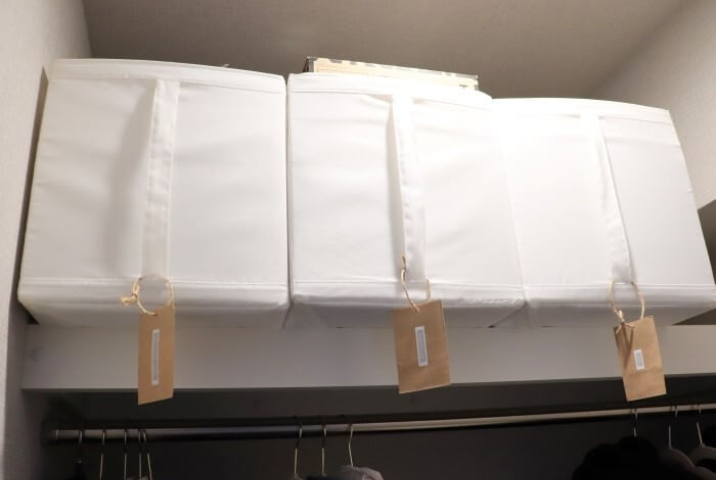
Another popular approach uses hanging wire under-shelf baskets. These coated steel wire attachments slide directly over the front lip of the existing wooden board. They require no adhesive, screws, or anchors. Instantly, the empty vertical gap beneath the shelf turns into a quick-access slot for lightweight scarves, seasonal knitwear, or flat bags. Creators use seasonal clothing bin dividers inside pull-handle storage boxes, aligning them edge-to-edge across the closet front to build a modular facade that functions like custom pull-out drawers.
The Evolution of Budget Closet Optimization (2024, 2026)
The transition from rough household improvisations to refined, aesthetic systems accelerated between 2024 and 2026. What began as crude zip-tie projects has matured into a design subculture that balances tight load-bearing tolerances with clean visual styling.
| Evolution Phase | Dominant Materials & Methods | Cost & Weight Limits |
|---|---|---|
| Phase 1: Early Improv (Mid-2024) | Exposed plastic tension poles, basic clear shoeboxes, zip ties | $5, $10 total; 2, 4 kg max threshold before slippage |
| Phase 2: Viral Standard (2025) | Under-shelf wire baskets, uniform non-woven felt bins, Seria wood boards | $12, $20 total; 5, 8 kg supported with reinforced brackets |
| Phase 3: Engineered Modular (2026) | Spring-loaded lever rods, pull-down reach handles, silicone-padded grips | $18, $30 total; 10, 14 kg safe operating capacity |
This timeline highlights a significant shift in retail inventory. In mid-2024, discount chains stocked general utility products that shoppers had to adapt themselves. By 2026, Daiso and Seria introduced dedicated closet organizer lines specifically sized to fit standard Japanese wardrobe depths and foreign modular flat-packs.
Weight Realities, Material Limits, and Safety Pitfalls
While dynamic transformations look polished in a thirty-second video clip, mechanical reality frequently disrupts online enthusiasm. Tension rods hold position purely through lateral friction and spring force. Overloading an unreinforced plastic tension pole is an easy way to cause an unexpected middle-of-the-night crash.
Standard 100-yen tension poles are typically rated for 1.5 kg to 3 kg (roughly 3.3 to 6.6 lbs) of static load across their mid-span. When users stack heavy winter coats, dense denim, or electronics cases onto an unanchored upper rack, the center bows. As the pole flexes, lateral friction drops, causing the entire assembly to collapse.
Experienced DIYers prevent this failure mode by adding two cheap modifications. First, they apply non-slip silicone adhesive pads or rubber furniture cups against the wall surface where the rod makes contact. This increases friction without marking the paint. Second, they insert a vertical center-support pole running from the main shelf floor directly to the underside of the newly formed secondary rack. This setup redirects downward pressure and effectively doubles load capacity without any permanent fixtures.
The Cultural Drive Behind Japan's Renter DIY Boom
The popularity of drill-free closet setups is rooted in Japanese housing laws and real estate culture. Japan's genjo kaifuku (原状回復) doctrine requires tenants to return apartments to their exact original condition when moving out. Landlords charge steep penalty fees for tiny nail holes, peeled wallpaper, or cracked trim.
These strict tenancy conditions created a dedicated demographic of renters who refuse to use hammers or drills. In response, budget retailers turned small-space management into an accessible art form. Daiso operates over 3,000 stores across Japan alongside expanding footprints in North America and Asia, while design-focused competitor Seria built a loyal customer base around aesthetic wooden boards, brass hardware, and minimalist brackets.
For young city workers paying high rents for 20-square-meter apartments, buying a $200 custom wardrobe is impractical. Spending $14 at a local 100-yen shop to convert high closet dead space into tidy storage delivers immediate control over their living environment. The trend spread globally because urban renters in London, Paris, and San Francisco face the exact same housing constraints: smaller floor plans, strict landlords, and high moving costs.
Frequently Asked Questions (FAQ)
Q1: What are the best 100-yen items for upper closet shelves?
The most reliable components are spring-loaded tension rods, hanging wire under-shelf baskets, fabric front-handle storage boxes, and lightweight Seria wooden slats. These allow you to split open air space horizontally without adding excessive dead weight.
Q2: How can I reach items on a deep upper shelf without a step stool?
Use uniform bins with integrated bottom pull-straps or low-profile front handles. Group items by season and pull down the entire container using the handle. For deeper closets, store out-of-season clothes toward the back wall and everyday items in front bins.
Q3: Will tension rods damage or indent rental apartment walls?
Bare rubber ends can leave grease spots or circular depressions on soft drywall over time. Slip clear silicone anti-vibration gel pads or thin squares of cardboard between the wall and the rod ends to distribute pressure evenly and protect the paint.
What Lies Ahead for Modular Renter Storage
The popularity of drill-free closet modifications signals a lasting shift in domestic design. As metropolitan rents remain high and living spaces stay compact, consumers increasingly reject bulky, permanent furniture that cannot move with them. Instead, they favor modular, zero-impact systems built from accessible household parts.
Major discount retailers have taken note of this movement. Rather than treating closet hardware as an afterthought, value chains are expanding their dedicated renter-friendly product lines. The focus is shifting toward higher-grade materials: matte carbon-steel tension poles, reinforced canvas compartments, and quick-release under-shelf attachments. High closet dead space is no longer wasted room, it has become a creative canvas for modern renters making the most of every square inch.