The Ultimate 100-Yen Cockroach Toy Buying Guide: Types, Uses, and Best Hacks

Tucked between the sleek ceramic dishware and rows of minimalist stationery in Tokyo's discount retail alleys sits a peculiar cultural staple: hyper-detailed, oily-brown synthetic pests. In the aisles of Daiso, Seria, and Can Do, the humble fake cockroach, known locally as gokiburi omocha, has evolved from a retro novelty shop gag into a meticulously engineered retail category. Priced at just ¥110 (or occasionally step-up tiers of ¥330 to ¥550 for mechanized variants), these polyvinyl crawlers routinely spark viral social media panics, clear living rooms during April Fools, and fill pet owners' carts across the globe.
The staying power of these inexpensive plastic replicas comes down to a deliberate collision of behavioral psychology and precision mold-making. What appears at first glance to be mere dollar-store junk is actually a masterclass in exploiting mammalian disgust triggers at scale. Japanese discount retail giants have refined the texture, sheen, leg splay, and movement mechanics of their novelty bugs to turn a century-old practical joke into a modern impulse-buy juggernaut.
📌 Key Takeaways:
- Retail Lineups: Daiso leads in dynamic, battery-powered and wind-up variations, while Seria dominates static visual realism and Can Do targets classic shock-gag packaging.
- Price-to-Panic Ratio: Basic multi-packs retail for ¥110 ($0.75 USD), while specialized infrared remote-control insect models max out around ¥550.
- Surprise Secondary Market: Beyond April Fools and Halloween haunted houses, pet owners purchase these items en masse as disposable, high-engagement cat toys.
- Safety and Quality Caveats: Brittle legs and soft polyvinyl chloride (PVC) construction present moderate ingestion hazards for unsupervised pets and small children.
The Retail Trifecta: How Daiso, Seria, and Can Do Engineer Cheap Panic
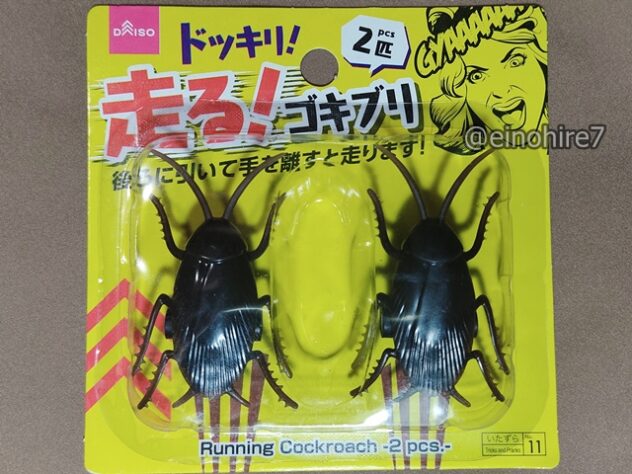
The three dominant chains in Japan's 100-yen ecosystem approach novelty manufacturing through distinct operational philosophies. Walk into any major Daiso flagship in Ikebukuro or Osaka, and the toy aisle reflects an obsession with scale and kinetic novelty. Daiso treats the bug category as an engineering proving ground, stocking basic static packs alongside mechanical curiosities. Rather than settling for soft rubber casts, Daiso frequently experiments with internal gearboxes and pull-string mechanisms, pricing complex units between ¥220 and ¥550 to capture buyers hunting for motion-driven reactions.
Seria, by contrast, operates on aesthetic fidelity. Known across Japan for attracting craft hobbyists and interior design enthusiasts, Seria skips motorized gimmicks in favor of chilling visual realism. Their prank items replicate the exact semi-translucent gloss of an adult Periplaneta americana (the American cockroach). Seria's buyers focus on scale accuracy, flexible antennae that tremble in drafty rooms, and matte-finished abdominal segments that look sickeningly organic under fluorescent kitchen lighting.
Can Do fills the third niche: pure retro slapstick. Where Seria aims for high-end optical illusion and Daiso goes mechanical, Can Do leans into traditional gag products. Their shelves feature classic shock accessories, bug-in-an-ice-cube novelties, and multi-piece party bags intended for mass distribution. When university students or office workers plan low-budget prank videos for TikTok or YouTube Shorts, Can Do provides the sheer volume required to carpet an entire floorboard on a shoestring budget.
Anatomy of a Synthetic Pest: Rubber Molds, Wind-Ups, and Infrared Creepers
The design spectrum of 100-yen synthetic bugs divides into three distinct hardware categories, each serving a different prank threshold.
The baseline product is the static rubber fake roach, usually sold in packs of four to six units for ¥110. Manufacturers cast these from pliable PVC or thermoplastic elastomer (TPE). High-tier molds capture the microscopic tibial spines along the legs, the physical feature that catches human peripheral vision and signals genuine biological threat. The underside detailing includes segmented abdomens and curled mouthparts, ensuring that even if an overturned prop lands on its back, it maintains the illusion of a dying insect.
Step up to the mechanical tier, and you encounter the wind-up crawling roach. Powered by a tightly wound internal spring, this design uses an offset crankshaft to vibrate tiny plastic feet across smooth surfaces like linoleum or polished hardwood. The motion is erratic and skittering, mimicking the panicked locomotion of real pests when exposed to sudden light. While noisy on tiled surfaces, the directional unpredictability makes them lethal shock-value tools when released from behind furniture.
At the technological summit sit the remote-control insect toys, commonly stocked at larger Daiso outlets under their ¥550 tier. Armed with miniature button-cell batteries and an infrared transmitter, these pocket-sized units allow an operator to pilot the insect across a room from up to three to five meters away. While the wheels underneath eliminate any pretense of anatomical accuracy upon close inspection, the psychological impact of an insect marching deliberately toward an unsuspecting victim bypasses analytical reasoning every time.
Field Comparison: Mapping Japan's 100-Yen Novelty Bug Inventory
To understand the price-to-performance landscape across Japan's discount retail sector, we evaluated the most common variants based on visual fidelity, motion mechanics, and typical retail pricing.
| Product Variant | Primary Retailer | Price (w/ Tax) | Realism Rating (1, 5) | Core Mechanism |
|---|---|---|---|---|
| Ultra-Realistic Static Mold | Seria | ¥110 | 4.8 / 5 | Textured TPE, glossy shell coating |
| Crawling Wind-Up Bug | Daiso / Can Do | ¥110, ¥220 | 3.1 / 5 | Internal clockwork spring & cams |
| Infrared RC Crawler | Daiso | ¥550 | 2.5 / 5 | Dual micro-motors, infrared remote |
| Party Gag Multi-Pack (6, 10 pcs) | Can Do | ¥110 | 3.6 / 5 | Rigid PVC, bulk production molds |
| Gel Adhesive Roach Sticker | Seria / Can Do | ¥110 | 4.2 / 5 | Washable polyurethane tack gel |
Staging the Jump Scare: Social Media Pranks and Halloween Setups
The explosion of short-form video has altered how consumers deploy these budget props. On platforms like X and Instagram, creators avoid overt, over-the-top gags in favor of contextual placements that let human paranoia do the heavy lifting.
A classic placement targets high-friction household zones: nestled inside an empty coffee mug, pressed against the inner translucent lining of a lampshade, or balanced on the edge of a fresh tissue box. The trick lies in lighting. Under direct, bright illumination, cheap plastic seams and flashing lines reveal the ruse instantly. In dim hallways, ambient kitchen nightlights, or behind bathroom doors, the human brain registers the silhouette before verifying the material authenticity. This split-second delay generates the desired shock value reaction prank.
During the autumn season, these 100-yen inventory items transition into seasonal decoration workhorses. Japanese retail stores consistently run out of insect inventory every October, as organizers buy out bulk stock to craft Halloween scare accessories. Suspending a dozen static roaches from transparent monofilament fishing wire inside a shadowy entryway costs less than a single fast-food meal, yet produces higher genuine fright responses than elaborate animatronics.
Unintended Utility: Feline Enrichment and Budget Pet Toy Conversions
One of the largest consumer bases keeping these dollar store novelty bugs in perpetual production has nothing to do with pranking roommates. Online pet forums, Reddit communities, and Japanese cat blogs consistently recommend 100-yen roaches as disposable cat entertainment.
Cats hunt based on high-frequency vibration, erratic directional shifts, and small, high-contrast silhouettes against light floors. A wind-up or pull-back crawler from Daiso triggers predatory stalking behaviors far more aggressively than standard fabric mice. The erratic mechanical clatter mimics an insect struggling on smooth flooring, keeping indoor cats mentally stimulated for extended sessions.
Pet owners also use the soft rubber variants for low-stakes fetch games or sensory foraging mats. Because specialized pet store interactive toys frequently retail for $15 to $30 (¥2,500 to ¥4,500), losing a toy under the refrigerator represents an annoying financial loss. A ¥110 replacement from Seria neutralizes that frustration entirely.
Prank Ethics and Microplastic Hazards: Where Cheap Novelties Go Wrong
Low price points carry structural liabilities. The overwhelming majority of these bargain-bin props are molded from petroleum-derived polymers with minimal post-processing. While suitable for brief visual gags, several operational and environmental risks demand attention.
The primary concern involves domestic pet safety. While thousands of owners repurpose these as cat toys, unsupervised play is dangerous. Cheap plastic antennae, brittle legs, and rubberized heads can detach under moderate jaw pressure. If swallowed, these non-digestible fragments risk causing intestinal blockage or internal lacerations. If you use synthetic bugs for animal play, supervise every session and discard damaged pieces immediately.
Environmental durability represents another friction point. Budget PVC degraded by ultraviolet light becomes sticky and prone to leaching plasticizers onto painted wood, wall surfaces, or polished granite countertops. Leaving a gag roach adhered to a cabinet for months as an abandoned joke can permanently strip varnishes or leave greasy chemical rings.
Finally, context matters. Setting up insect pranks in communal corporate kitchens, elderly care environments, or around individuals with severe entomophobia frequently backfires. The immediate physical recoil can trigger falls, spilled hot liquids, or genuine cardiovascular distress. Successful humor hinges on quick relief, not prolonged trauma.
Frequently Asked Questions (FAQ)
Q1: Are 100-yen cockroach toys safe to leave on painted walls or wooden furniture?
A1: Avoid leaving rubber or gel-based models on finished wooden surfaces or latex-painted drywall for more than a few hours. The chemical plasticizers in cheap PVC and TPE can react with varnishes and wall coatings, leaving permanent greasy stains or peeling paint upon removal.
Q2: Can I safely use these novelty bugs as regular cat toys?
A2: Only under strict human supervision. While their erratic motion and size make them engaging for cats, thin plastic legs and antennae break off easily. Ingesting these plastic pieces can cause serious gastrointestinal blockages in felines.
Q3: How do the remote-control models from Daiso perform on carpets?
A3: Daiso's ¥550 infrared insect toys rely on microscopic undercarriage drive wheels designed strictly for flat, hard surfaces. They perform reliably on hardwood, laminate, and polished stone, but will seize up immediately on rugs or medium-pile carpet.
Q4: Why are Seria's fake insects considered more realistic than Daiso's?
A4: Seria prioritizes mold quality, accurate color gradients, and thin, flexible appendages that catch subtle air currents. Daiso frequently prioritizes internal mechanical features like pull-back motors or infrared receivers, which compromises anatomical accuracy.
The Enduring Appeal of Cheap Synthetic Chaos
The quiet supremacy of the 100-yen cockroach toy reveals a fundamental truth about discount retail: maximum emotional impact requires minimal manufacturing overhead. Whether executing an elaborate April Fools layout, dressing up an apartment for October festivities, or keeping a house cat occupied on a Tuesday afternoon, these unassuming bits of Japanese molded polymer punch absurdly above their weight class. They remain proof of precise observational design, turning basic evolutionary squeamishness into the most cost-effective laugh in modern retail.