Uniform Standards Decoded: The Real Rules Behind ANA Flight Attendant Scarves
Step into Tokyo Haneda Airport or board a transpacific flight to Tokyo, and the visual precision of All Nippon Airways cabin attendants is unmistakable. Central to that presence is a vividly patterned silk scarf, angled sharply against light-gray suiting. While frequent fliers often assume these neck accents are personal styling flourishes left to individual whim, the reality is rooted in strict grooming manuals and aviation workplace ergonomics.
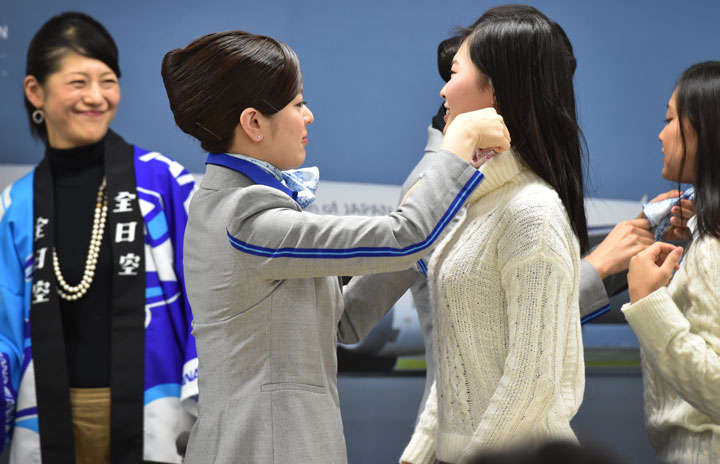
Public glimpses into these proprietary techniques remain rare. A defining exception occurred when active flight attendants conducted live scarf-tying workshops at Haneda Airport during the carrier's fan appreciation event, as detailed in an Aviation Wire Report. That demonstration pulled back the curtain on how Japan's largest airline balances runway aesthetic appeal with emergency safety protocols, showing that behind every crisp knot sits an exacting series of calculated folds.
📌 Key Takeaways:
- The Structural Blueprint: ANA flight attendants do not tie scarves freehand; every variation begins with a disciplined bias fold engineered to maintain uniform thickness.
- The Safety Imperative: Passenger rumors about hidden pins or tight knots ignore civil aviation reality, cabin neckwear must release cleanly under emergency snag conditions.
- Corporate Adaptation: The airline’s tension-lock knot techniques have crossed over into everyday professional wardrobes, solving the common problem of silk scarves unraveling during workday movement.
The Prabal Gurung Canvas and Cabin Visual Identity
The modern visual era for All Nippon Airways took flight with its tenth-generation uniform suite, conceived by New York fashion designer Prabal Gurung. Combining clean gray wool with striking signature blue accents, the collection introduced a deliberate canvas where the silk neckerchief serves as the sole burst of vibrant color. The scarf features abstract lines and floral motifs that reflect both traditional Japanese seasonal palettes and contemporary international fashion.
Uniforms across the global airline industry telegraph discipline before an attendant speaks a single word. At ANA, the neck arrangement functions as a non-verbal greeting. Grooming standards require the scarf to sit at a designated angle relative to the collarbone, ensuring that flight attendants across an entire crew present an identical visual silhouette whether boarding passengers at Narita or serving meals at 35,000 feet.
Inside the Manual: The Bias Fold and Tension-Lock Mechanics
The foundation of every airline scarf arrangement begins long before the fabric touches the neck. It starts flat on an ironing board with the basic bias fold. Flight attendants lay the square silk flat, fold opposite diagonal corners toward the center line, and roll or fold the fabric inward until it forms an even band roughly four to five centimeters wide.
Without this initial geometric discipline, silk tends to bunch, bulge, or expose raw underside seams. Once the band is formed, attendants apply specific knot sequences designed to resist cabin motion:
- The Centered Loop: The folded band rests around the neck with one tail measured exactly longer than the other, accounting for the knot volume.
- The Single Half-Wind: The longer end crosses over, winds beneath, and loops through the collar ring, establishing vertical anchor tension.
- The Flat Interlock: A discreet square knot or neckerchief fold locks the two tails flat against the upper chest. This step distributes friction evenly across the silk threads.
This friction-locking method prevents the knot from slipping loose during turbulence, luggage overhead checks, or galley service. The tails fan out deliberately, creating a balanced visual spread that sits comfortably without choking the wearer.
Separating Passenger Myths from Civil Aviation Safety Realities
Enthusiasts and corporate workers frequently misinterpret the mechanics holding these garments in place. One widespread myth suggests that flight attendants use safety pins, magnetic clips, or heavy scarf rings to keep their neckwear locked in place during grueling twelve-hour international shifts.
Airline grooming regulations explicitly forbid loose hardware or rigid fastening pins around the neck. In high-pressure situations or sudden evacuations, any pinned accessory presents a serious puncture hazard or strangulation risk if caught on emergency equipment. Attendants rely entirely on fabric-on-fabric friction. When scarf rings appear in official uniform options, they are engineered from smooth, lightweight materials built to slide free under sudden, heavy tension.
Similarly, grooming manuals dispel the belief that attendants can experiment freely with avant-garde arrangements on a whim. While senior pursers and cabin crew enjoy designated variations, ranging from side-swept loops to symmetrical rosettes, each style comes from an authorized catalog. Knot diameter, tail length, and positioning are carefully prescribed to maintain brand coherence across thousands of active crew members worldwide.

Decade of Detail: Evolution of ANA Cabin Neckwear Standards
The styling rules governing Japanese aviation neckwear have shifted alongside uniform generational overhauls, passenger expectations, and updated health-and-safety guidelines.
| Era & Generation | Design Signature | Manual Styling Protocols |
|---|---|---|
| 9th Generation (2005, 2014) | Classic navy palettes with discreet pastel borders, designed by Koshin Satoh. | Traditional forward ascot knot; strict symmetry required; fabric tucked firmly inside jacket collar lapels. |
| 10th Generation Launch (2015, 2020) | Prabal Gurung dynamic prints, vivid blues, and soft pinks pairing with cool gray blazers. | Introduction of asymmetrical neckerchief flares; bias fold standardized at five centimeters width. |
| Refined Global Era (2021, 2026) | Enhanced silk-twill weave with sweat-resistant back finishes, matching gender-neutral service adaptations. | Streamlined quick-release tension knots; approved soft-loop arrangements for varied galley and cabin assignments. |
Translating Flight Deck Rigor to Everyday Corporate Wardrobes
The practical techniques developed inside airline briefing rooms offer practical solutions for working professionals. Anyone who has worn a silk scarf to an office knows the frustration: by mid-morning, the knot twists sideways, sags, or unspools entirely.
To replicate cabin-grade stability in professional environments, adopt three basic airline principles:
- Match Silk Weight to Knot Structure: Heavy twill silk holds structural folds without needing pins. Lighter chiffon or habotai fabrics require smaller knots with multiple friction loops to avoid unraveling.
- Anchor the Base at the Nape: Flatten the folded silk securely against the back of your neck before bringing the ends forward. Loose back placement causes the knot to rotate sideways during desk work.
- Respect Collar Proportions: Crew members balance the scarf against their uniform jacket lapel. When wearing a high-collared blazer, opt for a flat neckerchief knot tucked slightly inward; pair open collarless blouses with wider, side-swept tails to balance visual proportions.
Frequently Asked Questions (FAQ)
Q1: Why do ANA flight attendants wear their scarves angled to one side?
A1: The slight off-center angle keeps the fabric away from food service tasks and microphone cables while creating a clean, dynamic line that complements the asymmetrical blue stripe on the back of the Prabal Gurung uniform jacket.
Q2: Can corporate professionals wear silk scarves this way without looking like flight crew?
A2: Yes. The key difference lies in the tail volume and outfit pairings. Flight attendants wear structured knots against tailored suiting. In daily business wear, pairing an airline-style bias knot with an open trench, relaxed knitwear, or a relaxed-collar shirt creates modern polish without looking like a uniform.
Q3: How do airline scarves remain clean and sweat-free on long flights?
A3: Crew manuals instruct attendants to wear the scarf securely over their collar or blouse neckline rather than directly against bare skin, preventing direct contact with body oils. Many crew members carry a freshly ironed spare scarf to swap in before final descent on long-haul routes.
Precision as the Ultimate Professional Signature
What seems like a simple flourish of printed silk reflects rigorous design discipline. Behind the immaculate posture of an ANA flight attendant lies a technical system of folds, calibrated tension knots, and safety standards built for 40,000 feet. By replacing delicate pins and makeshift fixes with precise folding geometry, the airline proves that true workplace elegance is never accidental, it is engineered to endure.