Where to Buy Solo Pain Relief Applicators Today: Current Stock Across Japan's Retailers

Anyone who has ever tried slapping a medicated pain patch between their shoulder blades knows the frustration. The adhesive folds in on itself, wrinkles trap air, and the patch ends up crooked or useless. In Japan, where single-person households now represent roughly 38% of all residences, the struggle to stick a pain relief poultice without assistance created a viral phenomenon around the Hitori de Pettanko (ひとりでペッタンコ), a mechanical back poultice applicator tool designed specifically for solo living. Yet millions of bargain hunters scour local budget aisles wondering whether 100-yen shops actually stock this clever device or if they need to check somewhere else.
The short answer cuts through a web of persistent social media rumors: Daiso, Seria, and Can Do do not sell the authentic, patented tool for 100 yen. Finding reliable self-care gear requires looking past the bargain bins into Japanese drugstores and established digital storefronts.
📌 Key Takeaways:
- The Budget Reality: Authentic Hitori de Pettanko applicators are not sold at 100-yen retailers like Daiso or Seria; dollar-store alternatives are limited to basic lotion paddles that lack poultice grip mechanisms.
- Retail Availability: Japanese drugstore chains like Matsumoto Kiyoshi, Welcia, and Sundrug regularly stock genuine plaster applicators in their home healthcare aisles for ¥1,000 to ¥1,600 ($7 to $11).
- Digital Speed: Online platforms including Amazon Japan and Rakuten offer immediate next-day fulfillment for standardized poultice sticking devices when local pharmacies run out of stock.
The Solo Healthcare Boom Behind Japan's Poultice Applicator Craze
Japan consumes more transdermal analgesic patches per capita than almost any other nation. From menthol-heavy Salonpas to prescription-strength loxoprofen and flurbiprofen tapes, these medicated sheets are household staples for stiff necks, chronic lower back fatigue, and athletic soreness. Applying them to the middle back, however, requires either flexible gymnastics or a cohabitant willing to lend a hand.
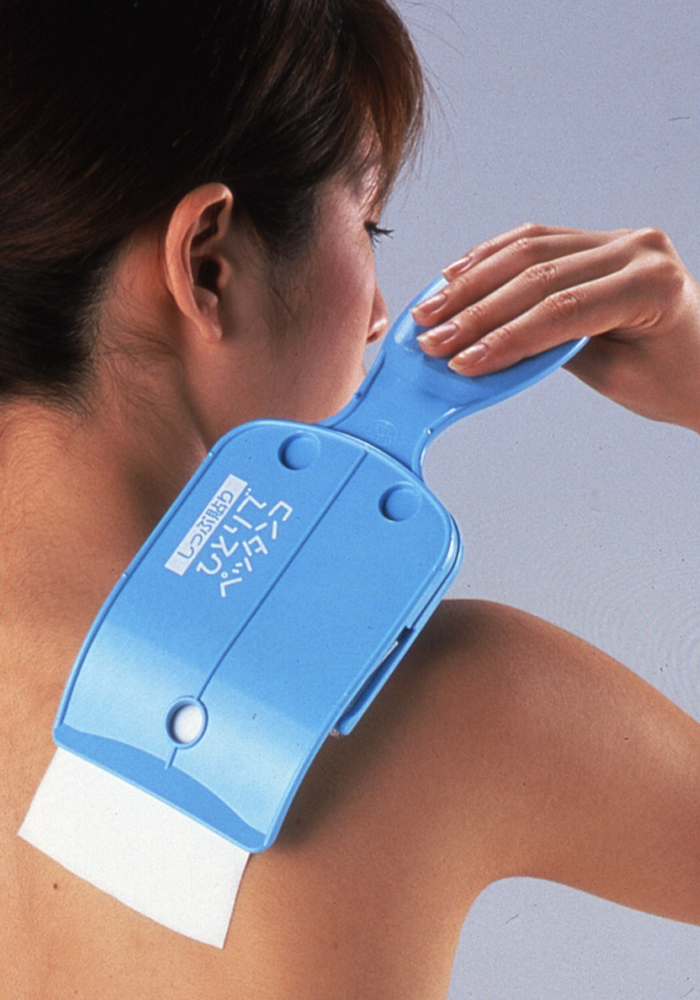
Manufactured by Osaka-based domestic gadget maker Asahi Denki Kasei under its Smile Kids product line, the authentic Hitori de Pettanko (model ASH-10) solved this daily friction point. The device relies on a curved plastic arm equipped with an adhesive retention plate. You slide the patch face down onto the plate, peel back the protective film, position the curved arm over your shoulder or under your armpit, and roll the applicator down. The patch transfers smoothly to your skin without a single fold.
Word of mouth spread through television variety segments and seniors' community networks, turning the ergonomic self-care aid into an unexpected hit. Soon after, discount seekers flooded search engines looking for a budget shortcut, hoping Japan’s famously inventive 100-yen chains had duplicated the design.
Can You Buy the Hitori de Pettanko at Daiso or Seria?
Walk down the health aisles of a sprawling Daiso or a design-focused Seria, and you will encounter hundreds of ingenious personal-care tools. You will find back-scratchers, lotion applicators designed for sunburn relief, long-handled bath brushes, and neck massage rollers. What you will not find is the Hitori de Pettanko.
The genuine tool is a patented, multi-component plastic assembly featuring dual-plate hinge tension, rubberized anti-slip friction pads, and curved reinforced ABS plastic. Manufacturing those moving parts at a baseline ¥100 wholesale threshold (approximately $0.65 to $0.70 at current exchange rates) remains economically unviable for domestic suppliers. Daiso previously experimented with flat foam applicators marketed for applying body cream across hard-to-reach zones, but those tools cannot secure a medicated plaster helper without tearing the backing film or gumming up the foam with medicinal adhesive.
Shoppers hunting for Daiso pain relief accessories often confuse these cream paddles with a dedicated poultice sticking device. Using a plain sponge paddle to affix a Salonpas sheet almost always ends with the adhesive folding onto the tool itself, wasting an expensive medicated patch.
Retail Stock Breakdown: Dollar Shops vs. Major Pharmacies
Finding a genuine self-applying salonpas aid requires heading to specialized retail channels. While discount shops handle basic accessories, pharmacies and big-box electronics stores stock certified medical sundries and assistive aging equipment.
| Retail Channel | Stock Availability | Price Range (JPY) | Functional Mechanism |
|---|---|---|---|
| 100-Yen Chains(Daiso, Seria, Can Do) | Unavailable(Only basic cream pads) | ¥110 | Static foam paddle; lacks patch tension plates |
| National Drugstores(Matsumoto Kiyoshi, Welcia) | Moderate to High(Senior & pain relief sections) | ¥1,180, ¥1,580 | Patented curved lever, roller plate, sliding grip |
| General Variety Stores(Don Quijote, Loft, Hands) | Seasonal / Variable(Elderly care or wellness aisles) | ¥1,200, ¥1,650 | Full mechanical applicator assemblies |
| Online Marketplaces(Amazon JP, Rakuten, Yodobashi) | Consistently In Stock(Multiple colorways & sets) | ¥980, ¥1,400 | Official Smile Kids ASH-10 & certified variants |
Why Cheap Imitations Fail on Medicated Plasters
Applying an elastic therapeutic tape to skin requires precise mechanical tension. Modern poultices come in two distinct formats: thick white moisture-retaining cataplasms and razor-thin plaster tapes. Both present major handling problems for makeshift tools.
Thick white poultices are heavy and lose grip if pressed unevenly. Modern plaster tapes (such as Salonpas-Ae or prescription loxoprofen patches) utilize ultra-thin film backings coated in aggressive acrylic adhesives. The moment an unguided corner touches skin at the wrong angle, the patch folds over onto itself. Once that happens, the patch cannot be peeled apart without ripping.
The Hitori de Pettanko overcomes this via a two-stage release system. One edge of the patch slots beneath a tension clamp while the protective backing is peeled downward across an angled lip. As the user sweeps the arm across their shoulder blades or lumbar zone, a smooth roller head lays the patch flat, smoothing out air bubbles along the way. Budget plastic paddles lack these moving parts. Attempting to jury-rig a tape dispenser or wooden kitchen spoon inevitably leads to ruined medicine, quickly erasing any initial savings.
Drugstore Shelves and Fast Online Channels
If you need an applicator today, bypass the dollar stores and head directly to a major pharmacy chain. In brick-and-mortar stores, placement can be slightly counterintuitive. You will rarely find the Hitori de Pettanko hung next to the impulse-buy checkout counters.
Check the senior living support shelf (often labeled Kaigo Yohin / 介護用品) or the transdermal patch section right beside Salonpas and Vantelin displays. Matsumoto Kiyoshi outlets in suburban residential districts are far more likely to keep them in stock than small, tourist-heavy transit kiosks inside rail stations. Chains like Welcia, Sundrug, and Create SD generally maintain reliable inventory in their home healthcare departments.
For guaranteed stock without wandering through multiple suburban storefronts, domestic e-commerce remains the fastest route. Amazon Japan, Rakuten Ichiba, and Yodobashi.com carry the original Asahi Denki Kasei ASH-10 model with same-day or next-day delivery across central Tokyo, Osaka, and Fukuoka. Yodobashi Camera’s online portal is particularly handy for travelers or residents: you can reserve the item online with real-time stock verification and collect it at any downtown retail branch within hours.
Frequently Asked Questions (FAQ)
Q1: Does Daiso carry any alternative tools that work for pain patches?
A1: No. Daiso sells lotion-spreading paddles (like the Senaka Nuri-nuri style sticks) and curved back-scratchers, but none of these include the clamp, rolling surface, or film-peeling guides necessary to secure and apply a transdermal adhesive patch without folding it.
Q2: How much does an authentic Hitori de Pettanko applicator cost?
A2: The list price ranges between ¥1,200 and ¥1,600 ($8 to $11 USD), depending on the store. Online retailers like Amazon Japan frequently discount the tool to around ¥980 to ¥1,100 during seasonal sales.
Q3: Will the applicator handle both small and large patch sizes?
A3: Yes. The retaining plate is designed to accommodate standard-size patches (roughly 7 cm × 10 cm) as well as larger 10 cm × 14 cm therapeutic sheets. For oversized lumbar patches, align the sheet along the primary center roller before initiating the downward roll.
Smarter Self-Care Across Japan's Solo Households
The ongoing online interest around cheap back-patch applicators highlights a broader shift in Japan's daily living patterns. As single-occupant households become the nationwide norm across both young urban professionals and retirees, consumer demand for autonomous wellness tools continues to climb. While bargain stores remain unmatched for simple household plastics, high-utility medical aids require specialized engineering.
Skipping the endless hunt through 100-yen aisles saves both time and wasted medication. Investing roughly ¥1,200 in a genuine pharmacy-grade applicator pays for itself within a week simply by saving ruined, expensive medicated patches from ending up balled up in the trash.