Why Could Zenitsu Only Master Form One? The Truth of Thunder Breathing
When theatrical screenings and streaming retrospectives revisited Koyoharu Gotouge’s swordplay epic ahead of the cinematic adaptation of the Infinity Castle arc, international interest surged around the mechanics of the Demon Slayer Corps. Comprehensive archival documentation, such as the Crunchyroll Report cataloging every breathing technique in the franchise, details dozens of forms across various disciplines. Yet no fighting style carries the specific, tragic duality seen in Thunder Breathing (雷の呼吸, Kaminari no Kokyū).
The system stands defined by an odd split between its two primary heirs. Zenitsu Agatsuma could execute only the baseline First Form, while his senior disciple Kaigaku learned every sequence except that foundational opener. This division puzzled audiences for years, sparking debates across forums and critical essays alike. The separation was neither a comedic running gag nor a random plot convenience. It stemmed directly from how the style distributes physical strain, how sword techniques adapt psychologically, and how an old master attempted to forge a single weapon out of two broken halves.
📌 Key Takeaways:
- The Structural Asymmetry: Thunder Breathing consists of six classical forms derived directly from Sun Breathing, requiring explosive leg strength that concentrates blood flow into single muscular bursts.
- The Dual Incompleteness: Zenitsu lacked the confidence and versatile coordination to link continuous sword paths, mastering solely the draw technique, whereas Kaigaku possessed technical variety but lacked the mental commitment to cross the threshold of explosive initial acceleration.
- The Lineage Resolution: The clash during the Infinity Castle arc forced both swordsmen to resolve their limitations, culminating in Zenitsu’s self-created Seventh Form, Honoikazuchi no Kami.
The Anatomy of Thunder Breathing and the Burden on the Legs
Thunder Breathing operates on rapid explosive decompression. As one of the five core branches stemming from Yoriichi Tsugikuni’s primordial Sun Breathing during the Sengoku era, it strips away ornate flourishes in favor of raw kinetic speed. The practitioner uses Total Concentration Breathing Constant to forcefully pump oxygen-rich blood into the lower extremities, specifically loading the quadriceps, calves, and Achilles tendons. When the swordsman releases that tension, the ground underfoot fractures, producing an acoustic shockwave that mimics an atmospheric lightning strike.
Nichirin sword lightning effects throughout the anime visually manifest this physical friction and sheer velocity. The slashes themselves do not conjure actual electrical plasma from thin air. Instead, the blinding yellow sparks and concussive snaps represent the sensory aftermath of steel moving faster than human ocular tracking. Jigoro Kuwajima, the former Roaring Pillar who trained both boys on Mount Momokumo, understood that this violent biomechanical load made Thunder Breathing notoriously unforgiving. Misjudging the footwork or hesitating mid-dash can rupture muscle tissue or shatter shin bones entirely.
Jigoro Kuwajima’s Dilemma: Split Talents on Mount Momokumo
Mount Momokumo served as a punishing testing ground. Jigoro Kuwajima took in young orphans and castaways, determined to rebuild the lineage of thunder swordsmen. In Kaigaku, Jigoro encountered an intensely driven survivor. Kaigaku possessed broad technical coordination. He understood the blade angles, mastered the flowing transitions of forms two through six, and carried an obsessive drive to elevate his status. Yet Kaigaku harbored an innate cowardice that locked his heels whenever a lethal gamble demanded total surrender to instant forward momentum.
Zenitsu arrived as Kaigaku’s polar opposite: weepy, neurotic, and burdened by crushing low self-esteem after falling into debt over a disastrous romance. During training drills, Zenitsu routinely panicked, bolted up trees, and wept under the weight of Jigoro’s wooden bokken. He could not memorize the continuous parries of Distant Thunder or the arcing trajectories of Heat Lightning. His nervous system seized up whenever multi-step kata required spatial tracking. Yet whenever he crouched into the Iaido posture for the First Form, his posture snapped into immaculate alignment. Recognizing this stark division, Jigoro made an unprecedented tactical decision: rather than casting Zenitsu aside, he named both boys joint successors, hoping their complementary strengths would eventually synthesize into a balanced whole.
Every Thunder Breathing Form Broken Down
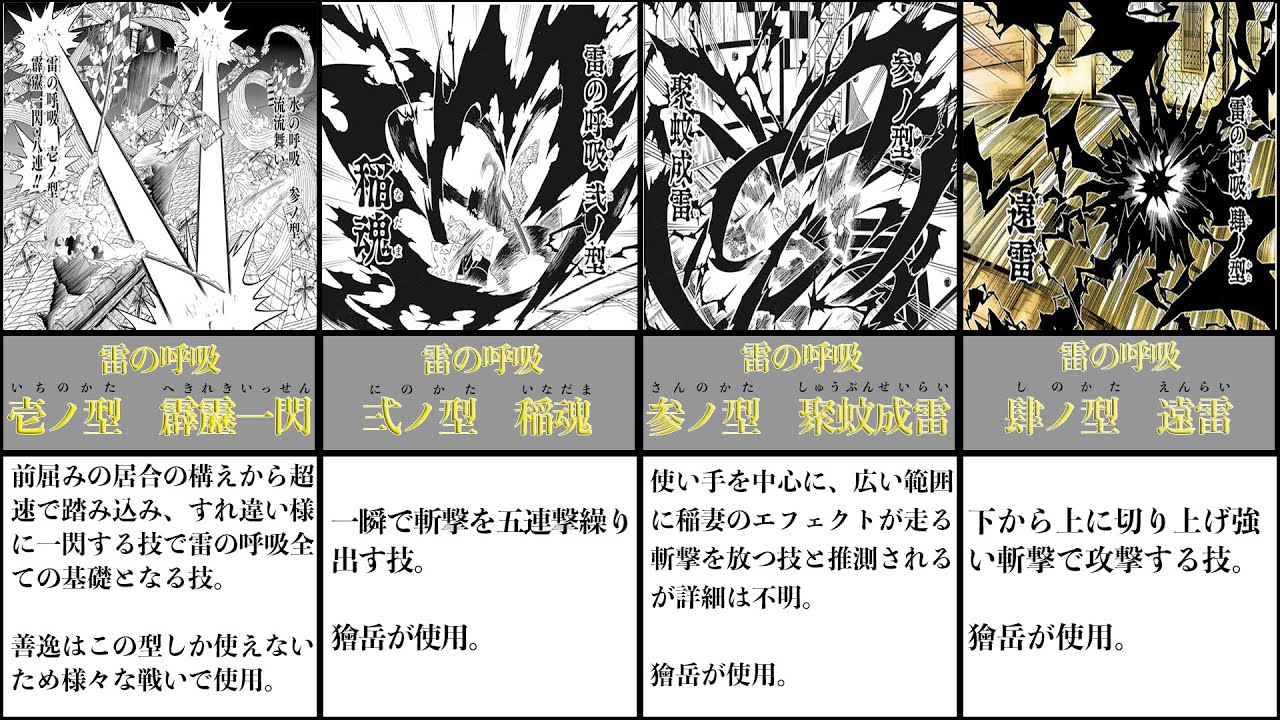
The standard codified catalog of Thunder Breathing features six ancient techniques, capped by a singular modern addition born from mortal necessity. Each form demands distinct footwork cadences and edge alignments.
| Form Designation | Technique Name | Primary Practitioner | Mechanical Function & Biomechanics |
|---|---|---|---|
| First Form | Thunderclap and Flash (Todoroki) | Zenitsu Agatsuma | High-velocity battojutsu draw; launches body forward in a straight line to sever the neck in one step. |
| Second Form | Lightning Ball (Inadama) | Kaigaku | A rapid series of five overlapping curved slashes deployed in an expanding sphere around the user. |
| Third Form | Buzzing Mosquito Thunder (Shūbun Seirai) | Kaigaku | A spinning wave assault launched from multiple angles to trap and shred an evasive target. |
| Fourth Form | Distant Thunder (Enrai) | Kaigaku | A mid-range ranged projectile-like slash creating cutting vacuum trails that strike targets at a distance. |
| Fifth Form | Heat Lightning (Netsu Kairai) | Kaigaku | An upward slash generating concussive thermal shock that cracks skin and destabilizes an opponent’s guard. |
| Sixth Form | Rumble and Flash (Dengou Raigou) | Kaigaku | A sustained multi-directional barrage combining close-range slashes with piercing spatial pressure. |
| Seventh Form | Honoikazuchi no Kami (Flaming Thunder God) | Zenitsu Agatsuma | Original creation; an ultra-high-speed dash taking the form of a golden lightning dragon that decapitates before sound registers. |

Why Zenitsu Perfected the Foundation While Kaigaku Evaded It
The philosophical divide between Zenitsu and Kaigaku explains why neither could perform the other’s repertoire. Thunderclap and Flash is an all-or-nothing engagement. When a swordsman drops into the scabbard stance, he commits his entire center of gravity to one explosive sprint. If the strike misses or gets deflected, the user’s momentum leaves him completely defenseless. Kaigaku possessed the technical flexibility to execute combinations like Distant Thunder and Heat Lightning, but his survival instinct refused that absolute, unhedged gamble. He could not perform the First Form because he would not risk total physical exposure on a single step.
Zenitsu operated under reverse psychology. Paralyzed by fear, his mind instinctively filtered out tactical complexities. Rather than spreading his focus over multiple flowing forms, he honed the single movement he could comprehend. Jigoro famously counseled him: "If you can only do one thing, hone it to perfection. Polish it to the absolute limit."
Zenitsu took that advice to its extreme mechanical conclusion. He developed custom physical extensions that bypassed his lack of variety:
- Sixfold (Rokuren): Rebounding off environmental structures six consecutive times to attack from blind spots while sustaining momentum.
- Eightfold (Hachiren): Accelerating the bouncing vectors to overwhelm spatial defenses.
- Godspeed (Shinsoku): Straining leg tendons past safe thresholds to deliver an untraceable strike, usable only twice a day before leaving his legs fractured.
By refining the primary movement rather than learning peripheral forms, Zenitsu achieved a standard of lethal precision that outmatched practitioners who merely divided their attention across the broader catalog.
The Infinity Castle Showdown: Blood Demon Art vs. Pure Essence
The catastrophic fallout of this division erupted when Kaigaku encountered Kokushibo, Upper Moon One. Faced with execution, Kaigaku abandoned his humanity, consumed demonic blood, and took the vacant rank of Upper Moon Six. Upon hearing that his chosen heir had defected to Muzan Kibutsuji, Jigoro Kuwajima performed ritual seppuku without an assistant to serve as his second, dying in prolonged agony. This tragedy shattered Zenitsu's comical exterior, forcing him to confront his senior peer awake, solemn, and fully lucid.
Within the shifting chambers of the Infinity Castle, Kaigaku showcased his transformed martial art. By weaving his demonic Blood Demon Art into forms two through six, Kaigaku caused his black lightning to rupture flesh from within, turning strikes like Rumble and Flash into flesh-shredding hazards. He mocked Zenitsu relentlessly, confident that an incomplete swordsman holding only Form One stood no chance against an Upper Rank wielding five lethal techniques.
Zenitsu dismantled Kaigaku’s hubris through original invention. Acknowledging that Kaigaku knew all standard variations, Zenitsu unleashed the Seventh Form: Honoikazuchi no Kami (Flaming Thunder God). Conceived specifically to fight beside, or execute, his fellow disciple, the form transcended human visual latency. Zenitsu did not simply swing faster. He focused his breathing into an instantaneous burst that outpaced Kaigaku’s demonic reflexes entirely, severing his head before Kaigaku could even register the blade’s trajectory. Kaigaku died bewildered, cursing the reality that the master had not kept secrets from him after all; Zenitsu had simply forged the ultimate form alone through unyielding focus.
Frequently Asked Questions (FAQ)
Q1: Why couldn't Kaigaku learn the First Form of Thunder Breathing?
A1: Kaigaku had plenty of athletic talent, but he fundamentally lacked the psychological willingness to commit everything to a single, unhedged forward thrust. Thunderclap and Flash requires total surrender of self-preservation during the initial launch, a mental barrier Kaigaku's self-centered survival instincts could never overcome.
Q2: Does Thunder Breathing produce real electricity?
A2: No. The lightning bolts, arcs, and golden sparks are visual and acoustic representations for the audience, reflecting how fast the swordsman moves and the atmospheric shockwaves created by breaking the sound barrier. Demon Slayer's creator confirmed that breathing styles mimic elemental properties through pure swordsmanship, though Kaigaku's demonic blood art did produce real, flesh-tearing black energy.
Q3: How many times can Zenitsu use Godspeed in battle?
A3: Under ordinary combat conditions, Zenitsu can activate Godspeed a maximum of two times. The physical stress places severe concussive force on the bones and ligaments in his lower legs, causing structural fractures that render him incapable of running or fighting once the technique concludes.
The Enduring Philosophy of Thunder Breathing
The structural narrative of Thunder Breathing provides one of the sharpest thematic lessons in modern shonen storytelling. Kaigaku gathered techniques the way a hoarder collects trinkets, valuing variety and status over deep commitment. When tested by mortality, his shallow mastery buckled, driving him to sacrifice his humanity for raw demonic resilience.
Zenitsu took a lonely path shaped by vulnerability and relentless repetition. Confining his ambitions to a single mechanical movement allowed him to refine footwork, blade draw, and breathing cadence into something extraordinary. When his master’s honor and his friend’s betrayal demanded resolution, he did not need the five forms he never learned. By mastering the single root of Thunder Breathing, Zenitsu unearthed the spark required to author its ultimate expression.