Inside the Award-Winning Picture Book: How 'Postcards Without Words' Brings Wartime Memory to Life
Paper holds memory in ways digital records rarely match. While municipal archives and community exhibits continually reconstruct local histories through preserved correspondence, a phenomenon detailed in a recent Chicago Tribune Report on regional postcard retrospectives, few mail artifacts carry the emotional weight of Japan's wartime postcards. Among them, none cuts deeper than Ji no nai Hagaki (Postcards Without Words), the autobiographical essay by celebrated essayist and screenwriter Kuniko Mukoda.
Adapted into a haunting, award-winning picture book illustrated by Seizo Tashima, the work strips war down to an intimate domestic fracture. The narrative bypasses military geopolitics to focus on a toddler sent away to escape Allied incendiary bombing, armed only with blank, self-addressed postcards and an improvised code of circles and crosses. Decades after Mukoda first committed the memory to paper, Tashima’s raw, earth-pigment visuals revitalized the story for contemporary readers, reminding audiences why this minimalist chronicle remains a foundational text in Japanese school curricula.
📌 Key Takeaways:
- The Core Narrative: Kuniko Mukoda’s preschool-age sister was evacuated during World War II Japan unable to write, instructed by their strict father to mail daily postcards marked with a circle (healthy) or a cross (unwell).
- The Artistic Evolution: In 2019, veteran artist Seizo Tashima translated Mukoda’s 1978 autobiographical essay into an acclaimed picture book, replacing nostalgic wartime sentiment with visceral, expressive brushwork.
- Pedagogical Impact: The story remains a staple of Japanese elementary literature, demonstrating how authoritarian home dynamics shattered under the weight of wartime child neglect and rural displacement.
A Father’s Desperate Code in the Shadow of the Pacific War
In 1945, Tokyo was burning. Under the Japanese government's mass evacuation policy (shudan sokai), hundreds of thousands of urban children were dispatched to rural farm districts, separated from parents to shield them from American air raids. Most evacuees were elementary schoolers. Mukoda's family, however, faced an agonizing exception: her youngest sister, Kazuko, was merely four years old.
The patriarch of the Mukoda household, Tsunekichi, was a man of rigid pre-war discipline. He ruled the home with an iron temper, demanding subservience and showing virtually no physical affection. Yet when the reality arrived that his youngest child would be sent to a farming village in Fukushima Prefecture, Tsunekichi collapsed into quiet terror. Kazuko was illiterate. She could neither write kanji nor basic hiragana, leaving her completely incapable of penning a letter home.
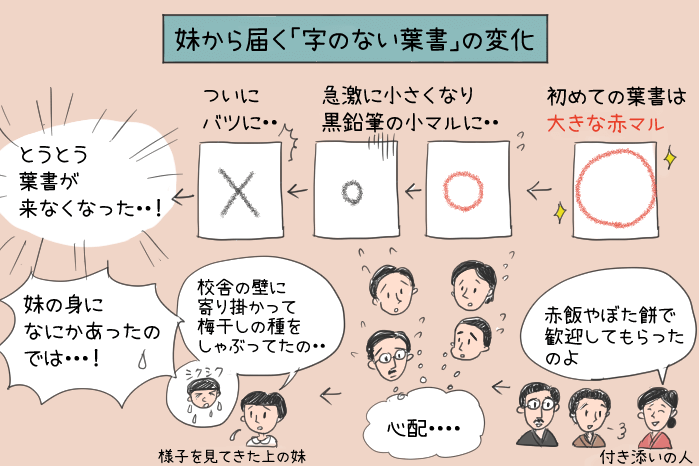
Tsunekichi bought a stack of government-issue postal cards. He painstakingly penned his own Tokyo address onto each one and handed them to Kazuko along with a lead pencil. His instructions were simple: every day, she was to draw a large red circle (○) on a postcard and drop it in the village mailbox to signal that she was safe and well. If she fell sick, became lonely, or suffered mistreatment, she had to draw a cross (×).
The Raw Power of Circles and Crosses on Paper
The initial mail deliveries brought brief relief. The first few postcards arrived in Tokyo bearing bold, energetic circles that stretched across the paper. Tsunekichi checked the mailbox daily with an urgency he had never shown for his office correspondence.
Then the circles began to shrink. Within weeks, the confident strokes degraded into shaky, misshapen ovals. Kazuko was withering from rural food shortages, lice infestations, and systemic neglect common to wartime evacuees billeted with hostile host families. Soon, the inevitable arrived: a postcard marked with a crooked cross (×). Then another. Then the postcards ceased altogether.
Postcard 1: [ ◯ ] --> Healthy, robust arrival in rural refuge
Postcard 5: [ ○ ] --> Shrinking rations, growing exhaustion
Postcard 9: [ × ] --> Malnutrition, untreated illness, desperation
The absence of words magnified the horror. An adult soldier or an older student might have filtered their reports through state censorship or filial modesty. A four-year-old’s solitary pencil stroke could not lie. The marks functioned as an unfiltered seismograph of childhood suffering, transforming everyday postal cards into clinical records of trauma.
The Journey from Literary Essay to Visual Masterpiece
Mukoda initially published the account in 1978 within her bestselling collection Chichi no Wabijo (Father’s Apology), an introspective excavation of her father’s contradictions. For decades, the text lived primarily in prose form, anthologized in middle-school language readers across Japan.
In late 2019, publisher Mitsumura Tosho commissioned Seizo Tashima to adapt the essay into a picture book. Tashima, a pioneering figure in postwar Japanese illustration known for his boundary-pushing books like Chikara Taro, approached the project not as a soft historical tribute, but as an urgent anti-war intervention.
| Medium / Version | Release Window | Primary Creative Focus | Cultural Footprint |
|---|---|---|---|
| Original Essay (*Father's Apology*) | 1978 | Psychological profile of an authoritarian father through personal adult memoir. | Established Mukoda as an elite essayist; adapted repeatedly for television. |
| National Curriculum Anthologies | 1982, Present | Reading comprehension and moral introspection for middle-school classrooms. | Read by tens of millions of Japanese students across five decades. |
| Picture Book Adaptation | 2019 | Visceral, earth-pigment visuals capturing childhood terror and family breakdown. | Won the Japan Picture Book Award; renewed public interest in wartime oral histories. |
Tashima refused to produce a standard, sanitized historical picture book. He relied on heavy strokes, thick paints, and scratchy lines that evoke mud, smoke, and hunger. The picture book format stripped away Mukoda's adult narrative distance, forcing the reader to sit directly across from the starving child and the panicked father.
Seizo Tashima’s Visceral Palette and the Breaking of Patriarchal Pride
The emotional climax of the book captures Kazuko’s eventual rescue. Recognizing that his daughter was dying, the father broke protocol and managed to bring her back to Tokyo ahead of schedule. When the train station doors opened, the family barely recognized the toddler. Her stomach was distended from malnutrition, her skin raw, and her scalp teeming with lice.
In traditional patriarchal households of Imperial Japan, men did not show physical affection, let alone weep in front of their wives and children. Yet as Kazuko stumbled into the home, Tsunekichi did something that etched itself into Kuniko Mukoda’s mind forever: he fell to the entryway floor on his hands and knees, embraced the lice-ridden child against his chest, and sobbed uncontrollably.
Tashima translates this breakdown through overwhelming visual distortion. The domestic setting dissolves. The authoritarian father shrinks into an angular, weeping figure swallowed by dark, heavy pigments. The book does not romanticize the sacrifice. It presents the scene as an indictment of the madness that forced an ordinary family into survivalist desperation.
Why Classrooms Still Rely on This Story Eight Decades Later
Japanese literature education often faces scrutiny for how it addresses World War II. Critics argue that educational materials sometimes emphasize national victimhood over historical responsibility. Ji no nai Hagaki, however, operates in a different emotional register. It does not heroicize soldiers or romanticize imperial defiance. It centers on the domestic fallout of state-mandated separation.
Educators favor the text because it teaches subtext through absolute simplicity. Students are asked:
- What does an illiterate child think about while clutching a pencil in an unfamiliar rural home?
- What happens to absolute authority when external collapse enters the home?
- How does an empty postcard carry more rhetorical weight than an official military dispatch?
The story acts as a masterclass in literary economy. By demonstrating that an illiterate mark on cheap paper can convey sheer human terror, Mukoda and Tashima prove that the truest records of conflict belong not to military planners, but to children who have no say in the borders they inhabit.
Frequently Asked Questions (FAQ)
Q1: Why couldn't Kazuko write her own letters on the postcards?
Kazuko Mukoda was only four years old during her wartime evacuation to Fukushima in 1945. She was too young to attend school and had not learned either the Japanese phonetic scripts (hiragana and katakana) or kanji characters, making written updates impossible.
Q2: What is the primary difference between Mukoda's original essay and Tashima's picture book?
The original 1978 essay in Father’s Apology is an adult memoir reflecting on the paradoxes of a stern patriarch and pre-war family dynamics. Tashima’s 2019 picture book distills the prose into an immersive visual experience, utilizing raw textures and expressionist art to evoke immediate emotional dread for younger audiences.
Q3: Did Kazuko Mukoda survive her wartime evacuation?
Yes. Kazuko returned to Tokyo severely malnourished and covered in lice, but survived the war under her family's care. She went on to live a full life, later managing culinary businesses and preserving her sister Kuniko’s literary estate after Kuniko died in a plane crash in 1981.
The Enduring Weight of Silent Correspondence
Eight decades after the sirens silenced over Tokyo, Ji no nai Hagaki retains its quiet force. The picture book adaptation strips away the patina of historical nostalgia, presenting wartime evacuation not as an abstract historical chapter, but as an acute childhood wound.
A red pencil stroke across paper remains the purest distillation of human vulnerability. As long as children find themselves trapped in the fallout of adult political failure, Kuniko Mukoda’s blank postcards will continue to speak with devastating clarity.