The Rising Surge in Job Declination Disputes: What Recent Legal Inquiries Reveal
A quiet panic is unfolding across Japan’s digital legal forums. Thousands of high school students, university undergraduates, and mid-career shifters are seeking urgent counsel after turning down job offers or skipping post-interview callbacks. According to an ongoing legal aggregation published in a 弁護士ドットコム Report, employment dispute legal inquiries regarding interview cancellations and post-offer declinations reached unprecedented volume in March 2026. Applicants repeatedly ask whether an aggressive manager can sue them for walking away from an informal retail shift or convenience store vacancy.
The spike in concern highlights a growing friction between traditional workplace expectations and a younger workforce unwilling to tolerate coercive hiring practices. For decades, Japanese hiring culture operated on implicit obedience, where reneging on an informal agreement was treated as a moral failing. Today, as candidates apply to multiple hourly roles simultaneously through mobile apps, the clash between corporate pressure and candidate autonomy is boiling over into legal dispute boards.
📌 Key Takeaways:
- The Core Driver: Inquiries on legal portal Bengo4.com show young applicants fear lawsuits after walking away from hourly jobs, often triggered by managers threatening compensation claims.
- Legal Reality: Under Japanese Civil Code Article 627, workers retain the right to terminate employment agreements with two weeks' notice, making real damages for reneging job acceptance virtually non-existent for regular part-time roles.
- The Best Protection: Sending a prompt, written post-interview declination email eliminates ambiguity, establishes a paper trail, and cuts off badgering phone calls before disputes escalate.
What Sparked the Influx of Legal Queries on Bengo4.com
Legal message boards in Japan rarely see spikes from part-time workers over procedural matters. Historically, the forum traffic on Bengo4.com centered on unpaid overtime, wrongful dismissal, or severance cuts. The March 2026 data shows a sharp divergence. Inquiries titled around post-interview cancellation etiquette and informal offer withdrawals (naitei jitai) have flooded the platform's labor category.
The questions reflect genuine distress. One applicant asked whether a diner could bill them ¥50,000 for training materials printed before their start date. Another described a mid-career recruiter concealing the response deadline, forcing an immediate verbal confirmation under duress. When the candidate later sent a formal job rejection notification to take a better position, the agency threatened litigation for lost placement revenue.
Labor attorneys responding on the platform point to a shared underlying cause: chronic labor shortages across the service, convenience, and logistics sectors. Store managers face steep hiring costs and punishing shift holes. When an applicant backs out hours after a screening, frustrated managers lash out with bluster about breach of contract job offer liabilities, terrifying young applicants who do not know their statutory protections.
Civil Code Protections Versus Threats of Financial Liability
Can an hourly employer actually sue an applicant for declining a job offer after an interview? The short answer from Japanese labor jurisprudence is almost unequivocally no.
Article 627, Paragraph 1 of the Japanese Civil Code stipulates that when an employment contract has no fixed term, either party may request termination at any time, with the contract ending two weeks after the notice is served. For part-time roles (baito) where work has not even begun, the bar for an employer to prove actual financial harm is extraordinarily high. Japanese courts require demonstrable, direct, and bad-faith causation before granting tort damages.
A shopkeeper who spent money on standard uniform laundering or scheduled an onboarding shift cannot claim those standard business operational overheads as tort damages against a candidate exercising candidate withdrawal etiquette. Legal liabilities typically arise only in exceptional corporate headhunting scenarios involving extensive overseas relocation, specialized machinery purchased exclusively for one executive, or explicit fraud. For hourly floor staff, threats of court action are almost always empty intimidation.
Evaluating Risk Across the Job Application Lifecycle
The legal risks of walking away from employment depend heavily on the stage of the interview process and whether formal paperwork was executed. The table below details how statutory rules interact with common hiring friction points.
| Hiring Phase | Legal Contract Status | Employer Recourse Reality | Recommended Candidate Action |
|---|---|---|---|
| Pre-Interview Cancellation | No contract exists. Absolute freedom to withdraw. | Zero legal standing. Business must absorb scheduling loss. | Send standard interview cancellation email 24+ hours ahead. |
| Post-Interview (Awaiting Result) | Screening phase only. No bilateral commitment. | Zero legal standing. | Send polite post-interview declination email to release application. |
| Verbal Offer Extended | Unilateral offer; conditional until accepted. | No enforceable claim against applicant. | Decline clearly via email before confirmation deadline. |
| Offer Accepted (Signed/Agreed) | Binding conditional employment contract formed. | Civil Code Art. 627 applies; damages claims fail without bad-faith proof. | Issue rescinding employment acceptance notice at least 14 days before start date. |
| First Day No-Show (Ghosting) | Active breach of agreed commencement terms. | High reputational risk; potential disciplinary dismissal record. | Avoid at all costs; communicate withdrawal immediately in writing. |
How High-Pressure Hiring Tactics Trap Applicants
The sudden wave of candidate withdrawal anxiety stems from aggressive recruitment behaviors known colloquially as recruiting harassment. In urban hubs like Tokyo and Osaka, restaurants, tutoring academies, and call centers frequently pressure candidates during interviews to commit on the spot.
Interviewers might tell an 18-year-old student that their slot will be given away in twenty minutes if they do not sign immediately. Caught off guard, the applicant accepts verbally. Days later, after assessing their course load or receiving an offer with better wages, they realize they cannot fulfill the shifts. When they try to back out, managers cite wasted administrative labor or threaten to contact their school administration.
This dynamic creates acute psychological stress. Rather than dealing with a calm administrative exit, candidates find their phones ringing incessantly. The fear of confrontation pushes many into destructive silence, where ghosting replaces clear boundary-setting. When anxious applicants turn to search engines and legal consultation sites, they are searching for validation that walking away is a legal right, not a crime.
The Post-Interview Declination Email Blueprint
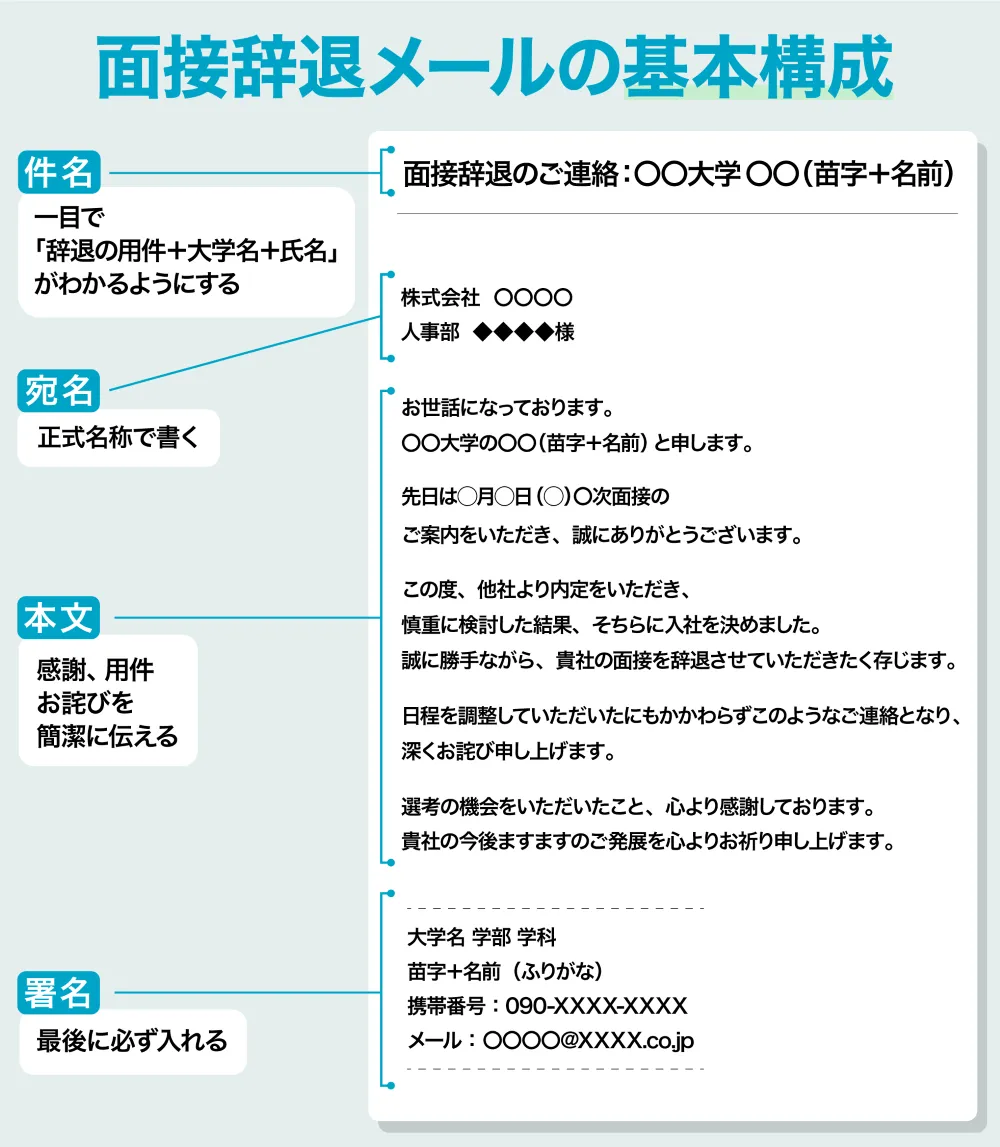
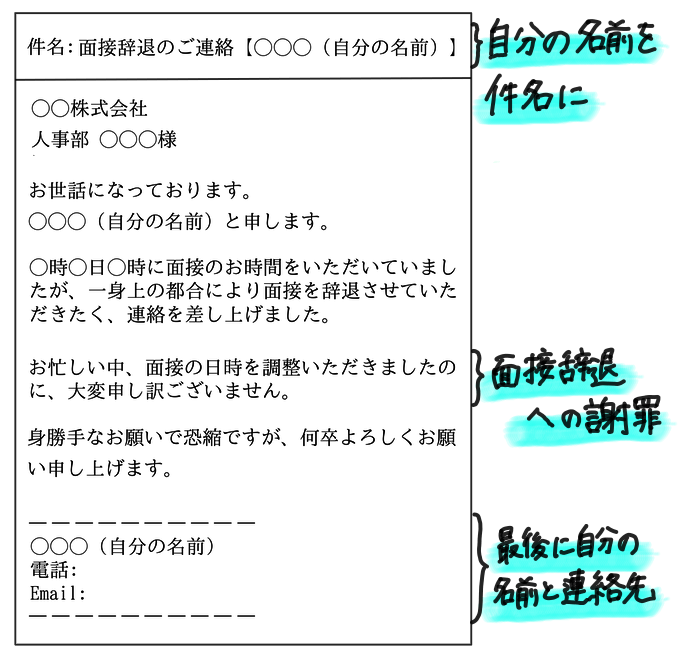
Knowing how to decline a job offer professionally defuses hostility and terminates mutual expectations without legal exposure. Written records via email provide concrete evidence of notice dates, foreclosing claims that an applicant vanished without word.
A proper declination message must be concise, unequivocal, and grateful. It does not require elaborate explanations or personal medical disclosures. Vagueness invites follow-up negotiations; absolute clarity ends the conversation.
Below is a field-tested part-time job rejection email template tailored to formal Japanese commercial expectations, accompanied by an English translation for foreign workers navigating the domestic market:
Subject: 面接辞退のご連絡(氏名:[Your Name])
Body:
[Company/Store Name] 採用担当 [Interviewer Name or 採用ご担当者様]
お世話になっております。[Your Full Name] と申します。
先日はご多忙の折、面接のお時間をいただき誠にありがとうございました。
面接後、自身の就業条件やスケジュールを改めて慎重に検討いたしました結果、大変恐縮ながら今回は採用の選考を辞退させていただきたく、ご連絡差し上げました。
貴重なお時間を割いて選考を進めてくださったにもかかわらず、ご期待に沿えず誠に申し訳ございません。
メールにて大変恐縮ではございますが、取り急ぎ選考辞退のお詫びとご連絡を申し上げます。
貴社の益々のご発展を心よりお祈り申し上げます。
--------------------------------------------------
[Your Full Name]
[Phone Number]
[Email Address]
English Equivalent Structure:
Subject: Notice of Interview Declination, [Your Name]
Body:
Dear Hiring Manager,
Thank you very much for taking the time to speak with me on [Interview Date] regarding the [Position Name] position.
Following our discussion and upon careful review of my current academic and personal schedule, I am writing to respectfully withdraw my application from the selection process.
I sincerely appreciate your time and consideration throughout this process. I wish your company continued success.
Sincerely,
[Your Name]
[Contact Information]
Shifting Generational Norms in Japan's Labor Market
The broader sociological dynamic underpinning these inquiries is a generational reassessment of workplace sacrifice. The days when young workers tolerated rigid conditions out of deference are vanishing. Japan's demographic contraction means hourly workers hold greater relative market leverage than their parents ever did, yet institutional managers still rely on legacy tactics of guilt and obligation.
When young job seekers encounter micro-red flags during a workplace visit, unkind treatment of waitstaff, dirty breakrooms, or ambiguous wage scales, they pull the plug early. They refuse to treat an initial application as a lifetime pledge. The influx of legal queries signals an awkward cultural transition: applicants are exercising modern labor mobility, but doing so while carrying residual cultural anxiety about administrative non-compliance.
As digital job boards expand transparent reviews of retail managers, companies that react vindictively to polite declinations face swift online backlash. A company that threatens legal action against an hourly applicant over an interview withdrawal often finds that confrontation transcribed onto community forums within hours, destroying its recruitment pipeline for the next hiring cycle.
Frequently Asked Questions (FAQ)
Q1: Can an employer sue me if I decline a part-time job after signing a hiring agreement?
A1: Legally, employers can theoretically claim damages if you breach a valid contract, but in standard part-time scenarios, courts dismiss such suits. Proving actual, direct financial injury caused solely by your withdrawal is exceptionally rare. Civil Code Article 627 allows you to cancel non-fixed agreements with two weeks' notice, making successful lawsuits virtually unheard of in practice.
Q2: Is an email declination sufficient, or must I call the hiring manager directly?
A2: An email is legally and professionally sufficient because it provides time-stamped proof of delivery. While traditional business manners in Japan prefer a telephone call for same-day shifts or cancellations scheduled within 24 hours, an email prevents unwanted intimidation and establishes a definitive written trail.
Q3: How soon after an interview should I send a rejection notice?
A3: Send the notification within 24 to 48 hours of completing the screening, or immediately upon deciding that the workplace does not fit your needs. Prompt communication allows the business to offer the spot to other candidates and minimizes complaints about wasted scheduling time.
The Rules of Walking Away in 2026
Walking away from an unsuitable job screening is not a failure of character or an invitation to litigation. It is a standard operational right protected by statutory law. The thousands of searches currently surfacing on legal portals reflect an applicant class waking up to their statutory rights while contending with managers who have yet to adapt to labor market realities.
Candidates who communicate decisively, document their actions in writing, and decline to be intimidated by hollow legal threats retain full control over their careers. Courtesy remains good practice; surrender to administrative coercion does not.