Trackside at APEX: Inside the Speed and Tech Behind the Porsche Sprint Challenge Opener
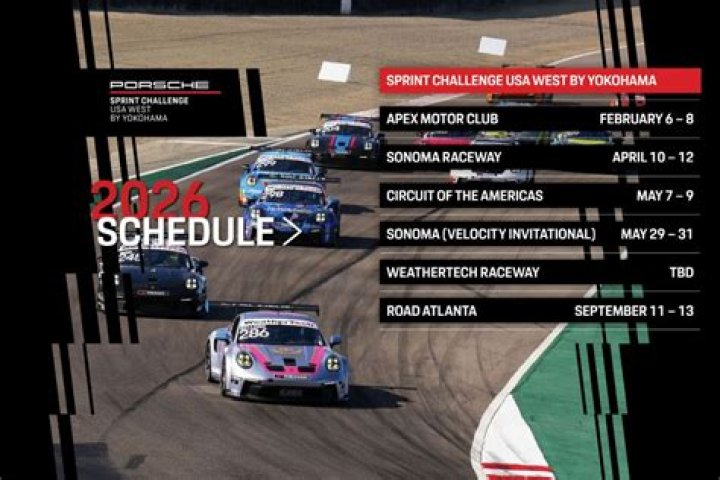
The Sonoran Desert air sat crisp at 58 degrees when forty naturally aspirated 4.0-liter flat-six engines fired simultaneously on the pit apron. APEX Motor Club, the private circuit carved into Maricopa, Arizona, opened its gates this February to host the 2026 Porsche Sprint Challenge USA West season opener. Fans tuning into live broadcasts via the official FloRacing Report witnessed a brutal showcase of customer racing engineering, tight track geometry, and unyielding driver precision.
For international motorsports followers searching what the "APEX Sprint" refers to, the answer blends private motorsport country club real estate with Porsche Motorsport North America's premier regional pipeline. The series drops Pro-Am and Am drivers directly into identical Porsche 911 GT3 Cup machinery without driver aids like ABS or traction control, turning raw car control and suspension tuning into the decisive factors.
📌 Key Takeaways:
- The Circuit Debut: APEX Motor Club staged its first championship opener on the 2026 Porsche Sprint Challenge USA West calendar, delivering technical desert racing over a 2.3-mile layout.
- The Machinery: Drivers competed in 510-horsepower Porsche 911 GT3 Cup (Type 992) cars running without electronic traction aids or anti-lock brakes.
- Paddock Movement: Orthopedic surgeon Dr. David Fabi linked up with Black Sheep Racing, demonstrating the championship's intense blend of elite amateurs and professional engineers.
The Maricopa Layout and Desert Trackside Engineering
APEX Motor Club breaks the traditional mold of legacy road courses like Laguna Seca or Sonoma Raceway. Built inside an expansive basin south of Phoenix, the circuit presents rapid directional changes, sweeping off-camber sections, and an abrasive asphalt aggregate that eats through Michelin racing slicks within twelve heat cycles.
Fine desert sand routinely blows across the track surface. Race engineers spent Friday practice fighting micro-grip variances that caused sudden 1.5-degree yaw angle spikes mid-corner. In a lightweight rear-engine chassis, sudden rear breakaway forces the pilot into aggressive steering counter-corrections. Teams countered the surface volatility by adjusting anti-roll bar blade settings and dropping cold tire pressures to 19.5 psi, allowing carcass expansion under heavy thermal loading down the 3,400-foot main straight.
Inside the 911 GT3 Cup Cockpit: Pure Mechanical Grip
The centerpiece of the Sprint Challenge is the Porsche 911 GT3 Cup car, based on the current 992 generation. Producing 510 horsepower at 8,400 rpm, the engine pairs with a six-speed sequential dog-ring gearbox operated through carbon fiber paddle shifters. There is no automated launch control. There is no electronic stability software.
Drivers modulate brake pressures topping 85 bar into Turn 1 using pure leg threshold muscle memory. If a front rotor locks, flat-spotting the tire is instantaneous, ruining performance for the remaining 35-minute heat. The cockpit environment demands intense physical fitness; cabin temperatures inside the carbon shell hover near 115 degrees Fahrenheit under direct Arizona sunlight, while drivers absorb sustained lateral loads exceeding 2.2g through the long carousel.
Paddock Dynamics: Dr. David Fabi and Black Sheep Racing
Customer GT racing thrives on high-stakes privateer programs. Among the most closely watched entries during the weekend was Black Sheep Racing, which announced the signing of orthopedic surgeon Dr. David Fabi to its driver roster in late January. Fabi, a veteran competitor in one-make sports car series, stepped directly into the team’s multi-car effort.
Balancing a rigorous surgical schedule with competitive motorsport requires surgical discipline behind the wheel. Fabi worked closely with team data engineers through telemetry traces, dissecting throttle application points against professional benchmark laps. Black Sheep Racing mechanics dialed in damper rebound settings on Fabi's No. 83 Cup car, seeking stability over the curbing on APEX’s inner sequence where drivers run two wheels completely over the serrated apex strips to shave hundredths off lap times.
Championship Calendar Metrics and Platform Comparison
The 2026 Porsche Sprint Challenge USA West calendar marks a calculated expansion across Western North American circuits. Porsche Motorsport North America structured the series as an accessible yet ruthlessly competitive stepping stone beneath the premier Porsche Carrera Cup North America.
| Event Attribute | Sprint Challenge USA West | Carrera Cup North America |
|---|---|---|
| Chassis Specification | Porsche 911 GT3 Cup (992 & 991.2) | Porsche 911 GT3 Cup (992 exclusively) |
| Race Length Format | 35-minute standalone sprints | 40-minute standalone sprints |
| Driver Rating Focus | Semi-Pro, Pro-Am, and Masters (Bronze) | FIA Gold, Silver, and Pro-Am elites |
| Season Operating Budget | $250,000, $400,000 per entry | $650,000, $1,000,000 per entry |
| Primary Broadcast Hub | FloRacing live streaming | IMSA.tv / Peacock streaming |
Trackside Telemetry: Where the Opener Was Won and Lost
Modern sports car paddocks run entirely on hard data. Inside the team awnings at APEX, laptops displayed Cosworth live-feed traces contrasting throttle percentage, steering input angle, brake line pressure, and ride heights measured through laser chassis sensors.
The decisive sector at APEX proved to be the Turn 8 through Turn 11 technical switchback. Telemetry overlays revealed that drivers who carried an extra 3 mph of entry speed into Turn 8 lost up to four-tenths of a second on the exit toward the back straight. The car washed wide on the dust-covered curbing, inducing power understeer that forced drivers off the throttle for an extra 18 meters. The race leaders braked three meters earlier, rotated the chassis around the front axle under trail-braking, and matted the throttle cleanly while pointing dead straight down the tarmac.
Frequently Asked Questions (FAQ)
Q1: What does "APEX Sprint" mean in sports car racing?
It refers specifically to the 2026 season opening round of the Porsche Sprint Challenge USA West held at APEX Motor Club in Maricopa, Arizona. It describes both the sprint race format, short, high-intensity 35-minute races without driver swaps or pit stops, and the venue hosting the championship kickoff.
Q2: Where can fans watch Porsche Sprint Challenge USA West races live?
Official live coverage and on-demand replays stream across the FloRacing platform throughout the 2026 season, alongside real-time timing and scoring boards maintained on the series official website.
Q3: How does the Porsche Sprint Challenge differ from Carrera Cup?
Sprint Challenge serves as the regional development and sportsman level running under the United States Auto Club (USAC) sanctioning body. Carrera Cup North America is sanctioned directly alongside IMSA, attracting international factory junior drivers and requiring substantially larger team operating budgets.
The Road Ahead for the 2026 Western Championship
The curtain-raiser at APEX Motor Club establishes the pecking order for what promises to be a grueling seven-round western campaign. By putting real-world machinery to the test across extreme desert ambient temperatures, teams emerged with baseline chassis maps that will dictate their technical strategies at upcoming stops like Utah Motorsports Campus, Sonoma, and WeatherTech Raceway Laguna Seca.
Sprint racing leaves zero room for tactical compromise. Without mandatory pit stops or fuel conservation strategies, the outcome rests on driver nerve, car setup, and immediate split-second execution when the green flag drops. The battles in the Maricopa desert showed that the 2026 championship will reward drivers who master mechanical grip long before the rest of the field catches up.