Camp Directly on the Sea: The Radical Evolution of Osaka Bay Saltwater Fishing

Ten minutes after exiting the Osaka Metro Chuo Line at Cosmosquare Station, anglers stand along a paved promenade casting 40-gram metal jigs into the dark shipping lanes of Osaka Bay. Behind them, glass office towers glow against the night sky; beneath them, pelagic predators hunt baitfish drawn toward port floodlights. The convergence of heavy urban infrastructure, accessible public transit, and productive marine currents has altered how city dwellers approach saltwater angling. As documented in a detailed MSN Report covering Kansai coastal dynamics, the region’s waterfront has developed into a premier territory for light shore jigging, drawing anglers who commute with multi-piece travel rods rather than cars.
The movement has expanded well beyond quick after-work casts from concrete revetments. A viral recreation wave across southern Osaka and Wakayama borders now puts campers directly onto offshore floating platforms, combining overnight bivouacs with continuous jigging. Anglers pitch dome tents inches from open water, barbecue their catch on marine rafts, and target everything from table-grade aji horse mackerel to hard-charging young yellowtail without boarding full-day offshore charter vessels.
📌 Key Takeaways:
- Transit-First Access: Deep-water ledges at spots like Seaside Cosmo allow metro commuters to target coastal game fish without private vehicle transport.
- Platform Evolution: Anchored floating raft camps provide sheltered, offshore-grade water access for overnight stays and immediate seaside cooking.
- Tackle Standardization: Versatile medium-light spinning outfits (20, 40g lures) now dominate local breakwaters, replacing heavy surfcasting rigs.
From Heavy Industry to Public Angling Hubs
Osaka Bay carried an industrial reputation for decades, dominated by container yards, reclaimed islands, and restricted shipping berths. While commercial ship traffic remains dense, municipal redevelopment and improved water treatment over the past twenty years produced an unexpected ecological dividend. Baitfish populations, predominantly Japanese anchovy (*katakuchi iwashi*) and sardine, pack the inner bays each spring and autumn. Predatory game fish follow them directly into harbor channels.
This environmental shift coincided with changing recreation demographics. Long-distance trips to remote peninsulas require highway tolls, car rentals, and extensive planning. By contrast, Osaka's municipal waterfront links directly to one of the most efficient rapid-transit grids in Asia. Anglers recognized that deep-dredged channels created along port perimeters mimic natural drop-offs, creating feeding stations where pelagic fish corner bait against concrete seawalls.
Family recreation monitors have tracked this shift toward harbor waterfronts. Data published in September 2026 by Japanese outdoor recreation index Iko-yo highlighted sustained demand for accessible, open-air waterfront venues across the Osaka Bay Area, even as indoor retail centers expand nearby. The coast has become an active playground rather than an industrial edge.
Subway-Linked Blue Runners at Seaside Cosmo
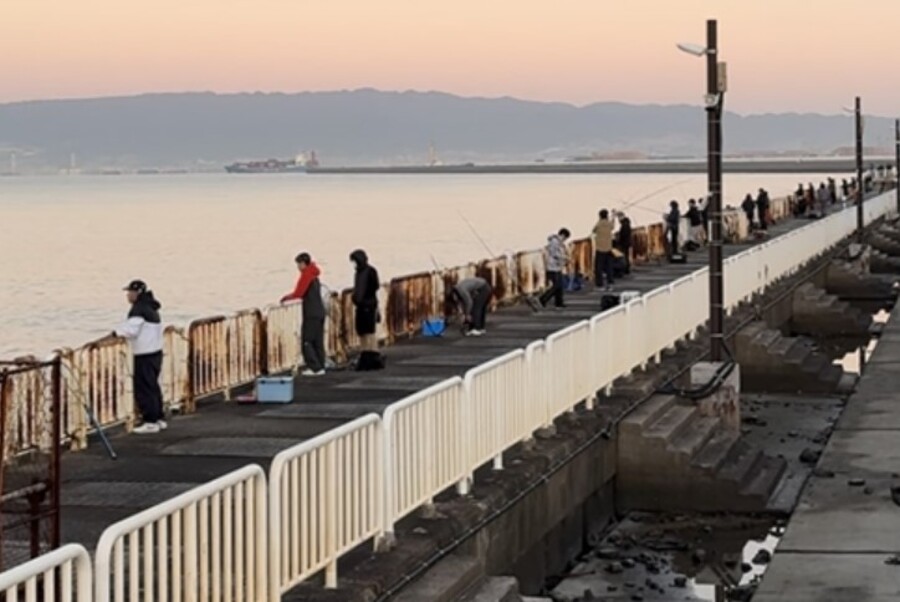
The centerpiece of urban shore angling in Osaka is Seaside Cosmo, an open seaside park lining the northern rim of Sakishima Island. Located less than five hundred meters from Cosmosquare Station, the promenade features flat paving, safety railings, and wide boardwalks. It also sits directly adjacent to the main shipping channel entering the inner port, giving shore anglers rare access to deep, swift-moving water without needing an offshore boat.
During the autumn peak, anglers line the rails before dawn and gather again around dusk. The primary tactic is light shore jigging, relying on 9-foot rods paired with high-gear 4000-series reels loaded with 0.8 to 1.2 PE braided line. Anglers cast slender tungsten or lead jigs weighing between 20 and 40 grams, working them through mid-water columns using rapid erratic twitches punctuated by pauses.
The quarry varies with water temperature. From late August through November, migratory young yellowtail, locally classified by size as *tsubasu* (under 40 cm) and *hamachi* (40, 60 cm), strike aggressively during tidal turnarounds. Alongside them, Japanese Spanish mackerel (*sagoshi*) slash through schools of anchovies near the surface. At night, action shifts down to ultralight soft plastics, as anglers pursue rockfish (*mebaru*) and aji horse mackerel under artificial wharf illumination.
Comparing Osaka Bay Saltwater Angling Venues
Different coastal zones along Osaka Bay serve distinct angling styles, technical skill levels, and logistical plans. The options span downtown transit-friendly wharves, commercial park piers, and offshore marine platforms anchored in sheltered coves.
| Location & Venue Type | Transit & Logistical Access | Primary Target Species | Typical Cost & Facilities |
|---|---|---|---|
| Seaside Cosmo(Urban Promenade) | 5-minute walk from Cosmosquare Station (Osaka Metro) | Young yellowtail (hamachi), Spanish mackerel, aji, hairtail | Free entry; public restrooms, safety railings, open 24 hours |
| Osaka Sea Fishing Platforms(Floating Marine Camps) | Train to southern ports + short boat transfer | Red sea bream, flounder, horse mackerel, large flathead | ¥4,500, ¥12,000 per person; rental tents, BBQ grills, portable toilets |
| Sennan / Rinku Coast(Coastal Parks & Jetties) | 15-minute walk from Rinku Town Station (Nankai / JR) | Seabass, black sea bream (*chinu*), squid (*aori-ika*) | Free entry; adjacent shopping facilities, pay parking lots |
| Tottori Port / Misaki Parks(Pay Fishing Piers) | Nankai Main Line connection + municipal local bus | Aji, sardines, yellowtail, stocked red sea bream | ¥1,000, ¥3,000 entry; tackle rentals, bait shops, life-vest loaners |
Overnight on the Swells: Marine Rafts and Raft Camping
Angling innovation in southern Kansai took a different direction with the rise of overnight floating camp rafts (*kaisen kyanpu*). Originally built as anchored wooden platforms for commercial oyster and fish farming, operators across southern Osaka, Wakayama, and Hyogo converted these structures into stable, floating platforms anchored inside protected inlets.
In March 2026, Yahoo News Japan documented how novice anglers turned this into a viral weekend pursuit. Two first-time fishing enthusiasts pitched self-standing camping tents directly onto anchored marine wood decking, dropped sabiki rigs straight down into schools of horse mackerel, and prepared the fresh fish immediately on portable tabletop grills over open sea. The arrangement avoids rough open-ocean swells while placing anglers on productive bottom structures that shore casters cannot reach.
These floating setups eliminate logistical bottlenecks. Campers board an eight-minute water taxi from coastal fishing ports, carrying compact backpacking gear, coolers, and rod cases. Operators supply safety mesh around deck borders, secured mooring rings for tent tie-downs, portable chemical toilets, and charcoal disposal drums. Anglers wake at first light to cast directly from their tent zippers into deep drop-offs where flathead, red sea bream, and migrating coastal pelagics feed.
Water Dynamics, Night Bites, and Harbor Regulations
Angling in Osaka Bay requires close attention to structural patterns and local shoreline regulations. The water circulation inside the bay is dictated by the Kii Channel to the south and the Akashi Strait to the west. This flow creates strong tidal changes twice daily, driving water past headlands, port breakwaters, and island bridges. Slack water often produces slow fishing; fast movement triggers sudden bite windows lasting under thirty minutes.
Night tactics rely heavily on artificial light lines. Large port installations illuminate seawall edges, creating feeding corridors where small aji gather to feed on copepods and plankton. In response, anglers employ the *ajing* technique: ultralight graphite rods rated down to 0.5 grams, paired with fluorocarbon or ester lines measuring 0.3 gou (roughly 1.5 lb test) and tiny lead jig heads tipped with straight-tail soft plastics. The bites are faint and sharp, demanding intense concentration.
Urban access brings real municipal restrictions. Several breakwaters across Osaka Port and Kobe remain strictly off-limits due to commercial shipping laws, Homeland Port Security directives, or past drowning incidents. Anglers must confirm designated fishing zones before unpacking tackle. Life vests are legally mandated on all water taxis, charter boats, and commercial raft platforms, and they remain standard common sense on public breakwaters.
Frequently Asked Questions (FAQ)
Q1: Can I fish at Seaside Cosmo without a Japanese fishing license?
A1: Yes. Saltwater recreational angling along public coastal promenades, ports, and beaches in Japan does not require an individual fishing license. However, anglers must adhere strictly to designated public zones, avoid commercial working docks displaying no-entry signs, and follow legal size and season restrictions on protected species such as spiny lobster and abalone.
Q2: How do travelers carry fishing rods on the Osaka Metro system?
A2: Osaka Metro allows passengers to carry recreational gear as long as it does not obstruct doorways or endanger passengers. Anglers commonly use multi-piece travel rods that break down into three to five segments, fitting inside daypacks or compact rod tubes under 60 cm in length. Exposed hooks must be safely secured in lure covers or lure boxes.
Q3: What tackle should beginners bring for floating camp platforms?
A3: Bring an all-around medium-light spinning rod (7 to 8 feet) paired with a 2500-size reel, 1.0 PE main line, and a fluorocarbon leader. For easy catches, carry sabiki rigs (sizes 4 to 6) with frozen krill bait cages for aji, alongside 30-gram metal casting jigs and bottom rigs baited with marine worms for bream and flathead.
Osaka Waterfront Angling in 2026
Urban angling around Osaka Bay has matured into a sophisticated, highly accessible outdoor culture. The old divide between muddy commercial wharves and remote pristine coastlines has dissolved. Commuters board evening trains carrying carbon fiber rods, catch pelagic game fish against a backdrop of neon port lights, or escape onto anchored rafts for an overnight cookout over the swells. By respecting local maritime regulations, wearing certified flotation, and keeping shoreline spaces clean, anglers continue to prove that heavy urban density and rich marine sport can thrive side by side.