Can Blue Impulse Fly Over Ainan? Fact-Checking Feasibility, Safety, and Government Approval

Ehime Governor Tokihiro Nakamura and Ainan Town Mayor Yoshinori Nakamura traveled to Tokyo in early October to deliver a high-stakes petition directly to Defense Minister Shinjiro Koizumi. Their objective was clear: secure an exhibition flight by the Japan Air Self-Defense Force's (JASDF) elite aerobatic team, Blue Impulse, to inaugurate the newly overhauled Shiden Kai Museum. As detailed by a 南海放送NEWS on MSN Report, prefectural leaders view the military aerobatic display as the definitive public draw for unveiling the upgraded home of Japan's sole remaining Imperial Japanese Navy Kawanishi N1K2-J Shiden Kai fighter aircraft.
The municipal bid links historical aviation heritage with modern military demonstration. Yet bringing supersonic-capable Kawasaki T-4 jets across the mountainous southern rim of Shikoku involves intricate coordination between municipal authorities, regional civilian air traffic controls, and the Ministry of Defense. While Minister Koizumi affirmed that he received the community's proposal with serious consideration, transforming that political gesture into certified flight corridors above Ainan requires clearing substantial operational and regulatory hurdles.
📌 Key Takeaways:
- The Direct Petition: Ehime Governor Tokihiro Nakamura and Ainan Mayor Yoshinori Nakamura met Defense Minister Shinjiro Koizumi on October 2 to officially request a Blue Impulse flyover for the Shiden Kai Museum reopening.
- Structural Preparations: Technicians from ShinMaywa Industries, the modern successor to original manufacturer Kawanishi Aircraft, are completing critical fuselage reinforcement beneath the cockpit to prepare the sole surviving N1K2-J airframe for safe building-to-building relocation.
- Logistical Bottlenecks: Official approval depends on JASDF squadron deployment schedules, nearby staging base availability in western Japan, and civil aviation route deconfliction above the Uwa Sea coastline.
Defense Ministry Petition: Shinjiro Koizumi Confronts Ehime’s Airspace Bid
The delegation from Ehime arrived at the Ministry of Defense accompanied by Diet lawmakers representing the prefecture. Governor Tokihiro Nakamura presented the petition directly to Defense Minister Shinjiro Koizumi, arguing that an appearance by Blue Impulse would serve as a powerful catalyst for regional tourism while honoring a rare artifact of national aviation history. The timing targets the grand reopening of the new Shiden Kai Museum facility, projected for completion in autumn.
Koizumi responded with diplomatic encouragement, noting that he took the strong local sentiment into account. However, ministerial receptivity does not equal immediate operational authorization. The 11th Squadron of the JASDF 4th Air Wing, based at Matsushima Air Base in Miyagi Prefecture, operates under strict annual quotas for civilian and public appearances. Municipalities across Japan submit hundreds of requests annually for civic anniversaries, national sports events, and maritime festivals. To secure a slot, Ainan Town must demonstrate that the ceremony holds broader regional and historical significance beyond a typical municipal opening.
Local assembly members argue that the preservation of the N1K2-J fighter is singular in Japan. Unlike generic municipal festivals, the event directly connects to airborne history. That distinction gives the petition notable political weight within defense circles, though it also attracts scrutiny regarding the balance between civic tourism and operational military tasking.
Airspace Logistics and Safety Protocols Over Southern Shikoku
Blue Impulse does not simply dispatch six Kawasaki T-4 jets to an isolated town without elaborate logistical infrastructure. A flight over Ainan presents distinct geographical challenges. Located at the southwestern tip of Ehime, the town borders the rugged coastline of the Uwa Sea. Surrounding elevations rise rapidly from sea level, creating microclimates notorious for rapid cloud base drops and gusting coastal crosswinds.
The JASDF conducts site surveys months in advance of any approved performance. Flight safety guidelines designate two distinct profiles: Level 1 through 4 aerobatic sequences, which require massive columns of clear airspace, and Level 5, which consists of formation flypasts. Given the topographic constraints of Ainan and its proximity to localized civilian flight corridors across the Bungo Channel, military planners would almost certainly limit any display to level flybys in delta, swan, or echelon formations.
Staging represents an additional logistical constraint. Matsushima Air Base sits hundreds of miles away in northeastern Japan. Consequently, the squadron requires a forward operating base. Potential forward staging hubs include Nyutabaru Air Base in Miyazaki Prefecture, Tsuiki Air Base in Fukuoka Prefecture, or JASDF Ashiya Base. Aircraft must transit, refuel, hold over water, execute precise timing over the museum coordinates, and return, all within tight fuel margins and civilian airspace corridors managed by the Ministry of Land, Infrastructure, Transport and Tourism (MLIT).
Conserving the Relic: Fuselage Reinforcement and the Relocation Plan
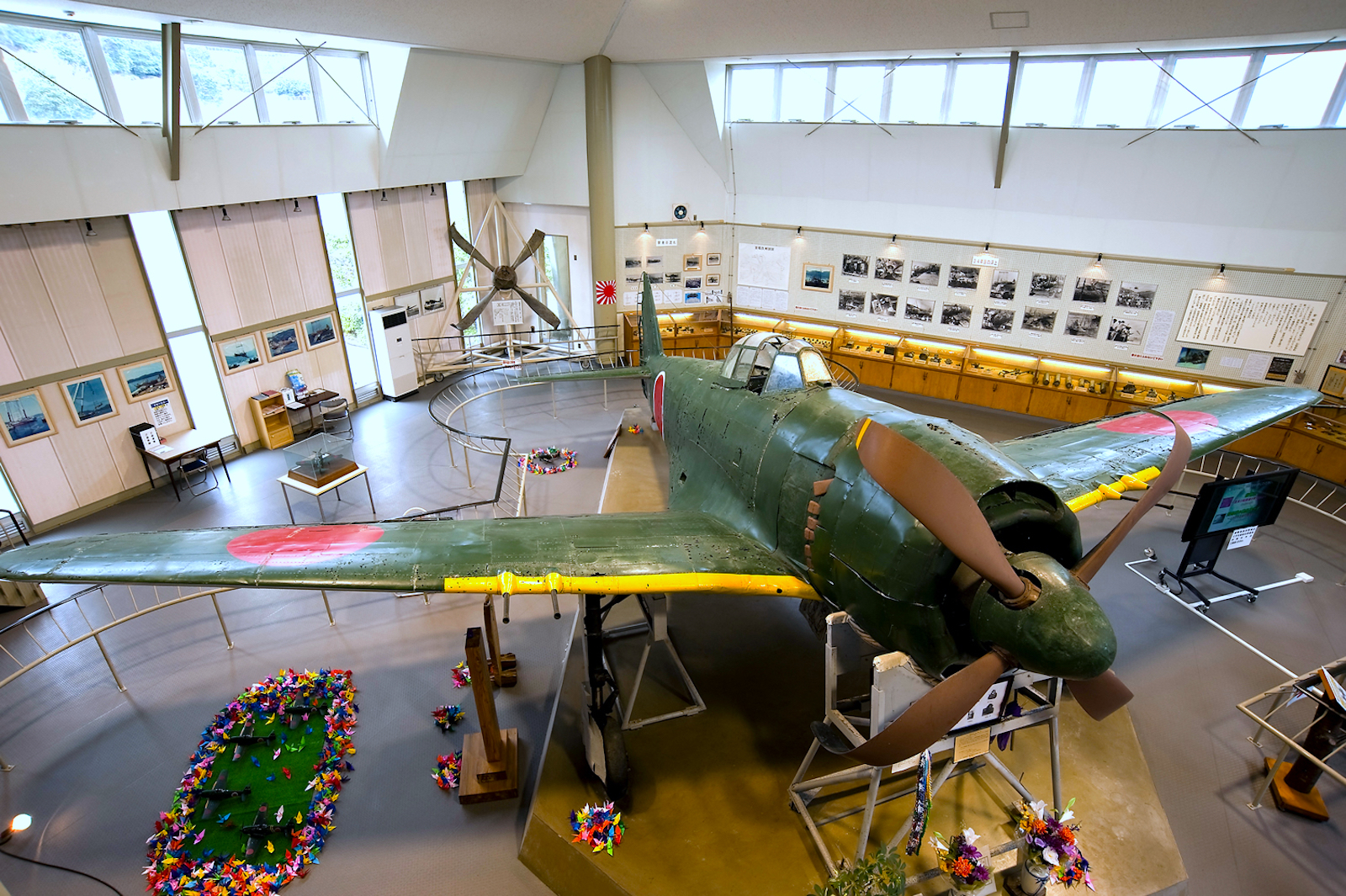
While government officials negotiate flight authorizations in Tokyo, specialized engineers work on the ground in Ainan to secure the center of the exhibition. The Kawanishi N1K2-J Shiden Kai on display is the only authentic model preserved in Japan. Originally assigned to the elite 343rd Naval Air Group (the "Tsurugi" Squadron), the aircraft ditched into the waters of Joushi Bay in July 1945 during the final air battles over western Japan. It rested undisturbed on the seabed for 34 years until salvage teams recovered it in 1979.
Prolonged submersion in seawater left the duralumin airframe chemically fragile. Salt crystallization and galvanic corrosion weakened load-bearing bulkheads. To prepare the aircraft for transfer into the newly constructed museum building, prefecture-contracted specialists from ShinMaywa Industries launched an intensive structural reinforcement program. ShinMaywa holds the direct industrial pedigree of the aircraft, having evolved from Kawanishi Aircraft Company after World War II.
Crews focused initial work on reinforcing the underside of the cockpit and the main spar joints. Workers installed custom structural cradles beneath the fuselage to distribute weight evenly and prevent shear fractures during transport. Moving the unpowered, intact warbird over municipal access roads requires slow-speed transport on hydraulic dollies, engineered to eliminate surface vibrations that could crack brittle aluminum panels.
| Operational Phase | Responsible Entity | Key Technical Challenge |
|---|---|---|
| Fuselage Stabilization | ShinMaywa Industries | Mitigating 80-year-old duralumin stress corrosion along lower cockpit bulkheads prior to physical lifting. |
| Building-to-Building Relocation | Ehime Prefecture & Heavy Transport Teams | Zero-shock hydraulic transport over public roads; clearances through custom roll-up structural bays. |
| Flight Schedule Allocation | Air Staff Office & Defense Ministry | Evaluating competition from major national public events against annual T-4 training cycles. |
| Airspace & Weather Deconfliction | JASDF 4th Air Wing & MLIT Aviation Bureau | Routing around mountainous coastal terrain and Bungo Channel commercial routes under changing visibility. |
Bridging Commemoration and Modern Air Power
Public reaction across Ehime reflects broad excitement, though observers note the layered symbolism of sending modern frontline military jets to celebrate a salvaged World War II fighter. The Shiden Kai Museum has long positioned itself as a peace education center rather than a militaristic monument. The recovered plane was never restored to flying condition out of respect for the pilot who perished when it sank. It remains preserved in its recovered state, complete with bent propeller blades and marine-weathered textures.
Inviting Blue Impulse shifts the emotional tone of the site toward dynamic public spectacle. Community organizers in Ainan view the potential flyover as an economic lifeline. The town sits more than two hours by car from Matsuyama Airport, making routine tourism difficult. An exhibition flight by Blue Impulse regularly draws tens of thousands of visitors, which would flood local hotels, markets, and regional transit lines in Minamiuwa District.
Defense analysts note that the Air Staff Office evaluates these requests through a public relations framework. Blue Impulse flights aim to foster positive civilian-military relations and boost recruitment visibility. Sponsoring a flight over a museum dedicated to wartime preservation requires careful messaging to ensure the JASDF's display honors historical remembrance while underscoring contemporary defense capabilities.
Assessing the Probability: Will the Flight Happen?
Defense Ministry officials face a rigorous calendar review before issuing a formal flight approval. The JASDF releases its official Blue Impulse performance schedule each spring, typically around March or April, covering the subsequent fiscal year. Until that document appears, all municipal planning remains conditional.
The operational calculus favors a low-altitude formation transit rather than an elaborate airshow. A flypast requires less specialized airspace clearance, generates minimal disturbance to regional civil air corridors, and carries a higher margin of safety over populated coastal hamlets. If Minister Koizumi’s staff signs off on the request, expect a sequenced passage of T-4 jets deploying white smoke trails along the coastline of Misho Bay, centered directly over the new museum pavilion.
Local organizers are structuring the grand reopening ceremonies with contingency planning. If the defense ministry approves the petition, the town will mobilize parking management, traffic diversions, and spectator zones across the surrounding hills. If operational duties or budget constraints force a rejection, the modernized exhibition facility and its carefully preserved Kawanishi fighter must stand on their own merits as regional attractions.
Frequently Asked Questions (FAQ)
Q1: When will the Ministry of Defense make a final decision on the Blue Impulse flight?
A1: The Japan Air Self-Defense Force typically announces the official Blue Impulse annual exhibition schedule between March and April. The exact confirmation for the autumn opening will be codified in that operational release.
Q2: Why is the Kawanishi N1K2-J Shiden Kai at Ainan so significant?
A2: It is the only surviving specimen of the Shiden Kai in Japan. While three airframes reside in American museums, the Ainan aircraft was salvaged directly from Japanese waters in 1979 and stands as an authentic cultural and historical artifact from the final months of World War II.
Q3: Could unpredictable coastal weather cancel the demonstration on opening day?
A3: Yes. Blue Impulse operations adhere to strict visual meteorological conditions. If coastal cloud ceilings drop below minimum safety thresholds over the Uwa Sea, flights are canceled or downgraded to basic navigational passes without smoke or formation maneuvers.
The Road to Ainan's Reopening
The campaign to bring Blue Impulse to Ainan represents a convergence of regional economic ambition, careful structural conservation, and ministerial politics. Technicians from ShinMaywa Industries continue reinforcing the aircraft's frame to ensure the artifact moves securely into its upgraded home. Concurrently, prefectural authorities await word from Tokyo.
Whether six blue-and-white T-4 jets streak across the skies of southern Ehime hinges entirely on military scheduling windows and defense bureau approval. For Ainan Town, the effort has already succeeded in thrusting a remote coastal museum and its lone surviving Imperial Navy fighter back into the national spotlight.