From 1989 to Global Distribution: The Complete Narrative Arc of Gaki no Tsukai's 'No-Laughing' Specials

When four comedians checked into a traditional Japanese ryokan in Yamanashi Prefecture in July 2003, they believed they were filming a temporary, low-stakes punishment game for a late-night variety slot. Instead, their four-day stay at that hot spring established an endurance-comedy template that dominated Japanese prime-time television for two decades. Now, that punishing concept has crossed its final frontier. In late February 2026, international production powerhouse Banijay Entertainment finalized an expansive format distribution agreement with talent agency Yoshimoto Kogyo and Nippon TV. As detailed in a マイナビニュース Report, the pact officially packages Downtown no Gaki no Tsukai ya Arahende! and its legendary No-Laughing franchise, marketed globally as YOU LAUGH YOU LOSE, for worldwide adaptation across major broadcast networks and streaming platforms.
The deal marks a watershed moment for Japanese non-scripted television. Long admired by international comedy aficionados through underground fan-subtitling networks, the franchise built an empire out of a ridiculously simple premise: participants must suppress every impulse to laugh during an unscripted, 24-hour gauntlet, facing swift, painful strikes from masked enforcers the millisecond they crack a smile. Banijay's acquisition tests whether this intensely localized balance of slapstick, psychological claustrophobia, and physical endurance can survive translation outside Tokyo.
📌 Key Takeaways:
- The 2026 Milestone: Banijay Entertainment partnered with Yoshimoto Kogyo and Nippon TV to market and license localized editions of *YOU LAUGH YOU LOSE* across global territories.
- The 2003 Genesis: The sprawling holiday format originated from a modest 2003 segment, *No-Laughing Hot Spring Inn* (笑ってはいけない温泉宿一泊二日の旅), where four comedians endured blowdart punishments inside a countryside ryokan.
- The Adaptation Barrier: Exporting the series requires navigating foreign broadcast standards regarding corporal comedy while preserving the deadpan psychological tension that made the original Japanese broadcasts an annual cultural staple.
The 2003 Onsen Experiment That Rewrote Japanese Variety TV
Downtown no Gaki no Tsukai ya Arahende! hit Japanese airwaves in October 1989, anchored by the rapid-fire banter of iconic Kansai comedy duo Downtown, composed of boke surrealist Hitoshi Matsumoto and volatile tsukkomi foil Masatoshi Hamada. Throughout the 1990s, the series treated viewers to raw studio banter and petty bet-settling segments dubbed batsu games (punishment games). Losers endured bizarre forfeits, such as living in a home surrounded by French art students or enduring solitary roller-coaster runs.
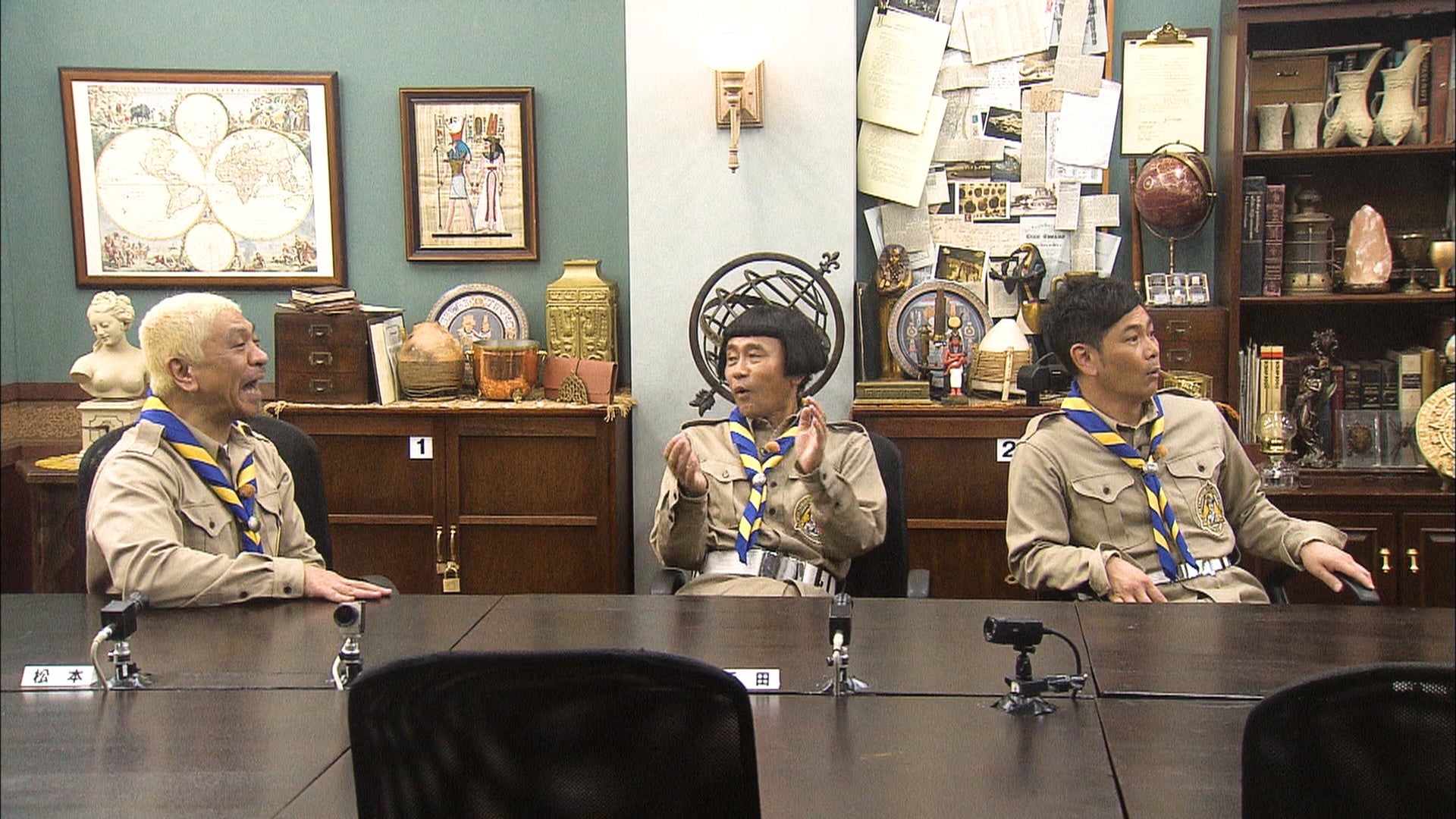
Everything transformed during the summer of 2003. Matsumoto, along with regular cast members Hōsei Tsukitei (then Hōsei Yamasaki) and the double-act Cocorico (Shozo Endo and Naoki Tanaka), lost a high-stakes bowling match against Hamada. Their forfeiture was No-Laughing Hot Spring Inn 一泊二日 (A Two-Day, One-Night Stay at a No-Laughing Hot Spring Inn). Hamada served as the orchestrator, stationing the four men inside a tranquil ryokan where staff, guest performers, and bizarre planted props constantly ambushed them.
The initial stakes were intimate and physical. Whenever a comedian broke character, enforcers shot them in the buttocks with miniature blowdarts. The cruelty lay in the forced domesticity of the setting: quiet tatami rooms, communal onsen baths, and formal dining halls. That silence magnified every suppressed snicker, turning quiet chuckles into agony. Japanese television critics took note immediately; the episode shattered standard variety tropes by replacing rehearsed banter with pure observational panic.
The Architecture of Pain: How Yugawara and New Year's Eve Scaled the Batsu Game
Buoyed by massive ratings, Nippon TV expanded the concept the following year with 2004's No-Laughing in Yugawara. Set in the famous hot spring town in Kanagawa Prefecture, the Yugawara special replaced blowdarts with hard rubber batons and padded bamboo shinai swords to avoid medical complications while amplifying visual impact.
Yugawara also introduced structural routines that defined the series for the next twenty years:
- Fake administrative meetings hosted by deadpan veteran character actors.
- Grotesque physical sight gags staged on moving passenger buses.
- Sudden middle-of-the-night roll-calls with absurd dress codes.
- Psychological betrayal, where participants fed each other setups designed to trigger involuntary laughter.
By December 31, 2006, Nippon TV took a monumental gamble. The network promoted the series into the hyper-competitive New Year’s Eve (Ōmisoka) broadcast corridor, pitting Matsumoto and Hamada directly against NHK's historic music broadcast, Kōhaku Uta Gassen. Moving through fictional high schools, hospitals, spy academies, police precincts, and American frontier towns, the franchise morphed from a niche 50-minute variety stunt into a high-budget, six-hour live-action marathon. For eleven consecutive years through 2020, Gaki no Tsukai captured the highest non-NHK commercial viewership on New Year's Eve, regularly securing national audience shares between 15.3% and 17.7% across the Kanto region.
Evolution of the Format: From Ryokan Torment to Global Rights Deal
The path from a rural ryokan punishment game to an international format licensing pipeline spans over three decades of media restructuring:
| Era & Timeframe | Structural Landmark | Primary Punishment Mechanism |
|---|---|---|
| The Prototype Era(1989, 2002) | Short-form late-night bets between Downtown members settling minor studio games. | Psychological embarrassment, public dressing-down stunts, bizarre solo stays. |
| The Ryokan Inception(2003, 2005) | Debut of *No-Laughing Hot Spring Inn* in Yamanashi and Kanagawa; establishment of core punishment rules. | Suction blowdarts shifting to lightweight padded whippers and plastic batons. |
| The Prime-Time Hegemony(2006, 2020) | Six-hour annual New Year's Eve specials capturing top commercial broadcast ratings in Japan. | Reinforced polyurethane foam batons wielded by anonymous black-clad squad members. |
| The Global Distribution Era(2021, 2026) | Hiatus of original broadcasts; Banijay Entertainment secures worldwide format distribution agreement with Yoshimoto Kogyo. | Standardized, production-friendly physical tap systems tailored to regional compliance. |
Banijay Entertainment and Yoshimoto Kogyo's Worldwide Distribution Push
Banijay Entertainment's formal move to license YOU LAUGH YOU LOSE in 2026 resolves years of intellectual property ambiguity. For two decades, international television producers eyed the Gaki no Tsukai format with intense jealousy. Elements of the show filtered into foreign markets through fragmented channels. Amazon Prime Video’s smash hit Documental, created by Hitoshi Matsumoto himself, took the core "laugh-and-you-are-eliminated" premise and dropped it into a closed-room poker match format, spawning official adaptations across Mexico, Germany, France, and Australia.
Yet the authentic No-Laughing architecture, the unscripted field-trip setting, the escalating gauntlet of outside performers, the sheer terror of hearing one's own name read aloud over a PA system followed by the computerized chime of judgment ("Matsumoto, OUT")-remained trapped inside Japan's domestic broadcasting sphere.
The Banijay partnership alters those mechanics. By controlling the format bible, Banijay can formally pitch the production framework to major American and European networks. Rather than relying on informal imitations or viral online clip shows, commercial buyers now have direct access to Yoshimoto’s decades of accumulated comedic blueprints. This includes set design secrets, bait-and-switch guest pacing, and exact specifications for creating high-stress psychological containment on camera.
Cultural Friction and Adaptation Challenges for Western Networks
Translating a show born in a 2003 hot spring requires overcoming steep production hurdles. Chief among them is the cultural reception of physical punishment on television.
In the original Japanese context, the violence is rooted in classical manzai dynamics, where physical slaps (tsukkomi) function as punctuation marks for verbal absurdities. The participants in Gaki no Tsukai are close collaborators who spent decades together; their visible discomfort operates under mutual consent and profound industry respect. When Western creators attempt physical slapstick without that foundational rapport, the comedy can easily read as grim hazing rather than an affectionate endurance trial.
Furthermore, Western broadcast regulations present legal and ethical parameters that Nippon TV never had to balance. Producers adapting YOU LAUGH YOU LOSE for Anglo-American audiences face strict workplace liability codes regarding physical strikes, requiring modifications to the foam bats, hit zones, and medical oversight.
Then comes the question of comedic silence. American variety television typically fears dead air, filling quiet moments with frantic musical stings and rapid-fire editing cuts. Gaki no Tsukai, conversely, draws its genius from unbearable stretches of absolute quiet. Five minutes of middle-aged men quietly peeling mandarin oranges while waiting for a trap to spring is compelling television only when directors have the patience to let the silence do the work.
Frequently Asked Questions (FAQ)
Q1: Why did the Japanese New Year's Eve specials stop airing after 2020?
A1: Nippon TV officially paused the specials following the 2020 broadcast due to complications from coronavirus filming restrictions, production fatigue after 15 consecutive holiday runs, and shifting domestic guidelines from Japan's Broadcasting Ethics & Program Improvement Organization (BPO) regarding physical punishment on commercial broadcasts.
Q2: Is Banijay's "YOU LAUGH YOU LOSE" the same show as Amazon's "LOL: Last One Laughing"?
A2: No. While both trace their creative origins directly to comedian Hitoshi Matsumoto, *LOL* is a direct adaptation of Matsumoto's *Documental* (a battle-royale contest inside a closed room where comedians eliminate each other). The Banijay-licensed *YOU LAUGH YOU LOSE* is the official format of the *Gaki no Tsukai* series, which features participants acting as passive victims traversing external scenarios packed with hidden traps.
Q3: Did the participants in the original 2003 hot spring special actually get injured?
A3: The blowdarts used during the original 2003 hot spring inn special caused legitimate stinging, minor skin welts, and significant bruising, which led the production crew to abandon blowdarts entirely in subsequent specials in favor of safer, high-impact foam and soft plastic weapons.
The Global Bet on Unfiltered Physical Comedy
Banijay’s worldwide distribution push proves that raw, unscripted human panic remains one of the world's most universal comedic currencies. A format that began as an internal joke inside an old ryokan bathhouse, reliant on small blowdarts and cheap rubber masks, has survived three decades of technological shifts, digital piracy, and corporate consolidation. Whether Western networks retain the slow-burn psychological cruelty of the Japanese originals or adjust the formula for modern prime-time sensibilities, the core engine remains indestructible. Forcing funny people to look directly at the absurd, with their bodies on the line and their dignity stripped away, never requires a translator.