How to Tell If You Have Deme or Okume: The 3-Second Profile Test and Visual Guide
How to Tell If You Have Deme or Okume: The 3-Second Profile Test and Visual Guide
A subtle shift in facial bone structure can change everything about how makeup sits on your skin, how light hits your eyelid crease, and why standard beauty tutorials repeatedly fail. In East Asian aesthetic discourse, the distinction between deme (出目, prominent or protruding eyes) and okume (奥目, deep-set or recessed eyes) has evolved from salon shorthand into a viral diagnostic framework across global social platforms. Identifying which category your features occupy eliminates the frustrating trial-and-error of creasing pigments and misplaced contour lines, particularly as clinical analyses cited by the Vogue Scandinavia Report emphasize how anatomical orbital depth governs both dark circle formation and effective surface treatments.
The architectural contrast between these two classifications boils down to orbital rim placement relative to the eyeball. While Western terminology often splits orbital features into basic deep-set or bulging descriptions, the deme and okume system creates a nuanced continuum rooted in cranial morphology. Understanding where your eyes fall along this axis unlocks precise adjustments for everything from lash curling angles to targeted under-eye concealer application.
📌 Quick Summary:
- The Core Diagnostic: A 3-second profile test using a flat ruler pressed against your brow bone and cheekbone immediately reveals whether your eye protrudes past the plane (deme) or sits back within the socket (okume).
- Anatomical Driver: The biological difference stems from brow ridge projection, orbital floor depth, and maxillary development rather than eyeball size alone.
- Styling Impact: Deme requires light-diffusing matte shadows and downward lash mapping to soften forward projection, while okume demands brightening satins and lifted inner-corner placement to counteract natural orbital hollows.
The Facial Mechanics Behind Eye Socket Depth and Brow Ridge Projection
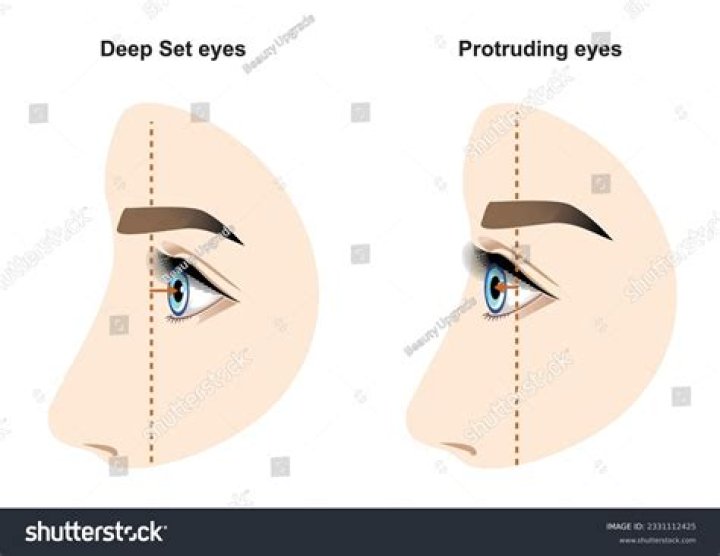
Eyeball volume across adult humans remains remarkably uniform, typically measuring around 24 millimeters in transverse diameter. What makes an eye appear forward-sitting or deeply embedded is the surrounding bone structure. In okume architecture, the supraorbital ridge protrudes forward, creating a prominent brow shelf. Paired with a high nasal bridge and an anteriorly positioned infraorbital rim, the eyeball sits recessed inside the skull cavity. This biological arrangement produces natural hollow eyelids, a pronounced crease depth, and permanent cast shadows underneath the lower lid.
In contrast, deme features an orbital rim that sits flush with or behind the coronal plane of the cornea. The supraorbital brow bone lacks heavy forward projection, and the maxilla below the lower lid offers minimal forward support. The eyeball sits closer to the visual surface of the face. This structural trait causes the upper eyelid to appear smooth, taut, and expansive, while giving the entire eye area a rounded, highly reflective appearance in direct lighting.
These differences explain why certain cosmetic techniques behave inconsistently across faces. When an individual with deep-set okume applies dark brown transition pigment into their natural socket, the shadow sinks into an already light-deprived hollow, producing a sunken, fatigued expression. When someone with prominent deme applies high-shimmer glitter across the center of the mobile lid, the reflective mica catches ambient overhead light, exaggerating the protrusion.
The 3-Second Profile Test and Visual Diagnostics
Confirming your structural eye type requires assessing facial landmarks from the side profile rather than relying on straight-on selfies, which flatten depth through lens compression. The easiest diagnostic requires only a clean, flat straightedge or ruler.
Place the flat side of a ruler vertically against the side of your face, connecting the highest point of your brow bone directly to the most prominent forward curve of your cheekbone. Hold the straightedge gently without depressing the soft tissue.
Observe what makes contact with the edge:
- The Okume Indicator: The ruler rests firmly against both your brow bone and your cheekbone without touching your eyelid or eyelashes. You can blink freely behind the straightedge. A distinct visual gap exists between the ruler and the surface of your closed eyeball. This gap confirms that your ocular globe sits recessed behind the facial skeletal plane.
- The Deme Indicator: The ruler cannot sit flush against both the brow bone and cheekbone simultaneously because your upper eyelid or cornea bumps into the edge first. When you blink, your lashes hit the obstruction. This physical contact indicates that the globe projects beyond the structural perimeter of the orbital rim.
- The Balanced Middle: The ruler gently grazes the eyelid skin right as it makes contact with both bone landmarks. This neutral structural alignment allows for versatile cosmetic handling without heavy corrective counter-shading.
Secondary visual indicators appear in your everyday photographs. Okume eyes frequently cast a soft shadow over the upper lid under overhead office lights, making eyeliner disappear into the fold even when looking straight ahead. Deme eyes present extensive lid exposure, catching crisp ring lights effortlessly, but they struggle with visible lower-lid vascularity due to skin stretching over the forward-sitting globe.
Structural Comparison: Deme vs. Okume Anatomy
The behavioral contrast between these facial structures dictates completely opposing product formulas, tool shapes, and lash geometry.
| Structural Characteristic | Deme (Prominent Eyes) | Okume (Deep-Set Eyes) |
|---|---|---|
| Orbital Rim Relationship | Cornea extends past the anterior orbital plane | Cornea rests posterior to the brow ridge line |
| Natural Shadow Distribution | Diffused light reflection; minimal socket shadowing | Deep anatomical shadows in upper fold and tear trough |
| Mobile Lid Canvas | Broad, visible surface area; minimal hooding | Compressed or hooded visual space; recessed crease |
| Under-Eye Concealer Wear | Prone to creasing along lower bulging fat pads | Casts hard structural shadows requiring color correction |
| Ideal Lash Extension Architecture | J-curl or B-curl, elongated cat-eye maps (8, 11 mm) | C-curl or D-curl, central doll-eye placement (10, 13 mm) |
| Primary Cosmetic Risk | Over-enlarging lids into an inflamed appearance | Deepening hollows into a prematurely aged look |
Corrective Makeup Principles for Deme: Calming Forward Volume
Protruding eyes already capture significant environmental light. Applying standard eye-opening tutorials to deme features leads to an over-widened, startled look. The editorial goal for deme focuses on recessing the forward-projecting center of the lid using light absorption and horizontal elongation.
Matte earth tones are non-negotiable across the central eyelid. Neutral taupes, soft espresso, and cool-toned slates absorb overhead illumination, visually flattening the dome of the eye. Instead of applying light shades over the mobile lid and dark shades in the crease, invert the layout. Apply a mid-tone matte wash across the most projecting curve of the upper lid, buffing it seamlessly toward the lash line.
Eyeliner placement must emphasize horizontal stretch rather than vertical height. Tightline the upper waterline with waterproof gel pencils to anchor the lashes, then draft an elongated wing that extends outward at a low angle from the outer canthus. Avoid thick liquid lines across the center of the pupil, which round an already spherical eye. For lower lids, omit heavy shimmery highlighting under the lash line. Highlighting the lower lid (aegyo-sal) can cause deme structures to resemble puffy under-eye exhaustion rather than youthful definition.
Under-eye concealer application on deme requires caution. When testing more than 75 concealers during comprehensive editorial evaluations, Byrdie confirmed that high-pigment, lightweight liquid formulas consistently outperform heavy cream sticks by preventing midday separation over dynamic lower lid movements. Use a pinpoint brush to deposit coverage strictly within the inner corner vascular hollow, keeping the highest curve of the lower orbital pouch free of excessive layering.
Cosmetic Strategies for Okume: Pulling Recessed Eyes Forward
Deep-set eyes naturally absorb light, turning orbital hollows into prominent structural darkness that mimics severe exhaustion. Heavy smoky eyes or dense black eyeliners compress the socket, driving okume features deeper into the skull. The corrective strategy demands lifting shadows and visually drawing the eyeball forward.
Swap flat, dark pigments for reflective, light-diffusing formulas. Apply satin champagne, ivory, or pale peach across the center of the mobile lid and into the inner third of the eye socket. Keep the deepest transition shades strictly above the orbital bone rather than sinking them into the crease fold. By placing your crease color slightly above your anatomical fold, you draw the visual boundary upward, neutralizing hooded folds.
Eyeliner on deep-set eyes should stay microscopic along the lash bed. A heavy black line consumes the limited visible mobile lid space entirely when looking forward. Rely on fine liquid pens to deposit pigment precisely between the roots of the lashes, lifting the line into a sharp, upward-angled flick only at the extreme outer edge.
Under the eye, okume faces structural shadowing that regular foundation cannot resolve. Because the orbital rim hangs over the lower lid, shadows persist regardless of sleep hygiene. Rather than piling on thick concealer, which cakes inside deep tear troughs, apply a peach or salmon color corrector directly into the trough shadow line. Top it with an illuminating, low-weight liquid concealer set with micro-milled silica powder to bounce light out of the depression.
Eyelash Extension Styling and Brow Adjustments for Both Types
Lash and brow geometry dictates how observers perceive the depth of your eyes. A miscalculated lash curl can bump awkwardly against a brow bone or make a prominent eye look startled.
For okume clients, the lash industry has seen massive adjustments. While classic extension studios frequently placed short, heavy clusters on deep-set eyes, recent economic and beauty shifts noted by InStyle highlight a widespread transition away from costly salon fills toward customizable magnetic lash strips and targeted cluster segments. For recessed okume sockets, strong curls like D-curl or L-curl are essential. The base of an L-curl extends horizontally forward out from under the heavy brow shelf before curling upward, clearing the hooded orbital overhang and preventing lashes from brushing against eyelid skin. Concentrate length (between 11 and 13 millimeters) at the center of the lash line directly above the iris to pull the eye forward visually.
Deme clients require the exact opposite approach. Dramatic D-curls on prominent eyes curve back into the eyeball, making the globe look rounder and exaggerated. Deme eyes look best in B-curl or J-curl styles that mimic natural hair growth patterns. Use an elongated cat-eye mapping layout, beginning with short 8-millimeter lengths on the inner half and tapering out to 10 or 11 millimeters at the outer corner. This pulls the visual focus outward, flattening the sphere into an elegant almond shape.
Brow positioning completes the optical illusion:
- Maintain a moderately groomed, clean arch. Keep the underside of the brow ridge clear of stray hairs to expand the visual vertical distance between the eyeball and the brow bone.
- A straighter, slightly fuller brow creates a horizontal frame above the eye, counteracting the natural vertical height of a protruding eyeball and grounding the entire upper face.
Frequently Asked Questions (FAQ)
Can your eye shape shift between deme and okume over time?
Yes. While your underlying facial bone structure remains fixed once adult cranial growth concludes, age-related fat redistribution significantly impacts socket appearance. Aging causes the retro-orbicularis oculi fat (ROOF) pad and orbital fat to atrophy, which can transform a youthful, neutral eye shape into an okume-like hollow socket. Conversely, thyroid conditions or chronic tissue inflammation can push the globe forward, temporarily creating deme characteristics.
Which eye shape is considered more aesthetically desirable?
Neither shape is universally preferred; beauty standards treat them differently across regions. Classical Western fashion photography has historically favored deep-set okume eyes for dramatic editorial contouring and high-fashion intensity. Conversely, East Asian pop culture and youth-oriented trends frequently celebrate deme eyes for their expressive, bright, and alert appearance on camera.
Why does regular mascara always smudge under my deep-set okume eyes?
Because deep-set sockets press the lower orbital skin closer to the tips of downward-facing lashes during blinks, mechanical friction continuously rubs natural skin oils against pigment. Switch to a tubing mascara containing polymers that dry into water-resistant sleeves around each lash, rather than wax-based formulas that melt upon contact with skin sebum.
Diagnostic Precision Over Generic Beauty Standards
Attempting to force an okume eye into makeup routines designed for a prominent deme lid guarantees frustrating results. Eye makeup is an exercise in structural light manipulation. When you stop fighting the underlying relationship between your orbital rim and your eyeball, cosmetic application transforms from a guessing game into a predictable technical skill.
Take three seconds with a flat ruler in your bathroom mirror. Identify where your brow bone and cheekbone position your eyes relative to the rest of your skull. Armed with that structural baseline, select the specific matte washes, targeted concealers, and tailored lash curvatures engineered for your precise anatomical profile.