Inside Cainz Pet's One: Documenting the Welfare Practices and Adoption Lifelines for Older Animals
Walk into almost any of Japan’s massive suburban home centers on a Saturday morning, and the glass display cases inside Cainz Pet's One pull immediate crowds. Shoppers push flatbed lumber carts past illuminated enclosures housing eight-week-old Toy Poodles, French Bulldogs, and Scottish Folds. Yet behind the visual appeal of these retail displays lies an uncomfortable question that millions of Japanese internet users search each year: What actually happens when a puppy or kitten does not sell before outgrowing its glass cubicle?
Public curiosity over the unsold pet lifecycle inside big-box chains has historically fueled rumors of covert disposal, breeder buy-backs, or quiet euthanasia. At Cainz, Japan’s dominant home improvement chain operating over 230 branches nationwide, that scrutiny has accelerated a visible operational shift. Under mounting public pressure and tighter regulatory oversight, the retailer has modified its older animal placement routines while turning its retail footprint into a venue for municipal animal shelter partnerships. According to an official municipal dispatch detailed in a PR TIMES Report, regional branches are now handing commercial floor space over to licensed rescue networks to bridge the gap between commercial sales and shelter rehoming.
📌 Key Takeaways:
- Retail Lifecycles: Cainz Pet's One operates a stepped-down pricing and transfer system for maturing animals rather than surrendering them to public cull facilities.
- Shelter Integration: High-traffic stores in Tokyo, Saitama, and Tottori now host recurring in-store pet adoption drives organized alongside public health centers and local volunteer groups.
- Legal Pressures: Revisions to Japan's animal protection laws have virtually eliminated the historic practice of returning unsold pets to commercial puppy mills.
The Glass-Case Dilemma in Japanese Big-Box Retail
Japan remains one of the few developed economies where purebred puppies and kittens are routinely purchased inside shopping centers rather than through direct breeder vetting or rescue organizations. Cainz Pet's One operates as an integrated commercial department within Cainz Home stores, running retail pet sales alongside grooming salons, veterinary clinics, and pet supply aisles.
The core tension stems from consumer buying habits. In Japan, retail demand peaks when animals are between 8 and 12 weeks old. Once an animal reaches four to five months of age, its commercial marketability drops precipitously. Customers looking for manageable apartment companions gravitate toward tiny infants. As an animal grows, its food costs climb, its exercise requirements expand, and its presence in a display pen creates an awkward visual for customers aware of the ticking biological clock.
For decades, the Japanese pet industry had a grim reputation regarding animals that aged out of display cases. Before legislative reforms took effect, commercial brokers routinely returned older animals to auction houses, transferred them to unregulated holding facilities, or offloaded them to municipal pounds. The phrase ka-inzu ho-mu petto urenokori (Cainz Home unsold pets) remains a fixture on Japanese search engines precisely because consumers suspect those practices continue behind closed stockroom doors.
How Maturing Animals Move Through the Pet's One System
Inside modern Cainz branches, the trajectory of a four-to-six-month-old animal follows a structured corporate protocol driven by pricing tiers and inter-branch transfers rather than abandonment.
When an animal crosses the three-month mark without finding a buyer, Pet's One stores typically initiate markdown protocols. Display tags reflect successive price cuts designed to offset the buyer's impending veterinary and spay/neuter expenses. In retail terminology, these are classified as clearance or long-stay animals (chōkizai).
Stage 1 (8, 12 Weeks): Standard Retail Display -> High-Traffic Floor Placement
Stage 2 (3, 5 Months): Stepped-Down Pricing -> Move to Larger Enclosures or Playpens
Stage 3 (6+ Months): Deep Discount / Staff Placement -> Transfer to Flagship Adoption Branches
If an animal reaches six months without an inquiry, several non-lethal pathways take over:
- Relocation to Flagship Facilities: Smaller satellite branches transfer adolescent animals to larger suburban stores with dedicated indoor dog runs and multi-tier enclosures.
- Employee and Network Adoption: Branch staff, veterinary nurses, and pre-screened regular customers frequently adopt long-stay animals at nominal transfer fees that simply cover mandatory microchipping, rabies vaccinations, and initial deworming.
- Breeder Contract Restrictions: Commercial contracts under Cainz's supply network prohibit simply dumping mature animals back into high-volume breeding pools. Returning an animal to an auction pipeline carries strict contractual penalties and reputational risk under current corporate social responsibility mandates.
While this system prevents direct abandonment, critics note that keeping an energetic adolescent dog inside a commercial retail environment for five months poses socialization risks. That operational friction led Cainz to begin testing direct collaborations with external animal welfare organizations.
Retail Footprints as Adoption Hubs: The 2026 Municipal Expansions
Rather than keeping commercial sales sealed off from the stray and shelter population, Cainz has increasingly opened its retail floors to civic rescue groups. The company uses its proprietary Kumimachi community space, designated event zones inside newer-format superstores, to host rescue dog and cat adoption events.
Municipal animal shelters in Japan have historically suffered from poor accessibility. Located in industrial zones or mountain outskirts, municipal health centers (hokenjo) draw minimal foot traffic. By moving adoption drives directly into high-traffic home centers, rescue operations gain immediate access to thousands of everyday pet owners who are already buying kibble, leashes, and crates.
| Location / Branch | Partner Organizations | Event Format & Schedule | Core Welfare Objective |
|---|---|---|---|
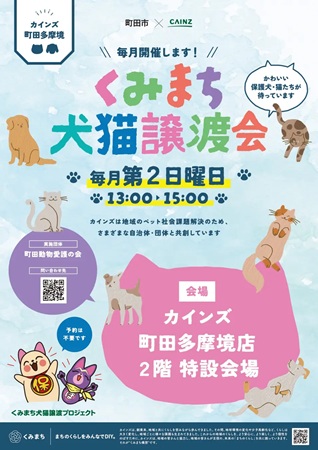
| Cainz Machida Tamasakai (Tokyo) | Machida Animal Welfare Association & Machida City Public Health Center | Monthly recurring drive (Every 2nd Sunday, 1:00 PM, 3:00 PM) | Rescue dog and cat matching; education on lifelong pet ownership |
| Cainz Yoshikawa Minami (Saitama) | Saitama Prefectural Government & Registered Welfare Groups | Kumimachi Community Space (Bi-monthly / seasonal dates) | Shelter cat rehoming; lowering municipal shelter surrender rates |
| Cainz Tottori (Tottori) | Tottori City Living Environment Division & Regional Volunteers | Civic-commercial pop-up shelter days | Expanding adoption visibility outside isolated municipal wards |
In western Tokyo, the collaboration between the Machida Animal Welfare Association, the city health department, and Cainz Machida Tamasakai established a permanent monthly cadence. Instead of treating rescue drives as one-off charity days, the store integrated them into its standard weekend retail schedule. A similar framework in Saitama Prefecture utilizes the second-floor Kumimachi community space at Cainz Yoshikawa Minami, creating a clean, climate-controlled venue where prospective owners interact with rescue cats outside institutional cage environments.
Stricter Regulations Reshaping Home Center Inventories
These retail adoption partnerships are not merely public relations campaigns. They reflect concrete compliance pressures stemming from recent amendments to Japan’s Act on Welfare and Management of Animals.
The regulatory landscape governing pet shops changed dramatically following successive phases of legal enforcement:
- All commercial dogs and cats must be microchipped and registered in a national database before sale, creating a digital paper trail that links every animal back to its registered wholesale supplier and corporate vendor.
- Numeric Cage and Staffing Standards: Retailers and commercial breeders must meet explicit cage dimensions and caregiver-to-animal ratios. Cramming older, larger puppies into infant display cages now triggers direct administrative inspections.
- Breeding Age Caps and Litter Restrictions: Female breeding dogs are restricted to a maximum age (typically six years) and lifetime litter limits, choking off the historical oversupply of cheap purebred litters that flooded big-box chains.
- Local public health centers gained legal authority to reject animal drop-offs from commercial businesses. A retail pet chain can no longer simply haul unsold animals to the local pound when floor space runs out.
These legal guardrails made holding unsold inventory expensive. When an animal cannot be legally abandoned and keeping it past six months consumes valuable floor space under strict cage-size rules, home improvement chains must adapt. Cainz’s response has focused on adjusting initial intake volumes, working with fewer regional breeders, and actively demonstrating animal welfare compliance to an increasingly skeptical consumer base.
The Dual Realities of Pet's One
Despite progress in shelter partnerships, the coexistence of retail puppy sales and nonprofit rescue drives under the same roof highlights an ongoing industry contradiction.
On the first floor, a family can purchase an eight-week-old pedigree Toy Poodle for ¥350,000 on an impulse finance plan. On the second floor, volunteer groups conduct rigorous home visits, income checks, and trial periods before releasing a mixed-breed rescue cat for a nominal vaccination fee.
Welfare advocates point out that as long as glass-case sales continue, the supply pipeline will inevitably generate animals that fall out of the high-value commercial window. Yet volunteers working with groups like the Machida Animal Welfare Association acknowledge that Cainz provides an audience they could never reach independently. Suburban families shopping for hardware, potting soil, or groceries walk directly past adoption booths. That incidental foot traffic converts casual browsers into rescue adopters, effectively leveraging commercial infrastructure to find homes for older animals.
Frequently Asked Questions
What happens to puppies and kittens at Cainz Pet's One if they do not sell?
They do not go to municipal cull facilities. Older animals follow a marked-down pricing scale, are moved to larger exercise-friendly enclosures, or transfer to regional flagship stores. Many are adopted by retail store employees, veterinary staff, or prescreened local customers at minimal fees covering medical care.
Can customers negotiate the price of an older animal at Cainz?
Store managers adjust prices based on age, time spent on the sales floor, and veterinary requirements. These price reductions appear directly on enclosure labels as standard markdowns rather than informal negotiations, ensuring transparency across branch audits.
How do the in-store rescue adoption events work alongside commercial sales?
External nonprofit groups and municipal animal services use designated store zones, such as the Kumimachi community spaces, to hold adoption events. These events operate independently from retail sales: volunteer groups set their own screening criteria, post-adoption home checks, and transfer contracts.
The Path Forward for Big-Box Pet Retail
The presence of aging animals in Japan's commercial pet corners is shifting from a hidden liability to an open operational challenge. Cainz’s strategy, combining systematic price-tier transfers with municipal rescue drives in high-traffic stores, marks a clear departure from the opaque pet retail practices of previous decades.
As regulatory oversight tightens and consumer attitudes toward pet acquisition evolve, the line between traditional retail pet stores and community adoption centers continues to blur. The test for Cainz Pet's One over the coming years is whether its community adoption model will remain a secondary initiative, or eventually replace the glass display case entirely.