Is It Truly Profitable? The Business Economics Behind Nakama's Karaage Stuffing Trend
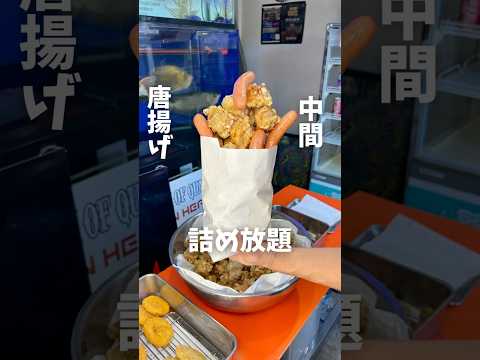
In Nakama City, Fukuoka Prefecture, a quiet industrial corner has turned into an arena for high-stakes fried chicken architecture. Hungry patrons queue outside JUJU no Karamori, an unassuming storefront operating within the meat distribution hub CARNI CERIA in Iwase. Armed with tongs and plastic bags, customers pile piece after piece of double-fried poultry into precarious, golden pyramids. The shop charges a flat rate, ¥1,000 for a small bag and ¥1,600 for a large bag, with zero time limits. As captured in an on-site YouTube (まさきグルメ) Report, elite contenders have pushed this offer to staggering extremes, walking out with an astonishing 2.3 kilograms of karaage in a single haul.
Spectacles like this raise an immediate operational question: how does a small bento shop avoid financial ruin when customers routinely walk away with enough protein to feed an entire household for three days? The answers lie within meat wholesale procurement, portion physics, and the calculated financial mechanics of Japanese retail promotions.
📌 Key Takeaways:
- The Yield Threshold: An average customer bags roughly 800 to 1,100 grams of chicken, allowing the shop to protect modest wholesale margins despite occasional extreme hauls.
- The Upstream Advantage: Operating directly inside meat company CARNI CERIA slashes intermediate distribution markups that strangle conventional bento shops.
- The Foot-Traffic Funnel: Limited operational days and high retail visibility turn the karaage stuffing challenge into a customer-acquisition vehicle for higher-margin sides and bento boxes.
The Viral Rise of JUJU no Karamori and the 2.3-Kilogram Record
JUJU no Karamori operates out of 3-23 Iwase in Nakama City. Unlike urban takeout counters wedged into high-rent train station concourses, the venue sits on wholesale processing grounds. The premise of their promotion is disarmingly simple: purchase a plastic bag, stand at the staging counter, and pack as many freshly fried soy-and-garlic chicken thighs as gravity allows. The house rules impose no ticking clock. As documented by regional food creator Yun Kitakyushu/Fukuoka Gourmet, shoppers can adjust, tuck, and reinforce their haul until the structural integrity of the plastic gives out.
The system gained widespread traction after video logs revealed customers hauling away over two kilograms of karaage for a single ¥1,000 note. Standard Japanese supermarket deli counters sell prepared karaage for ¥220 to ¥300 per 100 grams. At that benchmark, a 2.3-kilogram haul carries a conventional retail value between ¥5,000 and ¥6,900. Seeing a retail customer walk away with a 500 percent discount on retail equivalence sparked immediate debate over whether the owners were running a sustainable promotion or bleeding capital for temporary internet clout.
How Bento Operators Protect Margins on Unlimited Stuffing
Bento shop profit margins in Japan typically hover between 5% and 8%, with wholesale raw poultry driving the bulk of direct food costs. For an independent restaurant buying through multiple middle-tier distributors, raw boneless chicken thigh (*torimomo*) runs roughly ¥80 to ¥110 per 100 grams. If JUJU no Karamori bought chicken through standard retail-adjacent channels, a 2.3-kilogram haul would yield an immediate raw-material loss before accounting for cooking oil, potato starch batter, seasoning sauces, and staff wages.
The shop avoids this trap by operating directly within CARNI CERIA Co., Ltd. By bypassing regional wholesale agents and secondary distributors, the kitchen secures bulk commercial imports or domestic cuts at primary processing rates, which routinely dip below ¥50 to ¥65 per 100 grams. Furthermore, karaage weight changes during preparation. Breading absorbs marinades, oil, and moisture during the frying cycle. A finished piece of karaage consists of roughly 15% to 25% starch coating and absorbed liquids. The customer is not packing 100% pure imported meat; they are packing an engineered combination of protein, seasoned starch, and fry oil.
The Physics Behind the Bag Stacking Technique
Securing a massive yield requires a deliberate mechanical strategy. Diners who casually drop chicken pieces into the bag hit maximum capacity around 700 grams, as awkward air pockets consume valuable interior volume. Veteran stuffing challengers approach the counter with precise architectural methods.
The process starts by firmly stretching the plastic film without creating micro-tears along the bottom seam. Challengers drop smaller, angular chunks into the base to eliminate dead space, creating a dense foundation. Once the bag fills to the rim, the game shifts to cantilever physics. Contestants position flat pieces across the top edge like floorboards, then stack additional nuggets in inward-leaning tiers. Friction from the starchy coating keeps the tower from sliding apart. Because the shop imposes no time limit, successful customers can spend five to ten minutes fine-tuning the balance, turning a ¥1,000 investment into a towering display of culinary geometry.

Nakama City’s Deep-Fried Subculture from Torihanatei to CARNI CERIA
The viral phenomenon at CARNI CERIA did not appear in a vacuum. Nakama City holds a longstanding tradition of communal fried chicken challenges. As early as February 2017, local yakitori operator Yakitori Torihana offered a similar lunch service at Torihanatei, inviting diners to pack their proprietary "Nakappa karaage", a local specialty named after the city's mythological river sprite mascot, into takeout vessels.
That early Torihanatei initiative established Nakama as an epicenter for competitive, budget-friendly fried food promotions. Where standard restaurants view food challenges as rare marketing stunts, operators in Nakama treat *tsumehoudai* (all-you-can-stuff) as an accepted regional format. CARNI CERIA modernized that lineage by matching it to digital creator culture, turning an existing local foodway into an algorithm-friendly attraction.
Unit Economics: Customer Yield Versus Kitchen Cost
To understand why this model functions sustainably over hundreds of transactions, look at the distribution curve. The 2.3-kilogram record represents an outlier. Most customers do not possess the finger dexterity, patience, or willingness to construct a poultry skyscraper in front of a line of waiting patrons.
| Customer Category | Average Weight (g) | Estimated Food Cost (¥) | Gross Margin on ¥1,000 Fee |
|---|---|---|---|
| Casual Diner (No Stacking) | 600, 750 | ¥330, ¥410 | +59% to +67% |
| Informed Challenger (Basic Tiers) | 900, 1,200 | ¥495, ¥660 | +34% to +50% |
| Trained Expert (Tower Build) | 1,500, 1,800 | ¥825, ¥990 | +1% to +17% |
| Record Haul (Masaki Gourmet) | 2,300 | ¥1,265 | -26% (Calculated Loss) |
The numbers clarify why the promotion works. For every competitive eater who walks out with 2.3 kilograms and hands the shop an estimated ¥265 gross loss, dozens of everyday patrons pack 700 to 900 grams, netting the counter 40% to 60% gross returns. The bell curve stays firmly weighted on the side of the house.
Operational Safeguards That Keep the Fryers Running
Direct product margins only tell half the story. The store guards against burnout through precise operational constraints. The business does not run seven days a week. Instead, it closes every Wednesday, Sunday, and national holiday. By eliminating weekend overhead and high-penalty wage shifts, management keeps labor expenses lean.
Secondly, the stuffing station functions as a classic loss-leader. Customers arriving for cheap fried chicken rarely walk away with empty hands otherwise. They add steamed rice, dipping sauces, and pre-packed specialty bento meals, items carrying much higher gross profit percentages. The resulting marketing exposure eliminates promotional ad spending entirely. Independent video channels, Instagram reviewers, and regional food bloggers deliver consistent foot traffic, replacing conventional marketing budgets with organic social buzz.
Frequently Asked Questions (FAQ)
Q1: What are the exact hours and operating rules at JUJU no Karamori?
The shop operates out of CARNI CERIA Co., Ltd. at 3-23 Iwase, Nakama City, Fukuoka. It is closed on Wednesdays, Sundays, and public holidays. Diners choose between a small bag (¥1,000) and a large bag (¥1,600). The challenge has no formal time limit, but pieces that fall off during transport before completing checkout cannot be retrieved.
Q2: Is the karaage made from domestic Japanese chicken or imported poultry?
Like most high-volume budget bento counters across Japan, the core production relies on inspected commercial cuts sourced through commercial processing networks. This setup enables CARNI CERIA to maintain pricing that insulated urban delis cannot match.
Q3: Can anyone realistically hit the 2.3-kilogram threshold?
Reaching 2.3 kilograms requires exceptional technique, precise piece selection, and structural patience. First-time visitors generally plateau between 800 and 1,100 grams, which still yields roughly double the chicken compared to purchasing from a typical supermarket hot-food counter.
The Pragmatic Reality of Fukuoka’s Budget Food Culture
Nakama’s viral karaage challenge demonstrates the ingenuity of independent regional retail. Far from reckless financial gambling, the offer relies on supply-chain integration, calculated consumer averages, and high-yield foot traffic. Even as the 2.3-kilogram record holder leaves with an unbeatable bargain, the shop's fryers keep humming, backed by smart commercial arithmetic that keeps the business firmly in the black.