Spotting the Texture: Visual and Physical Clues That Separate Mortar From Concrete
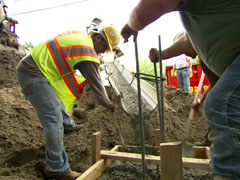
Walk into an unfinished industrial loft or browse an architectural catalog, and the gray masonry surfaces all begin to blur together. Muted mineral planes dominate contemporary residential design, celebrated for their raw, unfinished surfaces and intentional imperfections. Yet beneath those minimalist surfaces lies an enduring confusion between three related materials: cement, mortar, and concrete. As documented in an ITmedia Report analyzing a classic educational segment from PBS's This Old House, even seasoned renovators routinely confuse the trio, treating distinct structural composites as interchangeable paste.
Cement is simply the dry binding powder. The real functional and visual divide emerges when water and rocks enter the equation. Telling mortar from concrete is not merely an academic exercise for architects; it determines whether a wall can support a second story, whether tuckpointing holds through winter, or whether an interior feature wall cracks within six months of installation.
📌 Key Takeaways:
- The Core Recipe: Mortar combines Portland cement, lime, and fine aggregate (sand), while concrete adds coarse aggregate (gravel or crushed stone) to achieve high structural load-bearing capacity.
- Visual Signatures: Concrete surfaces reveal multi-toned, speckled cross-sections and scattered pinhole voids; mortar cures into a dense, sandy, monochrome paste without exposed rock chips.
- Application Boundaries: Concrete is formulated to hold compression loads across heavy slab foundations, whereas mortar functions primarily as a masonry bonding agent for bricklaying and jointing.
Why Construction Mix-Ups Spark Disputes and Costly Redos
In Japan, municipal arbitration boards and online legal consultancies like Bengo4.com regularly log disputes between property owners and general contractors over ambiguous contract language regarding concrete and mortar. Homeowners paying for reinforced retaining walls or slab floor work often discover that a contractor substituted mortar-rich top layers or misclassified structural specifications under the Japanese Building Standards Act. In the United States, structural failures traced back to incorrect mix designs prompt costly insurance claims every year.
The confusion stems from wet application. Freshly mixed batches of both materials look like thick, viscous gray mud. When wet concrete is troweled across a form, the aggregate sinks slightly, leaving a slurry on the surface that looks almost identical to pure mortar. Once the curing process runs its course, however, the internal physics take over. When structural integrity fails under load, or when exterior freeze-thaw cycles pop brittle seams, the composition of the mix becomes an expensive point of contention.
The Aggregate Rule: Sand Versus Crushed Stone Under the Magnifier
The simplest way to distinguish mortar from concrete is through aggregate size. Every cementitious blend relies on a glue, almost universally Portland cement, activated by water. What separates mortar from concrete is the aggregate mixed into that paste.
Mortar relies entirely on fine aggregate, almost exclusively clean mason’s sand. Grains typically measure under 4.75 millimeters across. When mixed with hydrated lime and cement, this fine sand creates a smooth, spreadable consistency comparable to heavy peanut butter. It is designed to squeeze into tight spaces, adhere to clay bricks or concrete blocks, and seal gaps against draft and rain.
Concrete introduces coarse aggregate into that same matrix. River gravel, crushed granite, or limestone chips ranging from 10 millimeters to over 25 millimeters make up the bulk of the volume. In a standard concrete mix, coarse stone accounts for roughly 40% to 50% of the total mass, with fine sand filling the interstitial spaces between the rocks. Under a pocket loupe or upon breaking a cured sample, concrete resembles a rough mosaic of distinct, angular stones encased in a hardened cement shell. Mortar looks like compressed sandstone with a uniform, micro-granular surface.
Mechanical Muscle: Comparing Load Capacity and Flexibility
Mixing gravel into cement paste changes its mechanical behavior. Concrete is an engineering heavyweight engineered for compressive strength. It routinely withstands 3,000 to 5,000 pounds per square inch (PSI), with specialized commercial mixes climbing above 10,000 PSI. Its sole weakness is tensile strength, the ability to resist pulling or bending forces, which builders offset by casting concrete around steel rebar during slab foundation pouring.
| Property / Metric | Structural Concrete | Masonry Mortar |
|---|---|---|
| Aggregate Composition | Coarse aggregate (gravel/crushed stone) + fine sand | Fine aggregate (sand) exclusively |
| Typical Compressive Strength | 3,000, 5,000+ PSI (20, 35+ MPa) | 750, 2,500 PSI (5, 17 MPa) depending on type |
| Target Consistency | Pourable to stiff slump; packed into forms | Trowel-adherent paste; holds its shape vertical |
| Primary Purpose | Columns, driveways, footings, structural floors | Bonding masonry units, joint fills, wall renderings |
| Curing Vulnerability | Requires deep hydration retention to prevent thermal cracking | Vulnerable to rapid moisture loss into dry brick units |
Mortar sacrifices raw load capacity for workability, adhesion, and controlled yield. In bricklaying and tuckpointing, mortar acts as a sacrificial cushion. If a masonry wall shifts as its foundation settles, the stress cracks should fracture the easily replaced mortar joints rather than shattering the expensive, face-fired bricks. Mortar rarely exceeds 2,500 PSI; using an overly hard mix can cause bricks to spall and flake under environmental temperature swings.
Surface Tell-Tales: Identifying Mixes on Finished Architectural Walls
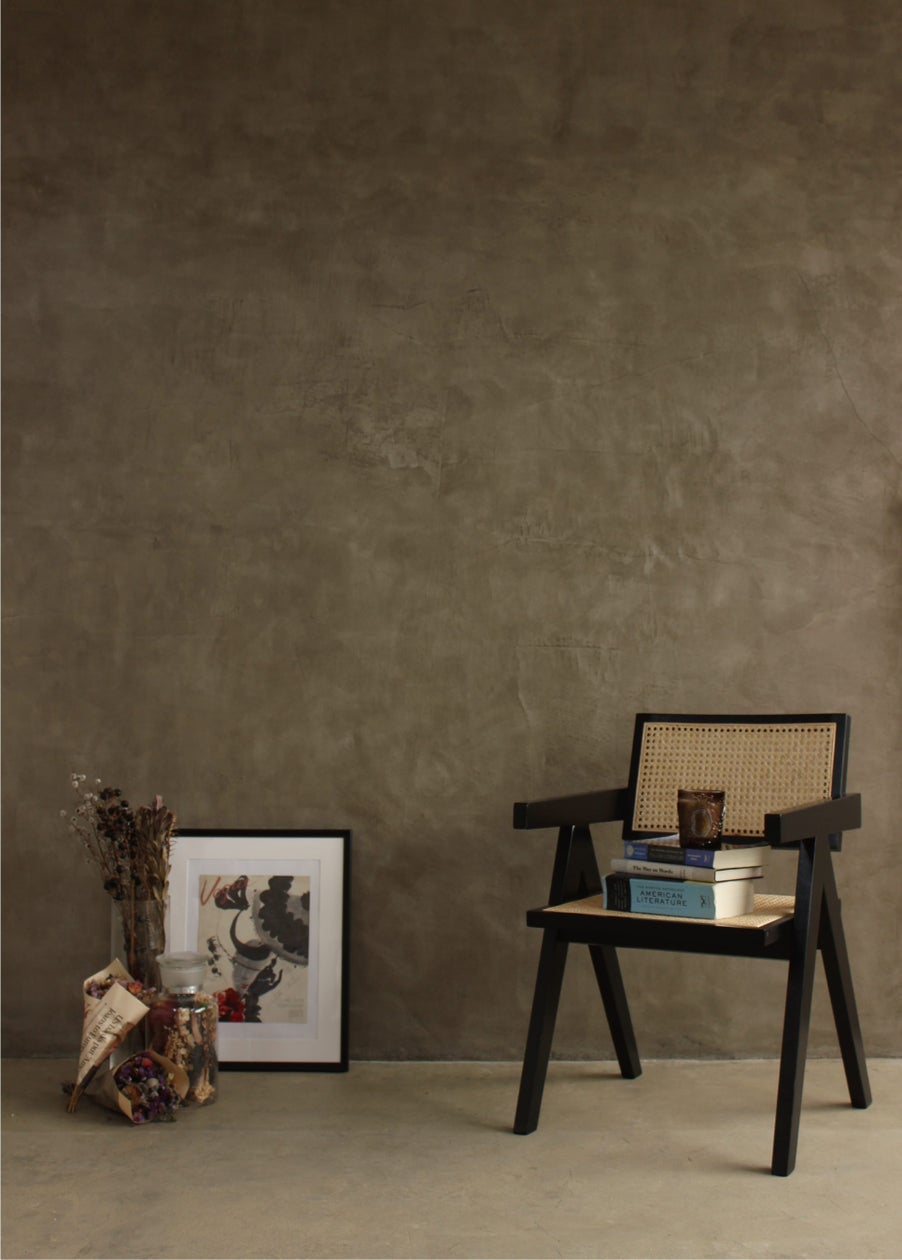
As industrial aesthetics have matured, architects increasingly leave raw mineral walls exposed in living rooms, galleries, and retail showrooms. Japanese building material firms have leaned heavily into this trend. In late 2024, Japanese coatings manufacturer Porter's Paints introduced transparent protective finishes designed specifically to preserve the raw, unadorned character of concrete and mortar walls indoors. These clear seals amplify surface variations, highlighting how differently the two materials age.
A poured architectural concrete wall shows evidence of formwork. Look for horizontal seam lines left by plywood forms or circular tie-rod holes plugged with round caps. Concrete surfaces also feature "bug holes", tiny entrapped air bubbles that could not escape against the form wall during placement. When cut or ground flat, polished concrete reveals random cross-sections of aggregate stones, creating a salt-and-pepper or terrazzo effect.
Mortar installations appear uniformly fine-grained. Applied with hand trowels as a skim coat, microcement, or stucco render, mortar lacks the heavy gravel necessary to produce stone cross-sections. Instead, you see smooth, sweeping trowel sweeps, subtle color variations from curing humidity, and microscopic shrinkage spider-webs. Mortar finishes feel velvety or sandy to the touch; ground concrete feels like chilled, polished stone punctuated by visible rock boundaries.
From Bricklaying to Slab Foundations: Where Each Mix Belongs
Selecting the correct material comes down to the mechanics of the task. Builders never use mortar to cast a self-supporting slab or driveway. Without coarse stone to distribute compressive stress, a 4-inch-thick patio poured entirely from mortar will crack under the weight of a passenger vehicle or garden furniture. The gravel and sand ratio in concrete creates internal arches of stone-on-stone contact, locking the structure against downward thrust.
Conversely, concrete is useless between courses of brick. Shoveling coarse river gravel into a half-inch bed joint prevents the mason from seating the brick flush. The heavy rocks hold the masonry units unevenly, creating uneven pressure points that snap bricks during minor thermal shifts. Mortar's lime content retains water long enough for the mason to reposition units before suction pulls moisture out of the paste, ensuring a continuous seal across every joint.
Managing the water-to-cement ratio is equally critical for both materials. Adding excess water makes mortar easier to trowel and makes concrete easier to pour, but that convenience carries a steep penalty. When excess water evaporates during the curing process, it leaves behind an internal network of microscopic capillaries. In concrete, these pores reduce compressive strength and allow road salt to corrode interior rebar. In mortar, high water content causes deep shrinkage cracks, weakening the bond between joint and brick.
Frequently Asked Questions (FAQ)
Can I use mortar mix to repair a cracked concrete driveway?
Mortar will bond temporarily, but it lacks the coarse rock required to handle wheel loads. Thin mortar patches applied to driveways routinely delaminate or crumble into sand within a year under traffic and winter freeze-thaw cycles. Structural concrete repairs require a concrete patching mix formulated with aggregate or specialized polymer-modified repair mortars.
Why is decorative micro-mortar more expensive than standard concrete?
While concrete relies on cheap gravel and bulk Portland cement, decorative interior mortars (microcements) are engineered polymer-modified systems. They incorporate fine graded quartz sands, acrylic resins, and elasticity additives that allow them to adhere to vertical surfaces at a thickness of just a few millimeters without cracking.
Does mortar dry faster than concrete?
Mortar loses its workability faster because dry brick units pull water directly from the mix, but neither material technically "dries." Both cure through hydration, a chemical reaction between water molecules and cement compounds. Concrete requires damp curing for up to 28 days to reach its full structural design strength, while mortar stabilizes within several days.
Reading the Built Environment with Precision
Deciphering the difference between concrete and mortar sharpens your eye for the built world. The next time you step onto a brushed patio, run your fingers over an exposed loft pillar, or observe a brick facade undergoing tuckpointing, look past the generic gray color. Check for the presence of heavy gravel, scan the joint depth, and inspect the surface for aggregate patterns. These small physical clues reveal the underlying balance of flexibility, load-bearing power, and craft that keeps our architecture standing.