The 2026 Resurgence of Mix Maki: How J-Beauty Aesthetics Captured Global Feeds

Across TikTok, Instagram, and specialized salon forums throughout early 2026, a specific phrase has dominated hair-styling feeds: mix maki (ミックス巻き). After years dominated by uniform heatless-robe curls and hyper-polished, heavy blowouts, global consumers are actively rejecting stiff, monolithic hair. Instead, millions are turning their hot tools sideways, adopting a vintage Tokyo salon staple that pairs alternating inward and outward spirals to build effortless, buoyant dimension. The Japanese cultural pipeline has spent decades exporting distinctive visual languages to Western consumers, a phenomenon cataloged across media history in archives like the Wikipedia (en) Report, and today, Tokyo's micro-technical salon rituals are steering mainstream international beauty standards.
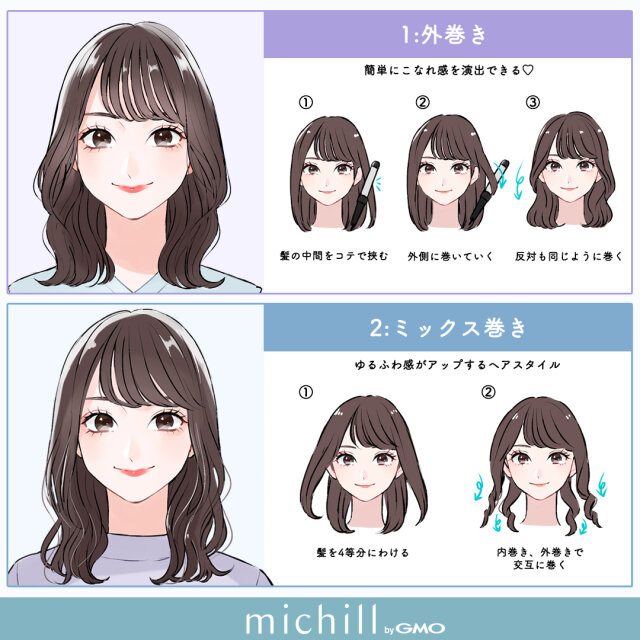
What makes this movement compelling is not simply aesthetic nostalgia, but structural engineering. Western curling tutorials have historically favored wrapping entire heads of hair away from the face in uniform ribbons. The resulting curls clump together into thick, static cylinders within two hours of application. In contrast, the mix maki technique deliberately breaks uniformity, setting opposing rotational forces against one another so individual strands bump, float, and maintain structural lift throughout the day.
📌 Key Takeaways:
- The Core Technique: Mix maki alternates forward inward curls (uchi-maki) and reverse outward curls (soto-maki) on vertical sections to prevent hair clumps.
- The 2026 Shift: Digital audiences have pivoted away from uniform Dyson wraps toward layered, airy volume that mimics organic hair texture and movement.
- The Essential Hardware: Success relies on matching curling iron barrel size to hair length, specifically 32mm for mid-length cuts and 38mm for long layers, finished with micro-dosed botanical styling oils.
The Omotesando Blueprint Behind the Viral Resurgence
The viral eruption of mix maki across international feeds traces directly back to the hyper-competitive salon districts of Omotesando, Harajuku, and Daikanyama. For more than two decades, Japanese master stylists developed styling protocols tailored to straight, dense, coarse hair types that resisted curling. While soft Western hair textures often hold shape with minimal tension, East Asian hair requires meticulous heat distribution and directional opposition to achieve natural hair volume.
During late 2024 and 2025, American and European beauty creators began documenting their experiences in Tokyo salons, exposing Western audiences to the precision of Japanese sectioning. The realization hit fast: those voluminous, airy curls seen on J-pop icons and street-style models were not digital filters or genetic miracles. They were the result of deliberate mechanical opposition.
The aesthetic philosophy differs fundamentally from American curling trends. In Western styling, heat tools create defined ribbon shapes that are subsequently brushed into a singular wave pattern. Tokyo salon techniques prioritize negative space. By winding one section inward toward the chin and the adjacent section outward toward the ear, the curls bounce against each other rather than nestling together. The hair occupies more physical volume in space without needing tease combs, backcombing powders, or suffocating lacquers.
Deconstructing the Mechanics of Inward and Outward Sectioning
Executing an authentic mix maki pattern requires clean geometry before the hot tool ever touches a strand. Stylists divide the hair horizontally into at least two tiers, upper and lower, and then vertically into four to six equal segments per side.
The core execution follows a strict alternating sequence:
The process begins with the face-framing section, which almost universally calls for an outward curl (soto-maki). The stylist clamps the iron vertically at mid-length, rotates the barrel backward away from the face, slides down toward the ends while maintaining light tension, and rolls back up toward the cheekbone. Holding for three to five seconds allows heat to penetrate the hair cortex without frying the cuticle.
The immediate next section receives an inward curl (uchi-maki). The iron clamps in reverse, rolling forward toward the mouth. Because the barrel angle remains slightly diagonal (roughly 75 degrees off horizontal), the curl falls in an elongated spiral rather than a flat, round sausage ring.
This rhythm, outward, inward, outward, inward, continues around the perimeter of the skull. Stylists deliberately leave the bottom 0.5 inches of the hair ends partially relaxed. Pin-straight ends make hair look brittle, while fully curled ringlet ends make the style look childish. A slightly softened, relaxed end produces that lived-in, effortless wave styling that dominates modern feeds.
Curling Iron Barrel Sizing, Heat Limits, and Longevity Metrics
A primary reason home attempts at mix maki fail is incorrect tool selection. Using an iron with too small a barrel creates tight spiral curls resembling a perm from 1987. Conversely, an oversized barrel drops out within forty minutes on non-textured hair.
| Barrel Diameter | Ideal Hair Length | Curl Profile & Longevity | Target Texture Match |
|---|---|---|---|
| 26mm (approx. 1 inch) | Bobs, lobs, above-collarbone cuts | High definition; holds 12, 16 hours without setting spray | Fine to medium hair prone to dropping curls quickly |
| 32mm (approx. 1.25 inch) | Collarbone to mid-back (universal standard) | Medium-soft wave; holds 8, 10 hours with basic prep | All hair types; standard Tokyo salon benchmark |
| 38mm (approx. 1.5 inch) | Mid-back to waist-length hair | Loose, airy bend; holds 5, 7 hours on straight textures | Thick, wavy, or chemically treated hair with natural grip |
Temperature regulation serves as the second mechanical pillar. J-Beauty styling strictly discourages setting thermal tools above 180°C (356°F). Operating irons at extreme temperatures of 210°C (410°F) crystallizes keratin proteins inside the hair shaft, stripping elasticity and leaving ends crunchy. Stylists apply a light, non-greasy heat protectant spray across dry lengths, waiting twenty seconds for residual moisture to evaporate before applying the iron. Wet sizzle destroys cuticles instantly.
The Chemical Shift: Why Aerosol Sprays Yielded to Styling Oils
For decades, the standard Western curling finish involved freezing the hair in place using high-hold aerosol sprays loaded with alcohol and polymers. The hair felt rigid to the touch and shattered into frizzy clumps when exposed to wind.
The mix maki philosophy relies on an entirely different chemistry: high-refractive-index finishing styling oil. Popularized by Japanese salon brands like Track, Napla N., and Milbon, these formulations use light botanical bases, such as jojoba seed, rice bran, and meadowfoam seed oil, rather than heavy silicones.
Stylists allow the curls to cool completely for three to four minutes. Rushing to break curls while they remain warm disrupts hydrogen bonds, flattening the shape. Once ambient, two to three drops of styling oil are rubbed thoroughly between warm palms and finger webs.
The hands then comb up from the nape of the neck, raking fingers through the interior sections before lightly glazing the exterior surface. This accomplishes three distinct goals: it separates the alternating inward and outward spirals, seals the outer cuticle against ambient humidity, and introduces high-gloss light reflection without weighing down the roots.
Diagnostic Criteria: Matching Mix Maki to Your Cut and Texture
While social feeds present mix maki as a universal solution, the style behaves differently across haircuts. Knowing whether your current haircut supports this architecture prevents daily frustration.
Ideal candidates feature interior layering, soft curtain bangs, and face-framing angles. Long layers provide vertical clearance, allowing inward and outward waves to overlap without stacking into a wide triangle at the shoulders. Hair with medium density and mild natural wave holds the alternating shapes effortlessly.
Those with ultra-blunt, single-length bobs should proceed with caution. Executing full mix maki on a blunt, unlayered cut generates excessive horizontal width, creating an unwanted trapezoidal silhouette. For blunt cuts, stylists recommend alternating only the surface canopy while leaving bottom layers straight, or sticking to outward flicks at the base. Coarse, tightly coiled hair requires smoothing with a thermal blow-dry brush prior to curling; curling directly on unstraightened coils alters the rotational geometry and creates unpredictable bulk.
Frequently Asked Questions (FAQ)
Q1: What is the main difference between mix maki and standard beach waves?
A1: Standard Western beach waves generally wrap all hair backward away from the face, often leaving the bottom two inches completely straight or using a flat iron for S-bend crimps. Mix maki systematically alternates directional rotations (inward toward the face, outward away from the face) on every single section using a round-barrel curling iron. This delivers three-dimensional bounce, rounded volume, and soft movement rather than a jagged, textured surfer wave.
Q2: Why do my mix maki curls clump together into one big curl after an hour?
A2: Curl clumping happens when you accidentally curl adjacent sections in the same direction or run a fine-tooth comb through warm hair. To prevent clumping, verify that you alternate between inward (uchi-maki) and outward (soto-maki) on every vertical segment. Let the hair cool down 100% to room temperature before finger-raking with a lightweight finishing oil or wide-tooth comb.
Q3: Can you execute mix maki with a flat iron instead of a curling iron?
A3: Yes, although it requires precise wrist articulation. By rotating the flat iron 180 degrees forward for inward curls and 180 degrees backward for outward curls as you glide downward, you achieve a similar opposing dynamic. However, a traditional spring-loaded 32mm curling tong provides more uniform heat distribution and smoother cylindrical tension for beginners.
The Structural Future of Global Hairstyling
The viral rise of mix maki signals a broader maturation in global hair culture. Consumers are no longer satisfied with automated curling wands and single-direction wrapping tricks that produce flat, cookie-cutter profiles. By prioritizing dynamic tension, negative space, and structural balance, the J-Beauty styling tradition treats hair as an architectural medium. Mastering the simple alternation of inward and outward twists delivers something universal: hair that looks intentional, moves freely, and holds its ground long after leaving the mirror.