The 5-Year Balcony Pineapple Timeline: How Viral Gardeners Harvested Against the Odds
Most kitchen scrap gardening projects end quickly. Green onions regenerate on a windowsill in ten days; celery regrows pale, watery stalks within three weeks. Pineapple crown propagation operates on an entirely different scale. When social media creators post videos of golden, homegrown pineapples plucked from cramped apartment balconies after four to five years of daily maintenance, the comment sections fill with disbelief. As documented in a detailed cultivation log from an MSN Report, seeing a commercially purchased top through to a ripe fruit required exactly 1,360 days of meticulous care. That translates to nearly four full years of repotting, pest checks, and winter hauling.
This slow-burn achievement has struck a chord across global gardening channels. A viral video tracking a four-year crown cultivation pulled over 120,000 views on YouTube within days of publication, drawing emotional comments from viewers stunned that store-bought produce could yield tropical fruit in temperate urban apartments. Growing a pineapple on a balcony is not passive hobbyism. It is a grueling endurance test against frost, root rot, and sheer impatience.
📌 Key Takeaways:
- The Real Timeline: Regrowing a pineapple from a grocery crown takes between 36 and 60 months in non-tropical container setups, far longer than casual gardening guides claim.
- Winter Lethality: Sustained ambient temperatures below 10°C (50°F) halt growth, while dips under 5°C (41°F) cause irreversible cellular collapse, requiring strict indoor winter transitions.
- The Flowering Barrier: Potted specimens often stall in a perpetual vegetative state without deliberate ethylene gas induction or three-plus years of massive leaf rosette development.
From Grocery Remnant to Balcony Phenom
The online resurgence of regrowing pineapples from tops traces back to individual urban growers documenting long odds on social platforms. In mid-2025, Japanese gardener Maya (@mayao216) shared an image of a fully ripened pineapple grown entirely on a home balcony, capping a journey of four and a half years. The post sparked thousands of shares from astonished apartment dwellers who assumed tropical fruit trees demanded high-humidity greenhouses.
Similar endurance stories followed. Creator Haru (@haru0110mana), known for residential lawn curation, went viral after harvesting a miniature pineapple from a crown saved five years earlier from a standard Costco fruit. Cultivation channels like "Noringo" have popularized the idea of infinite fruit cycles, demonstrating how single discarded leafy tops can sprout side suckers and slips that guarantee subsequent crops.
Balcony container gardening rarely involves plants that outlast apartment leases. Yet the pineapple has become an unlikely emblem of slow gardening. It demands zero specialized initial investment, just a kitchen knife, potting soil, and sunlight. The real cost is space, vigilance, and time.
Prepping the Crown and Preventing Stem Rot
Most attempts fail within the first forty-eight hours because growers leave sugary fruit tissue attached to the leafy top. That rotting flesh invites fungal pathogens, turning the base into black mush before adventitious roots can emerge.
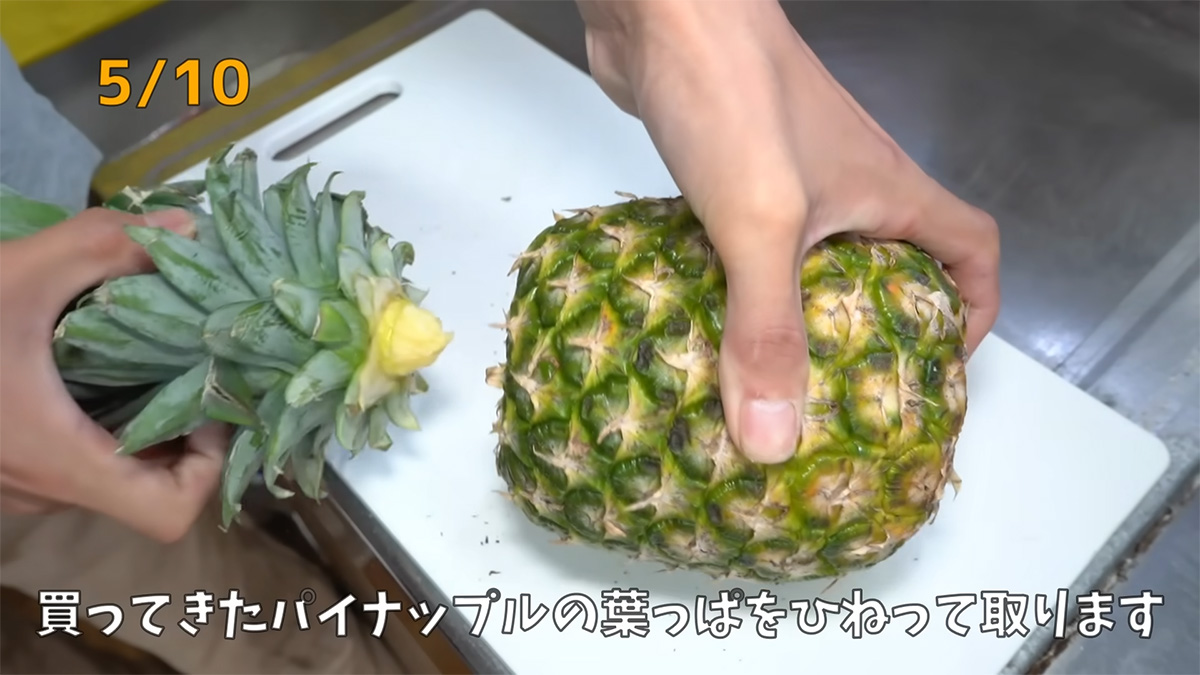
Successful pineapple crown propagation starts by firmly gripping the leafy cluster and twisting it clean off the fruit base. Slicing with a kitchen knife works, but any remaining yellow pulp must be carefully carved away until the firm, white core is exposed. Stripping away the bottom four to six tiers of lower leaves reveals tiny brown root primordia along the stem. These dormant nubs become the plant's feeder system.
Air-curing is non-negotiable. Veteran growers leave the stripped base on a dry counter for two to three days to form a hard callus over the wound. While water rooting in a transparent jar allows quick inspection of root growth, direct planting into moist perlite or coarse horticultural sand avoids the shock of transferring water roots into soil.
The 1,360-Day Fruiting Timeline
Patience separates casual experimenters from successful harvesters. Tropical field crops mature in 14 to 18 months under uniform sun and equatorial heat. Potted specimens subject to seasonal shifts take substantially longer.
| Phase & Timeline | Physical Indicators | Core Balcony Management |
|---|---|---|
| Phase 1: Days 1, 60Rooting & Establishment | Tug-resistance in potting mix; emergence of lime-green center spikes. | Bright indirect light; bottom heat (22, 26°C); moderate moisture without waterlogging. |
| Phase 2: Months 3, 24Vegetative Rosette Explosion | Arching spiny foliage expanding to 80, 120 cm wide; massive taproot anchoring. | Full sun light requirements (6+ hours); bi-weekly high-nitrogen feeding; potting up to a 5-gallon container. |
| Phase 3: Months 25, 40Stagnation & Winter Stalling | Tightening central whorl; reduced leaf generation during cooler months. | Mandatory indoor relocation; cold protection below 10°C; sharply reduced watering. |
| Phase 4: Months 41, 43Inflorescence ("Red Heart") | Vibrant red or deep violet floral cone rises from the rosette center. | Shift to high-potassium fertilizer; ethylene induction if flowering stalls; maintain steady warmth. |
| Phase 5: Months 44, 46Fruit Swelling & Harvest | Compound fruit scales turn from dark green to golden yellow; sweet aroma intensifies. | Protect from bird scavenging; stake heavy fruiting stalks; harvest once lower half turns gold. |
Surviving Winter Chills: The Container Transition
Pineapples are terrestrial bromeliads (Ananas comosus). Their natural biology handles intense drought and tropical downpours with ease, but cold drafts will destroy them. The primary reason multi-year experiments collapse midway is improper winter temperature protection.
When outdoor conditions drop below 12°C (54°F), pineapple roots stop absorbing nutrients. If soil stays soggy below 10°C (50°F), the root system decays rapidly. Balcony growers in temperate climates must treat these plants as indoor potted fruit trees from late autumn through mid-spring.
Indoor living presents its own hazards. Low humidity from home heating crisps leaf tips, while reduced light causes weak, floppy growth. Placing the container next to a south-facing window with supplemental LED grow lights maintains metabolic stability. Gardeners must also alter how they water the center rosette. During hot summer months, keeping clean water in the central cup mimics natural jungle hydrology. Indoors during winter, trapped water in the rosette quickly breeds crown rot. Water should be applied strictly to the surrounding soil mix, and only when the top two inches dry out completely.
Soil Chemistry and Forcing Stubborn Blooms
Standard heavy potting soils choke pineapple root networks. A customized potting mix for bromeliads requires aggressive aeration. A proven ratio combines two parts coarse orchid bark, two parts peat moss or coco coir, and one part perlite or pumice, maintaining an acidic pH range between 5.0 and 6.0.
By year three, a healthy container pineapple features roughly thirty large leaves. Yet many stubborn plants refuse to flower, soaking up sun while remaining stuck in vegetative limbo. Commercial farms solve this with industrial ethylene sprays. Balcony hobbyists can replicate the process using natural plant hormones.
Placing two overripe apples at the base of the plant and sealing the entire pot inside a clear plastic contractor bag for seventy-two hours traps natural ethylene gas. Placed in a shaded spot to avoid overheating, this ethylene exposure triggers floral induction. Within six to eight weeks, growers will spot the unmistakable crimson crown of the inflorescence pushing through the heart of the rosette.
Frequently Asked Questions (FAQ)
Q1: Can a balcony pineapple grow to full commercial size in a container?
A1: Container-grown pineapples are generally 20% to 40% smaller than field-grown supermarket fruit, weighing between 0.8 and 1.4 kilograms. Restricting the root system to a five-gallon pot limits physical size, but the resulting fruit develops a higher sugar concentration, delivering far superior flavor.
Q2: Why are the lower leaves of my potted pineapple turning dry and yellow?
A2: Lower leaf shedding is natural as the plant extends upward, provided new growth emerges green from the crown. If yellowing affects the entire rosette at once, check for poor drainage, saturated soil, or root rot triggered by cold potting mix.
Q3: Does the plant die immediately after harvesting the single fruit?
A3: The mother plant will slowly decline after fruiting, but it does not die right away. It channels its remaining energy into producing one to three vegetative suckers (pups) between its lower leaves. These pups can be separated and potted up, producing a second-generation fruit in roughly eighteen months, half the time required for a grocery crown.
The True Value of Slow Micro-Farming
Harvesting an edible pineapple on an urban balcony after four and a half years makes very little economic sense. A grocery store sells ripe fruit for under four dollars. Yet urban container growers spend hundreds of dollars on soil amendments, specialized pots, and winter LED lighting to produce a single golden fruit.
The draw lies elsewhere. In an era dominated by instant gratification and algorithmic speed, tending a tropical perennial for 1,360 days demands an increasingly rare virtue: steady, quiet persistence. When that spiky red cone finally surfaces through the rosette after years of patient watering, it offers something grocery stores cannot sell, proof that natural cycles still operate on their own unhurried terms.