The Complete Ofuse Guide: Envelope Selection, Writing Rules, and Etiquette
Japanese Ofuse Etiquette: How to Prepare, Inscribe, and Present the Temple Offering
Preparing a monetary offering for a Buddhist priest often brings an unexpected wave of anxiety to households across Japan. Whether organizing a first-anniversary memorial service or managing sudden funeral arrangements, family members find themselves handling delicate paper envelopes, traditional calligraphy pens, and unwritten cultural protocols. Unlike ordinary commercial transactions, this ritual exchange leaves no room for casual casualness. A comprehensive analysis by the 毎日新聞 Report highlights that understanding the core intent behind ofuse, a sincere expression of gratitude to the temple rather than a commercial fee, transforms an intimidating social hurdle into a dignified spiritual gesture.
The practice demands strict attention to graphic and physical details: the shade of ink applied to the paper, the specific layout of legal kanji numerals, the orientation of pristine currency, and the exact folding sequence of silk wrapping cloths. Missteps occur frequently because families confuse condolence money intended for bereaved relatives with offerings presented directly to the clergy. Navigating these distinctions ensures your memorial rites proceed smoothly, honoring both your ancestors and the resident monk conducting the ceremony.
📌 Quick Summary:
- The Essential Meaning: Ofuse represents an offering to the temple’s principal image (honzon) through the presiding priest, meaning it is never a transactional fee for service or subject to sales tax.
- The Script and Ink Rule: Always write ofuse inscriptions using solid, jet-black ink (koizumi), deliberately avoiding the pale, diluted gray ink reserved exclusively for condolence envelopes (koden).
- Presentation Protocol: Never hand an envelope directly across the table with bare fingers; rest it upon a small lacquered tray or an unfolded silk fukusa turned so the script faces the priest.
Why Ofuse Envelope Etiquette Confuses Even Lifelong Residents
Modern funeral customs in urban centers have largely shifted toward simplified, package-based services managed by commercial funeral directors. This commercial convenience has severed many generational lines of oral tradition. Families who grew up disconnected from their ancestral family temple (bodaiji) suddenly face ancient customs during high-stress life events. When a relative passes away or a posthumous Buddhist rite (hoyo) approaches, questions emerge instantly: Which envelope design fits this specific sect? Do we write horizontally or vertically? Is a five-thousand-yen bill acceptable?
The primary source of confusion stems from conflating ofuse with koden. Condolence offerings (koden) travel between mourners to support a grieving family. In stark contrast, ofuse travels from the family to the Buddhist altar, administered by the priest. Because grief protocols dictate using faded ink and crumpled bills for koden to symbolize tears and sudden shock, people mistakenly apply those exact sorrow-tinged rules to temple gratuities. Doing so inverts the meaning of the ritual. The monk serves as a conduit for spiritual merit, making the offering an act of intentional religious support rather than an emergency consolation gift.
Regional variations add another layer of complexity. In Kansai and western prefectures, families frequently select envelopes featuring yellow-and-white cords (kizuru mizuhiki) for annual memorial gatherings. In Kanto and eastern regions, plain white envelopes without any cord whatsoever remain standard across both initial funerals and decades-later memorial milestones. Failing to consult local customs can leave well-meaning hosts second-guessing their choices hours before the incense is lit.
Selecting the Proper Paper: Plain White vs. Mizuhiki Cords
Envelopes designed for temple offerings fall into two standard categories: unadorned white stationery and ceremonial paper tied with decorative paper cords (mizuhiki). Choosing between them depends on the solemnity of the occasion, local regional practices, and the scale of the financial donation.
The safest, most widely accepted vessel across Japan is a plain white envelope (shiro-muto). It must be constructed without pre-printed postal code boxes on the back. It should consist of a single layer rather than a double-layered structure. In Japanese funeral superstition, double envelopes (niju-futo) symbolize misfortunes repeating or arriving in pairs. Smooth, high-grade white paper provides an uncontested, universal foundation for any Buddhist tradition, from Soto Zen to Jodo Shinshu.
When presenting substantial offerings, typically amounts exceeding ¥50,000, a formal ceremonial wrapping paper (hoshoshi) folded over an inner envelope proves appropriate. If opting for pre-tied envelopes, cord colors convey specific stages of ritual. Black-and-white (kuroshiro) cords signal initial funerals and the early 49-day transitional mourning window. After the first-year anniversary (ichinenki), communities in western Japan favor yellow-and-white cords (kishiro), whereas silver-and-white cords appear across certain historic urban temples. The knot must always feature a flat, non-reopening bind (musubikiri), signifying that this specific solemn milestone is completed and will not recur.
Inscription Standards and the Financial Ledger Format
Writing on the envelope demands strict physical precision. Always choose a brush pen (fudepen) filled with deep, pitch-black ink (koizumi). Never reach for the watery, washed-out gray ink (usuzumi) sold at convenience stores for funeral cards. Pale ink communicates that tears fell into the inkstone, blurring the strokes, a sentiment appropriate for a grieving neighbor, but entirely disrespectful when offering thanks to a spiritual officiant.
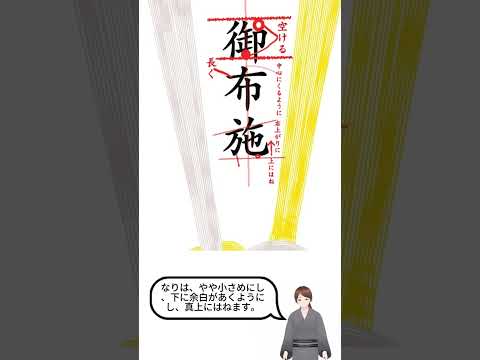
The exterior front panel requires vertical script. On the upper half, center the characters for the offering. You may write 御布施 (Ofuse), or leave that space blank if your pre-packaged stationery already features gold or black embossing. On the lower half, directly beneath the cord or midpoint, write the family identifier. Acceptable forms include your family name followed by "House" (e.g., 佐藤家), or the full name of the chief mourner or living donor (e.g., 佐藤 太郎). Avoid signing on behalf of the deceased person; living family members make the religious gift.
| Location on Envelope | Traditional Content | Practical Rules & Character Types |
|---|---|---|
| Outer Front (Top Half) | 御布施 (Ofuse) | Centrally aligned, vertical, bold black ink; omit if pre-printed. |
| Outer Front (Bottom Half) | Family Name or Chief Mourner | Write [Surname]家 or full legal name; smaller than the top characters. |
| Inner Envelope (Front) | Monetary Total (金 ○○圓也) | Mandatory use of formal legal kanji numerals (daiji). |
| Inner Envelope (Back) | Donor Address and Postal Code | Vertical script on lower-left side to assist temple bookkeeping. |
When logging monetary totals on the inner sleeve (nakabukuro), standard Japanese numbering invites administrative fraud or accidental alteration. Historical practice mandates the use of complex formal kanji numerals, known as daiji. Prefix the amount with the character for money (金, Kin) and close it with the suffix Nari (也). For instance, an offering of ¥30,000 must be written as 金 参萬圓 也 rather than 金 三万円. For ¥50,000, record 金 伍萬圓 也; for ¥100,000, write 金 拾萬圓 也. The reverse lower-left corner must carry the donor's full residential address and legal name, giving temple administrators accurate data for their annual accounting ledgers.

Banknote Preparation and Interior Envelope Alignment
Handling physical currency for an ofuse presentation requires an exact reversal of funeral etiquette. When visiting a wake to hand condolences to a friend, old, circulated, slightly creased bills are mandatory. Pristine, uncreased notes (shinsatsu) at a funeral imply that the donor anticipated the death and visited a bank teller in advance.
Temple offerings follow the exact opposite logic. Because ceremonies are scheduled in advance on the temple calendar, presenting fresh, crisp bills honors the priest's preparation and time. If you do not have crisp banknotes, visit a commercial banking branch or use an automated exchange machine well ahead of the weekend ceremony. Never include ragged, torn, or soiled bills inside a temple envelope.
Insertion mechanics follow strict directional rules. Slide the banknotes into the inner sleeve so that the portrait faces the front panel of the envelope. The face of the portrait must also sit right-side up, greeting the recipient immediately when the envelope flap opens. Seal the inner envelope lightly if an adhesive strip is attached, but avoid excessive tape or liquid adhesives that might tear the paper when temple accountants open it.
Executing the Hand-Off: Fukusa Wrapping and Bowing Manners
Carrying a bare envelope directly in an overcoat pocket or handbag signals poor preparation. Custom dictates keeping the prepared offering wrapped securely within a silk cloth known as a fukusa. Traditional ceremonial colors dictate deep purple for mourning, which carries the distinct advantage of being universally acceptable at both solemn memorials and celebratory weddings. Dark navy, gray, and dark green cloths are also widely accepted.
To fold a square cloth (tsutsumi fukusa), lay the silk out in a diamond orientation. Place the envelope face-up slightly to the right of center. Fold the left corner over the envelope first, followed by the top flap folding down, then the bottom flap folding up. Fold the remaining right corner across to cover everything, tucking the small excess tab underneath the backside. Modern clam-shell or folder-style versions (hasami fukusa) simplify this process, allowing you to slip the envelope smoothly inside without elaborate origami.
The presentation takes place either inside the temple reception chamber or directly after home altar chants conclude. Never hand over the envelope until formal greetings wrap up. Remove the envelope from the silk cloth, fold the fukusa into a flat rectangular cushion, and lay the envelope on top. If the temple provides a small wooden lacquered tray (kiri-bon), set the offering upon the tray instead.
Rotate the tray or the folded silk smoothly across the floor mats. Rotate it clockwise in two distinct, gentle quarter-turns so that the inscribed kanji face the priest, allowing him to read your name directly. Accompany this physical hand-off with a low bow from the waist and a polite verbal acknowledgment: "Honjitsu wa kokoro o komete o-tsutome itadaki, makoto ni arigatou gozaimashita. Dozo o-same kudasai" ("Thank you deeply for conducting today’s holy services with such dedication. Please accept this offering"). Wait for the monk to bow, utter his thanks, and draw the tray toward himself before you sit upright.
Frequently Asked Questions (FAQ)
Q1: How much money should we put in an ofuse envelope for a memorial service?
For annual memorial rites (such as the 1st, 3rd, or 7th anniversary), standard donations typically range from ¥30,000 to ¥50,000. Funeral-related services (including the reading of posthumous Buddhist names, or kaimyo) range widely from ¥150,000 to well over ¥500,000, depending on the lineage of the temple and the status of the title bestowed. If you are uncertain, you may politely ask the head monk: "Other patrons often ask, what is the customary range for this specific rite?" Most priests provide clear guidance without hesitation.
Q2: Can I use a standard Western-style white envelope from an office supply store?
You can, provided it meets two essential requirements: it must have completely blank faces without red postal-code indicator boxes printed on the top corner, and it must contain a single layer of paper. Double-lined security stationery must be avoided because layered designs metaphorically duplicate misfortune.
Q3: Should transportation allowances and meal gratuities go into the same envelope?
No. If the monk travels to your family residence, prepare a separate small envelope marked O-kuruma-dai (御車代, vehicle fee), containing roughly ¥5,000, ¥10,000. If the priest declines your invitation to join the post-service memorial banquet, prepare another separate envelope marked O-zen-ryo (御膳料, meal allowance), usually ¥5,000, ¥10,000 per officiating priest. Present these together alongside the primary offering.
Navigating Modern Temple Traditions
Observing Buddhist memorial rituals requires patience, self-possession, and respect for generational memory. While exterior elements like brush line density, silk folds, and formal numbering may feel exacting, their objective remains simple: they demonstrate that you spent intentional time preparing an offering for your family's spiritual heritage.
Temples today recognize that younger generations and international families encounter these customs without extensive background knowledge. Priests consistently emphasize that honest respect outshines flawless penmanship. By choosing an unadorned white envelope, applying deep black ink, aligning clean banknotes upright, and turning the envelope respectfully toward the officiant, you maintain an ancient line of Japanese cultural gratitude with quiet confidence.