The Complete Yucho-to-Yucho Transfer Handbook: Methods, Limits, Timing, and Common Errors
Japan Post Bank, known domestically as Yucho Ginko, manages roughly 120 trillion yen in retail deposits across more than 24,000 branches. For foreign workers, international students, and longtime expatriates, navigating this massive postal banking network is often their first major financial hurdle in Japan. While newer fintech services are altering domestic retail payments, highlighted by cardless ATM cash mechanisms detailed in a PayPay株式会社 Report, the standard internal Yucho-to-Yucho transfer remains the default way to split rent, pay local bills, and send personal funds.
Transferring money between two Japan Post Bank accounts is faster and cheaper than domestic interbank wire transfers (furikomi). The process can confound newcomers due to unique account numbering, distinct physical hardware, and strict verification checkpoints. Mastering the workflow saves both time and unnecessary transaction fees.
📌 Key Takeaways:
- The Numbering Rule: Yucho accounts rely on a five-digit kigou (code) and eight-digit bangou (number), which do not follow standard Japanese commercial bank branch codes.
- Cost Efficiency: Yucho Direct online banking grants 5 free transfers per month, while standard ATM transfers charge 100 yen per transaction.
- Processing Window: Transfers between Yucho accounts clear instantaneously 24 hours a day, provided both accounts have updated residence card records.
Decoding the Kigou and Bangou Account Structure
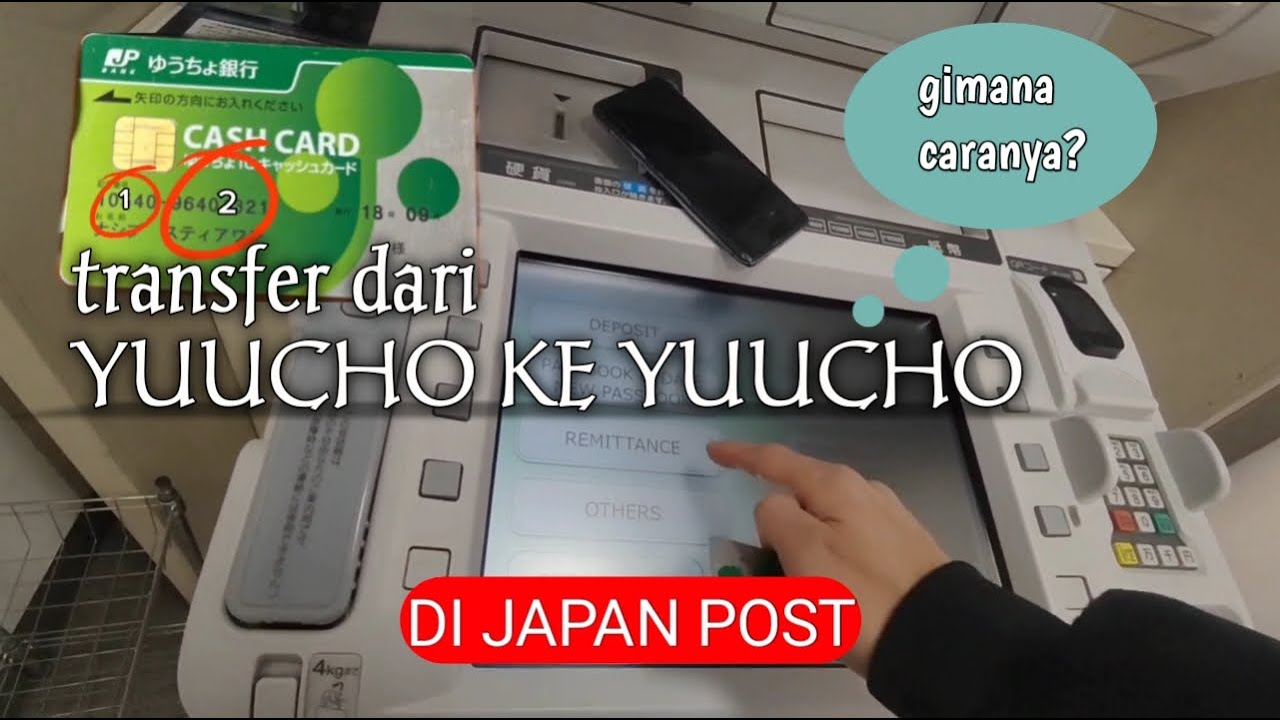
Every standard Japanese commercial bank uses a three-digit branch code (shiten code) alongside a seven-digit account number (kouza bangou). Japan Post Bank does not work this way natively. Yucho accounts feature an internal system printed on the front cover of every green paper passbook (tsucho) and debit card.
The first component is the kigou (記号). This is a five-digit sequence that identifies the issuing postal group or region, usually beginning with the digits 10 or 11. The second component is the bangou (番号), a seven- or eight-digit unique customer sequence. If a recipient sends an eight-digit number ending in a "1", you must enter that full sequence during an internal transfer.
Entering an external bank code when sending money between two Yucho accounts will prompt a terminal error. The automated system checks for internal compatibility immediately. When transferring within the same network, only the kigou and bangou are required. If an outside bank like Mitsubishi UFJ or Sumitomo Mitsui sends funds to Yucho, the user must convert their numbers into a standard branch number via the Japan Post Bank translation formula. For internal transfers, keep the original digits intact.
Navigating the Japan Post Bank ATM Menu
Physical green ATMs handle millions of domestic transfers weekly. Most standalone machines inside convenience stores or small post offices feature an English language option on the startup screen. Using the English menu can restrict complex transfer options, making familiarity with the standard Japanese interface practical.
Insert your Japan Post Bank cash card or paper passbook into the designated slot. The terminal screen displays several operations:
1. Select ご送金 (Gosōkin) to access the remittance menu.
- Choose ゆうちょ口座へのご送金 (Yūcho kōza e no gosōkin) for internal Yucho-to-Yucho movement.
- Enter your four-digit PIN code on the physical numeric keypad.
- Input the recipient's five-digit kigou, then press 確認 (Kakunin).
- Type the recipient's bangou, verifying whether it contains seven or eight digits.
- Enter the exact numerical amount you wish to transfer, followed by 円 (Yen).
- Review the remittance recipient name verification screen (furikomisaki shōkai), which displays the target account holder's name in Katakana.
Double-check the katakana name before pressing the final confirmation. If one syllable differs, cancel the transaction immediately. The ATM returns your card without deducting funds.
Digital Transfers with Yucho Direct and the Yucho Pay Smartphone App
Visiting a post office during working hours is unnecessary when managing balances digitally. Japan Post Bank splits its mobile infrastructure across distinct tools: the browser-based portal Yucho Direct, the account management tool Yucho Tsucho App, and the QR-code purchasing client Yucho Pay.
For routine domestic money transfers, Yucho Direct paired with the Yucho Authentication App (Yucho Ninsho) delivers the fastest execution. The bank discontinued physical paper token generators for digital security, moving two-factor verification to biometric device prompts.
To send funds through the portal, log in and select the Transfer tab. The system asks whether the target destination is internal or external. Selecting Yucho allows you to type the five-digit and eight-digit sequences directly. Biometric confirmation on your registered smartphone authorizes the transaction. Funds clear instantly, notifying the recipient via automated transaction emails.
The bank offers a tangible perk for choosing digital access: the first 5 transfers per calendar month are completely free. Once you exceed that threshold, the platform charges a modest fee of 100 yen per transaction.

Transfer Channels, Limits, and Operating Windows
Understanding Japan Post Bank processing rules prevents missed deadlines on rent and bill payments. The internal settlement engine operates outside the constraints of traditional Zengin interbank processing cutoffs, meaning money transfers clear around the clock with few maintenance exceptions.
| Transfer Method | Transaction Fee | Standard Daily Limit | Processing Availability |
|---|---|---|---|
| Yucho Direct (Online) | 5 free/mo, then 100 yen | 500,000 yen default | 24/7 (Real-time) |
| Japan Post Bank ATM (Card/Passbook) | 100 yen per event | 500,000 yen combined | ATM operating hours |
| Post Office Counter (Madoguchi) | 146 yen per transfer | Account balance max | Weekdays 09:00, 16:00 |
| Yucho Tsucho Mobile App | 5 free/mo, then 100 yen | 500,000 yen default | 24/7 (Real-time) |
ATM operating hours depend on the facility. Standalone post office branches routinely run their hardware from 07:00 to 21:00 on weekdays and 09:00 to 17:00 on Sundays. FamilyMart branches housing green Yucho machines offer near-continuous uptime, closing briefly between 23:55 Sunday and 07:00 Monday for system updates.
Daily transfer caps default to 500,000 yen for both ATM and online channels. This ceiling covers ATM cash withdrawals and electronic transfers combined. Users planning major outlays, such as apartment deposits or tuition, must increase their threshold through Yucho Direct settings or visit a customer window with identification.
Resolving Transfer Rejections and Account Locks
Errors during money transfers stem from specific regulatory safeguards and data discrepancies. When an ATM spits out your passbook or the mobile application throws an alphanumeric alert, the culprit is typically one of three issues.
The primary issue affecting foreign residents is the residence card validity lock. Japanese financial regulations obligate Japan Post Bank to track immigration statuses. If your residence card expires, the bank restricts outbound remittances while still accepting deposits. Resolving this requires uploading renewed documentation through the dedicated online portal or showing physical identity cards at a postal counter.
Input mismatches trigger the second most frequent failure. If the account holder's name features middle names or non-standard Katakana phonetic strings, manual entry errors abound. Yucho software automatically pulls the legal name based on the kigou and bangou. If that readout does not match your intended recipient, stop. Proceeding sends funds to the wrong party, initiating a complex return procedure called kumimodoshi that costs upwards of 880 yen in administrative fees without guaranteeing fund recovery.
Exceeding the daily transfer limit also produces an uninformative general error code. If you attempted an ATM withdrawal of 300,000 yen in the morning and later try to wire 250,000 yen to another Yucho account, the terminal terminates the action because the cumulative sum crosses the 500,000 yen threshold.
Frequently Asked Questions (FAQ)
Q1: Can I transfer money at a Yucho ATM using only cash, without an account?
A1: Cash-only remittances without a Yucho cash card or passbook are restricted. Due to strict Anti-Money Laundering mandates, unverified cash remittances require identity validation at a post office counter (madoguchi), incurring higher processing fees.
Q2: What should I do if the recipient gives me a three-digit branch number instead of a five-digit kigou?
A2: That recipient provided converted domestic wire information meant for non-Yucho banks. Ask them for their internal 5-digit kigou and bangou, or convert their numbers using the account translation calculator hosted on the official Japan Post Bank website.
Q3: How long does it take for a Yucho-to-Yucho transfer to reflect on weekends?
A3: Internal remittances process immediately, even on Saturdays, Sundays, and national holidays. The recipient sees the credited balance within minutes unless the network is undergoing monthly scheduled maintenance.
Q4: Why does the ATM reject my transfer even though my balance is sufficient?
A4: You have most likely reached your daily cumulative limit of 500,000 yen, or the bank has frozen outgoing operations pending updated proof of your legal residence documentation.
Establishing Reliable Transfer Routines in Japan
Managing daily finances in Japan becomes straightforward once you separate internal postal network mechanics from external commercial banking systems. For those processing recurring domestic payments, maintaining active access to both a physical cash card and the Yucho Direct portal provides the right operational balance.
Prioritize digital transfers via your smartphone to take advantage of the free monthly allowance. Keep your residence documentation current to prevent sudden account restrictions, and always verify the Katakana name displayed on screen before approving payment. These simple habits keep your transfers fast, inexpensive, and trouble-free.