The Hardest Kanji in the World Ranked: From 56-Stroke Biang and 84-Stroke Taito to 1,024 Strokes
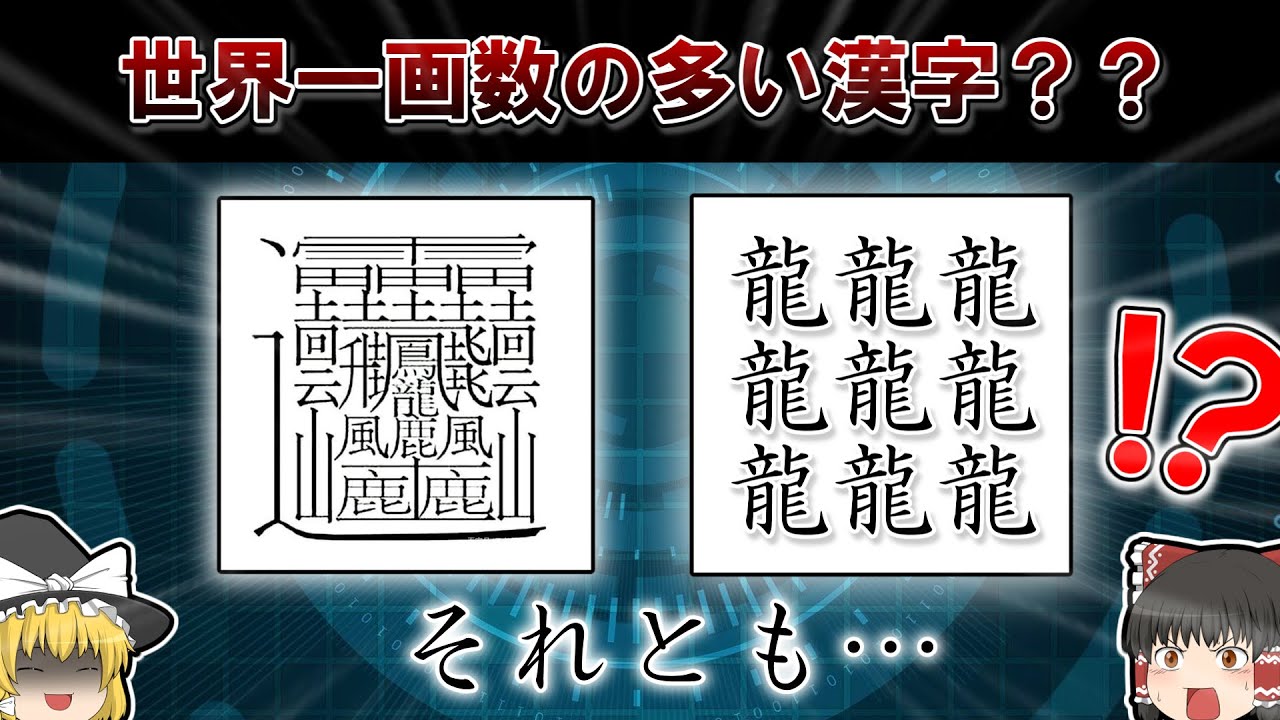
Shrinking an entire constellation of spoken meaning into a single square millimeter is the central obsession of East Asian logography. Push that ambition to its mathematical extreme, however, and typography collapses into an impenetrable smudge of black ink. Across Japanese message boards and Chinese calligraphy circles, discussions around the theoretical limits of written script periodically converge on a singular oddity: a monstrous, theoretical glyph boasting an astonishing 1,024 strokes.
The quest to identify the most difficult kanji exposes a sharp divide between living vernacular language, historical lexicography, and unhinged digital hyperbole. While casual learners struggle through the 29-stroke matrix of 鬱 (*utsu*, depression), paleographers and coders grapple with a spectrum that stretches from Shaanxi noodle shops to obscure Edo-period registers and, ultimately, into the outer rings of internet subculture.
📌 Key Takeaways:
- The Academic Record Holder: The 84-stroke Japanese kokuji Taito holds the record for the highest stroke count documented in a major modern reference work, indexed in Tetsuji Morohashi’s definitive Dai Kan-Wa Jiten.
- The Living Cultural Champion: The 56-to-58-stroke character for Shaanxi’s Biangbiang noodles remains the most intricate logogram in everyday commercial use, formally inducted into Unicode 13.0 after decades of typographic exile.
- The Viral Edge Case: The notorious 1,024-stroke character is an artificial pseudograph, a fractal constructed by multiplying 64-stroke quadrupled-dragon and thunder components into an impossible grid designed to test software renderers and human patience.
Decoding the 1,024-Stroke Monster: Digital Myth or Orthographic Reality?
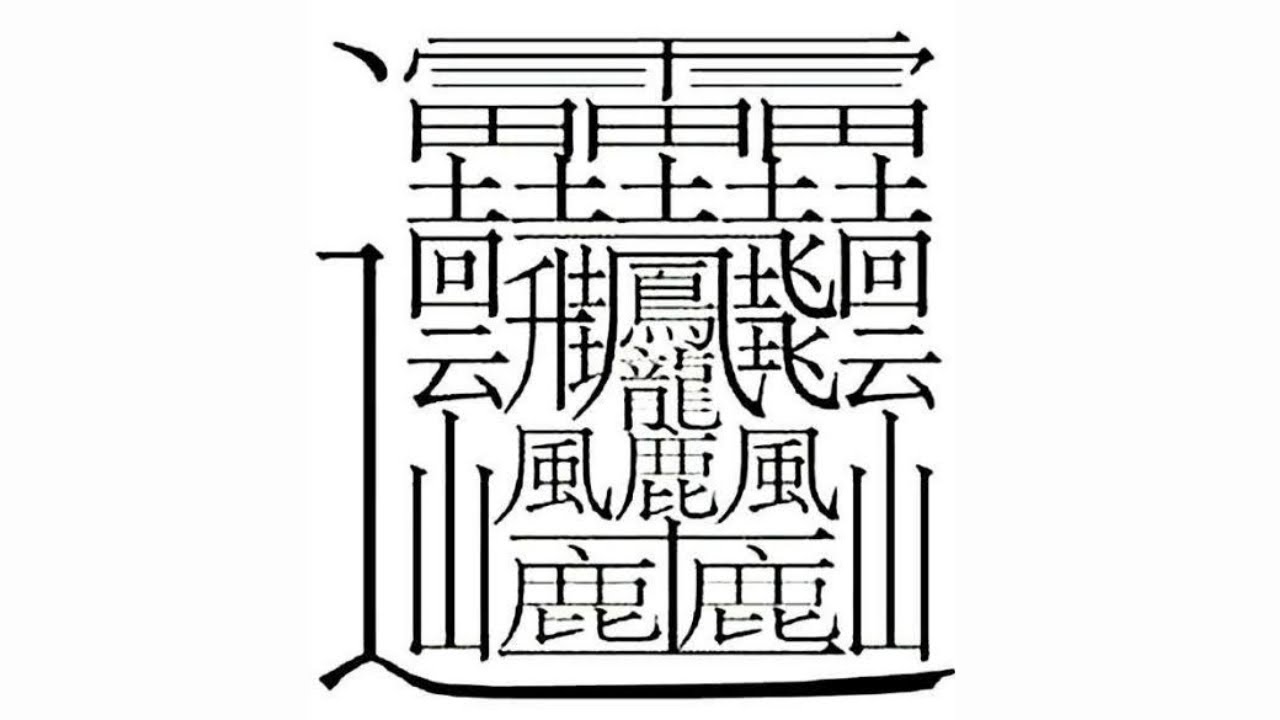
Every few months, Japanese social media feeds re-circulate an image that looks less like a written word and more like a high-density QR code drawn by hand. The character carries an estimated stroke count of 1,024. Inquiries routinely flood forums: What does it mean? How do you pronounce it? Does it belong to any real language?
Linguistically, the glyph is a *gisho*, a pseudograph. It possesses no historical pedigree in classical Chinese literature, nor does it appear in municipal Japanese family registries. Instead, it represents the outer boundary of competitive logographic recursion. The character is typically constructed by arranging sixteen distinct units of the 64-stroke character *zhé* (itself composed of four interlocking traditional dragons, 龍) or four massive clusters of 256-stroke nested arrays featuring dragon, cloud, and thunder radicals.
The creature is an artistic and intellectual thought experiment. Much like mathematicians constructing hypothetical googolplexes simply to see what happens when numbers break down, online typographers designed the 1,024-stroke behemoth to find the absolute physical limit of the *em-square*, the uniform bounding box that governs all Chinese, Japanese, and Korean (CJK) ideographs. At standard reading sizes, the 1,024-stroke character renders as solid black. At poster scale, it reveals a dizzying, symmetrical mandala of traditional brush strokes that defies practical human writing.
The Canonical Ceiling: How Daikanwa Jiten Documented 84-Stroke Taito
Strip away modern digital stunts, and the conversation shifts to genuine lexicographical history. The recognized peak of authenticated kanji complexity belongs to *Taito* (alternatively vocalized as *Daito* or *Ototodo*), a staggering 84-stroke construction cataloged in the monumental *Dai Kan-Wa Jiten* compiled by Tetsuji Morohashi.
The character is composed of two triplicated elements stacked tightly together: three clouds (雲, 12 strokes each) crowning three traditional dragons (龍, 16 strokes each). That simple multiplication, (3 × 12) + (3 × 16), yields 84 precise movements of the brush. Unlike internet-native inventions, *Taito* carries documented cultural footprint in Japan as a *kokuji* (a kanji forged domestically rather than imported from mainland China).
Historical evidence suggests the character served as a rare, highly stylized family surname during the Edo and early Meiji eras. Niche trade records from the early 20th century also point to its use on tavern signboards and business certificates, chosen precisely because its thunderous visual weight signaled power, auspicious arrival, and sheer presence. If you attempted to brush *Taito* with standard sumi ink on porous washi paper at standard handwriting scale, the dragons would fuse into an unrecognizable pool before the ink dried.
Culinary Vernacular Meets Unicode: The Real-World Conquest of Biang
If *Taito* represents an antique curiosity, the character for *Biang*, the celebrated wide, hand-pulled noodles of China’s Shaanxi province, represents living, breathing linguistic resilience. Clustered between 56 and 58 strokes depending on regional calligraphic preferences, *Biang* is neither dead nor theoretical. You will see it emblazoned across neon restaurant boards in Xi'an, Tokyo, Melbourne, and New York.
The character is an acoustic and structural riddle. Because standard dictionaries omitted the vernacular character for generations, locals preserved its construction through oral rhyming mnemonics taught to school children. The poem dictates the step-by-step assembly: starting with the central heart (心), threading through thread (糸) and speech (言), crowned with a roof (宀), and bordered by horses (馬), knives (刂), and the movement radical (辶).
For decades, the inability to render *Biang* on digital operating systems created bureaucratic nightmares for restauranteurs and food writers. Menus had to substitute the phonetic pinyin "BiángBiáng" or deploy low-resolution embedded bitmap images. That changed in March 2020. With the release of Unicode 13.0, the Unicode Consortium officially encoded traditional and simplified variants of *Biang* under CJK Unified Ideographs Extension G at code point U+30EDD. The rogue street noodle had officially conquered global computing infrastructure.
Mapping the Outer Limits: From Real Dictionaries to Internet Folklore
To grasp how these monstrous constructions compare, one must evaluate them across two axes: their total physical complexity and their actual legitimacy within authoritative linguistic corpora.
| Character / Concept | Stroke Count | Status & Classification | Structural Composition |
|---|---|---|---|
| Biang (Shaanxi Noodle) | 56, 58 | Living Vernacular (Unicode Ext-G) | Speech (言) flanked by thread, horse, heart, walk |
| Zhé (Verbose) | 64 | Classical Kangxi Dictionary | Quadruple traditional dragon (龍 × 4) |
| Zheng (Dense Clouds) | 64 | Classical Han Dynasty Glossaries | Quadruple cloud (雲 × 4) |
| Taito / Ototodo | 84 | Historical Kokuji (Daikanwa Jiten) | Triple cloud (雲 × 3) over triple dragon (龍 × 3) |
| Housetsu (Variant) | 128 | Obscure Calligraphic Esoterica | Doubled Taito-type cluster configurations |
| The 1024 Megalith | 1,024 | Internet Pseudograph / Joke Kanji | Grid of 16 Zhé (龍 × 64) or nested thunder arrays |
Esoteric Talismans and Guild Secrets: The Lineage of Impossible Scripts
The human impulse to build unreadable kanji did not originate on anonymous 21st-century imageboards. East Asia possesses a rich, documented tradition of intentional typographic illegibility spanning more than a millennium.
During the Tang and Song dynasties, Taoist priests generated *fulu*, incantation talismans written in what outsiders saw as supernatural, tangled scripts. These holy logograms mashed dozens of standard radicals together alongside cosmic thunderbolts, star diagrams, and celestial seals. The goal was deliberate obfuscation: if an uninitiated mortal could decipher the glyph, the spell lost its protective potency. Some of these talismanic ligatures approached 100 strokes, functioning as spiritual locks and keys.
Centuries later, during the Qing Dynasty, secret fraternal organizations like the Tiandihui (Heaven and Earth Society) relied on intentionally encrypted Hanzi characters. By merging disparate radicals representing brotherhood, death before betrayal, and Ming loyalty into single composite logograms, members authenticated their identity without alerting imperial authorities. Similarly, merchant guilds frequently invented unpronounceable *gisho* combining characters for wealth, gold, and longevity to serve as trademark seals. The 1,024-stroke meme character follows this identical psychological groove: transforming functional writing into an esoteric graphic spectacle.
The Font Engine Breakdown: Why Extreme Ideographs Break Modern Tech
Printing an 84-stroke kanji or attempting to render a 1,024-stroke monster exposes the physical limitations of modern graphic rasterizers. When a font engine processes a standard glyph, it relies on vector bezier outlines defined by mathematical coordinate nodes. In an em-box designed for standard body text, every additional stroke narrows the whitespace margin between black lines.
Typographic engineers refer to the failure mode as "clogging." As stroke counts pass 50, the distance between parallel vector paths shrinks below the threshold of standard display pixel grids. Without aggressive subpixel rendering or custom delta hinting, font rasterizers convert intricate inner structures into solid blocks of color. On modern mobile screens operating at typical resolutions, even *Biang* requires high-resolution display scaling or deliberate design thinning to keep its heart and speech radicals legible.
Beyond screen real estate, the Unicode Consortium maintains strict governance preventing runaway stroke-count inflation. To secure inclusion in the CJK Unified Ideographs blocks, candidates must submit exhaustive primary evidence: historical usage across published literature, government registry listings, or sustained, widespread commercial adoption. Because viral constructs like the 1,024-stroke character exist exclusively as visual stunts without syntactical usage, they will never receive an official Unicode code point. They live outside the global digital lexicon, destined to remain static PNGs and vector demonstrations.
Frequently Asked Questions (FAQ)
Q1: What is the highest stroke count kanji currently included in the standard Kangxi Dictionary?
The classical Kangxi Dictionary caps its standard entries at 64 strokes. The two most famous are *zhé* (composed of four traditional dragons, meaning verbose or chatty) and *zheng* (composed of four clouds, describing an overcast sky). Both are tetragrams that push classical brush geometry to its symmetrical ceiling.
Q2: Does anyone in Japan actually have the surname Taito (84 strokes)?
While historical registers like the *Daikanwa Jiten* and Meiji-era name directories record *Taito* as a localized family name, there are no verified living citizens in modern Japan registered with this 84-stroke surname today. It remains an extraordinary historical relic rather than an active legal identifier.
Q3: How many strokes can an official Joyo kanji have in modern Japan?
Among the 2,136 regular-use *Joyo kanji* mandated for daily Japanese literacy and administrative use, the character with the highest stroke count is 鬱 (*utsu*, depression/melancholy), requiring 29 strokes. The runner-up is 鑑 (*kan*, model/specimen/mirror) at 23 strokes.
Q4: Why did Unicode add the 56-stroke Biang character if it is so complicated?
The Unicode Consortium encodes characters based on communicative necessity, not simplicity. Despite its dizzying density, *Biang* is widely used throughout China and global diaspora communities on storefronts, recipes, transit systems, and menus. It met every strict standard for documented real-world utility required for CJK Extension G inclusion.
The Eternal Fascination with Logographic Extremes
The human impulse to stack characters beyond usability reflects an enduring romance with the written word. Alphabets cannot easily achieve this effect. You can string consonants together into unpronounceable German compounds or Welsh place names, but the result merely stretches across the page horizontally. It takes up time; it forces the eye to travel.
Kanji functions differently. Because it operates within a rigorous, unyielding square box, every added stroke increases internal pressure. Stacking dragons atop clouds or multiplying thunder radicals forces boundless energy into an immutable geometric space. Whether examining a 56-stroke Shaanxi noodle bowl, an 84-stroke Edo-period surname, or a 1,024-stroke viral fever dream, the appeal remains constant: testing how much human meaning and graphic tension can survive inside a single square.