The Meaning Behind 'Yuyake Koyake': Lyrics, Chords, and Cultural Significance

At precisely 5:00 PM across Tokyo's Hachioji district and dozens of municipalities throughout Japan, towering civic loudspeakers crackle to life. What follows is not a siren or a stern civil defense warning, but the bell-like chime of a simple, four-phrase piano melody ringing across apartment blocks, schoolyards, and rice terraces. Children immediately drop their soccer balls, pack their book bags, and head home.
The song is "Yūyake Koyake" (夕焼け小焼け), an evocative Japanese dōyō nursery rhyme composed over a century ago. Long recognized as the premier beginner piano tutorial piece across Japanese elementary schools and Yamaha music conservatories, this nostalgic Japanese folk song is simultaneously a national childhood memory, an essential disaster prevention test signal, and a foundational study in pentatonic keyboard harmony.
📌 Key Takeaways:
- The Civic Routine: Municipalities broadcast the Shin Kusakawa composition via the Bousai Musen evening broadcast daily at 5 PM to verify emergency disaster communication systems and signal children to return home safely.
- The Music Theory: Built entirely on the five-tone Major Pentatonic scale melody (Yonanuki scale), the melody requires zero black keys in C Major, making it an accessible piece for early keyboard instruction.
- A Resilient History: Written by poet Uko Nakamura in 1919, the printed score nearly vanished from history when the Great Kantō Earthquake leveled Tokyo just months after its 1923 publication.
From Hachioji Farmlands to Tokyo Classrooms: The 1919 Origins
The evocative lyrics of "Yūyake Koyake" began not in a formal conservatory, but along the dusk-lit footpaths of rural Tama. In 1919, a primary school teacher named Uko Nakamura (born Ukichi Nakamura) regularly walked the four-mile route between his workplace in central Tokyo and his family home in Onda village, nestled within modern-day Hachioji. Watching the setting sun cast long shadows over Mt. Jinba while village temple bells tolled the close of the workday, Nakamura jotted down a brief four-stanza poem describing crows flying back to the hills and children walking home hand-in-hand.
Four years later, in early 1923, Nakamura handed the verse to Shin Kusakawa, a gifted composer at the Tokyo Music School who was deeply involved in the Taishō-era *Akai Tori* (Red Bird) literary movement. The campaign sought to replace rigid, nationalistic Meiji school marches with gentle, artistically rich children's songs rooted in authentic emotional life. Kusakawa set Nakamura’s verse to a rolling 2/4 meter, drafting an intuitive piano score that matched the cadence of spoken Japanese.
How Twelve Copies Survived the Great Kantō Earthquake
The song almost disappeared before the public ever heard it. In August 1923, music publisher Bunka Shobo printed an initial run of 10,000 copies of the sheet music collection containing Kusakawa's score. On September 1, 1923, the catastrophic Magnitude 7.9 Great Kantō Earthquake struck the capital region, igniting massive firestorms that leveled Tokyo.
The Bunka Shobo warehouse burned to ashes, incinerating almost every single unreleased book. Historians and musicologists later discovered that only about 12 printed copies had been distributed to schools and acquaintances in the final week of August. Nakamura and Kusakawa believed the work had perished. Yet those dozen surviving copies circulated quietly by hand among Tokyo music instructors. Children sang the tune in temporary post-disaster shelters, keeping the melody alive through sheer oral repetition until publishers officially reissued the sheet music in 1926.
Musical Evolution: From 1923 Sheet Music to Modern Digital Arrangements
To grasp why "Yūyake Koyake" remains an enduring piano benchmark in 2026, examine how its musical structure shifted across historical and technical formats over the past century:
| Era & Format | Key & Scale Framework | Left-Hand Arrangement | Primary Civic / Cultural Function |
|---|---|---|---|
| 1923, 1926Original Print (Shin Kusakawa) | D Major / F MajorYonanuki Pentatonic | Classical vocal accompaniment with subtle voice-leading | Taishō-era dōyō renewal movement; classroom vocal training |
| 1965, 1990Bousai Musen Chime Broadcasts | Monophonic / Electronic Chimes (Transposed to regional horn pitch) | Unaccompanied chime bells; synthetic square-wave synth | Daily municipal emergency radio testing; childhood curfew chime |
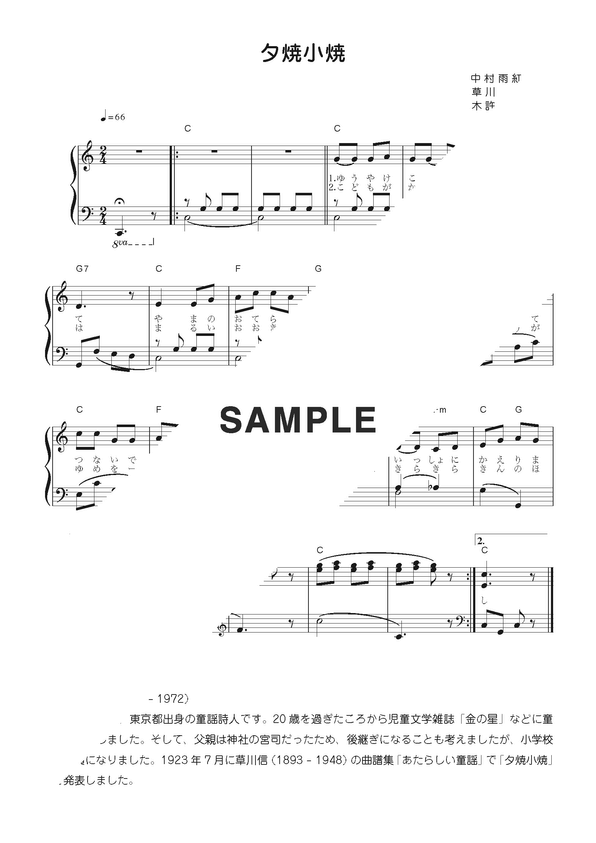
| 2020, 2026Easy Piano Arrangement PDF Downloads | C MajorC-D-E-G-A Pentatonic | Broken chords (Alberti bass) & root-fifth open intervals (C, F, G7) | Global adult beginner piano repertoire; cross-cultural music education |
Architectural Simplicity: Decoding the Yonanuki Pentatonic Scale
Search trends for Yūyake Koyake piano sheet music surge continuously among adult beginners and early childhood music instructors. The secret to its accessibility lies in music theory. Kusakawa crafted the vocal line using Japan's traditional *Yonanuki* (ヨナ抜き) Major scale. In modern Western theory, this corresponds to the Major Pentatonic scale.
When played in the beginner-friendly key of C Major, the Yonanuki scale omits the fourth scale degree (F, or *Yo*) and the seventh scale degree (B, or *Na*). The melody relies exclusively on five notes: C, D, E, G, and A.
Removing the fourth and seventh degrees eliminates the harsh half-step semitone frictions (E-to-F and B-to-C) as well as the tense tritone interval (F-to-B). Beginners can run their fingers across the keyboard without sounding dissonant. Even an accidental finger slip naturally lands within the consonant harmonic field. This structural property makes the piece a staple of early ear training across global piano methods.
Left-Hand Harmony and a Practical Finger Placement Guide
A standard easy piano arrangement PDF of "Yūyake Koyake" arranges the right hand around a fixed, five-finger position, avoiding wide wrist shifts that trip up novice players. The foundational melody spans a range from Middle C up to high A, allowing students to place their right-hand thumb (finger 1) on Middle C and pinky (finger 5) on G, shifting just one key upward for the expressive emotional climax on A ("*Yama no o-tera no kane ga naru*").
For the left hand accompaniment chords, the harmonic progression relies on the classic primary triads of Western harmony: C Major (I), F Major (IV), and G7 (V7).
Elementary arrangements assign steady root-position chords or two-note fifth intervals (C-G, F-C, G-D) to the left hand on beats one and two. Intermediate arrangements use broken arpeggios that mimic the gentle swing of temple bells. Because the right-hand melody does not contain F or B, novice pianists can practice pedal transitions and left-hand chord inversions without clashing with the melody line.
The 5 PM Town Chime: Civic Routine and the Bousai Musen Network
Beyond music schools, "Yūyake Koyake" remains an unavoidable daily acoustic feature of Japanese life through the *Bousai Musen* (防災行政無線), the nationwide municipal disaster radio network. Established under Japan's Disaster Countermeasures Basic Act following the 1964 Niigata earthquake, this wireless horn-speaker infrastructure allows local ward offices to alert residents instantly during tsunamis, earthquakes, and flood evacuations.
Maintaining a high-powered outdoor amplifier network requires daily operational testing. Local governments solved the technical problem with civic psychology: rather than blasting abrasive test tones every evening, wards broadcast a chime recording of a beloved folk melody. In western Tokyo, Kawasaki, and large swaths of Kanagawa and Yamanashi, the chosen tune is Kusakawa’s composition.
Broadcast at 5:00 PM during spring and autumn (often pushed to 4:30 PM in mid-winter and 5:30 PM in mid-summer to match astronomical sunset), the music prompts unattended elementary school pupils playing in parks to return home before dusk. It acts simultaneously as an acoustic public curfew, a check against childhood crime, and an operational equipment diagnostic.
Frequently Asked Questions (FAQ)
Q1: Why is "Yūyake Koyake" chosen over other Japanese folk songs for 5 PM broadcasts?
A1: The song's literal narrative details the sun setting, temple bells tolling, and children walking home together with crows flying back to the hills. Its peaceful imagery fits evening safety messages, and its Yonanuki pentatonic tones cut clearly through outdoor civic speaker systems without creating muddy echoes.
Q2: Is "Yūyake Koyake" easy for absolute beginner piano players?
A2: Yes. Arranged in C Major, the entire right-hand melody avoids black keys and requires minimal finger shifting. Beginners who follow an introductory finger placement guide can typically master the melody and two-chord left-hand accompaniment within one to two weeks of practice.
Q3: Is the sheet music for "Yūyake Koyake" protected by copyright?
A3: No. Composer Shin Kusakawa died in 1948, and lyricist Uko Nakamura passed away in 1972. Under Japanese copyright law (which protects works for 70 years posthumously), Kusakawa's musical composition is in the public domain. Standard public domain scores and beginner piano arrangements can be freely studied, printed, and performed worldwide.
The Enduring Resonance of an Evening Melody
More than a century after Nakamura walked the gravel roads of Hachioji and Kusakawa's first manuscripts burned in the rubble of Tokyo, "Yūyake Koyake" retains its singular hold on Japanese acoustic identity. The composition endures because it balances simplicity with emotional resonance. It asks very little of the beginning pianist's hands, just five keys and simple chords, while delivering an unmistakable sense of homecoming.
As international music students and digital hobbyists look beyond Western methods to discover Japanese folk repertoire, this four-phrase evening chime remains the most inviting doorway into Japan's lyrical musical heritage. When the bells sound at dusk, the piece still accomplishes precisely what its creators intended in 1923: drawing listeners away from daily labors and guiding them home.