The Ultimate Easy Santa Drawing Guide: Quick Steps for Cards, Crafts, and Decor

Every December, kitchen tables and elementary school desks transform into makeshift production studios for seasonal cards, ornaments, and envelopes. The appetite for tactile, handmade holiday gestures has rebounded sharply across communities worldwide. When the Kagoshima Central Post Office launched its annual exhibition displaying children’s illustrated mail sent to the Finland Santa Claus Foundation, the gallery walls highlighted an undeniable reality: drawing Santa Claus remains an essential childhood milestone. Cultural features such as a recent 読売新聞 Report on seasonal picture books capture how families returned to communal celebration traditions, rekindling interest in hands-on festive storytelling.
Yet anyone who has sat down with a blank sheet of cardstock knows how quickly an attempt to sketch Saint Nick can drift into an awkward tangle of mismatched facial proportions and lumpy line work. Mastering a simple cartoon Santa Claus does not require technical drafting experience or expensive supplies. By reducing the character's signature silhouette into fundamental geometric forms, overlapping circles, cloud-like curved loops, and soft triangles, anyone can construct an instantly recognizable figure in under five minutes.
📌 Key Takeaways:
- Core Technique: Beginning with the nose and mustache establishes stable facial proportions before committing to the hat and beard outline.
- Creative Utility: A minimalist sketch adapts seamlessly across handmade greeting cards, classroom gift tags, and seasonal dinner party settings.
- Skill Spectrum: Simple adjustments in line weight and geometric shapes allow toddlers, grade-schoolers, and adult crafters to produce polished results without tracing templates.
Establishing Santa Face Proportions with the Center-Out Approach
Most beginners make the mistake of drawing Santa's head from the outer perimeter inward. They sketch a large oval, attempt to attach a beard, and quickly run out of room for eyes or a smile. The center-out method avoids this trap entirely.
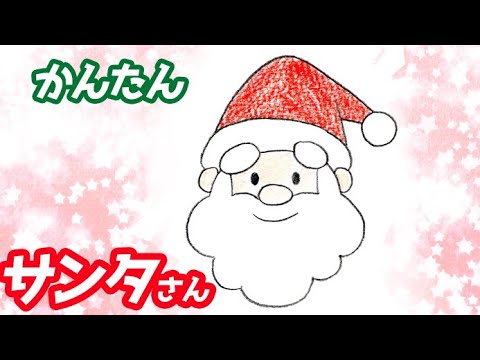
Start with a medium circle right in the middle of your paper. This serves as Santa’s classic round button nose. Directly beneath that circle, draw two sweeping teardrop shapes pointing outward to form the mustache. This mustache acts as the anchor for the entire portrait. Once the center point is locked, you never have to guess where to position the eyes or mouth.
Place two small, solid black dots or gentle arches just above the mustache for the eyes. Add small comma marks above the eyes for friendly eyebrows. Santa face proportions rely heavily on low eye placement; keeping the eyes tucked close to the top of the nose gives the character an endearing, approachable expression that resonates in a simple cartoon Santa Claus design.
Constructing the Santa Beard and Hat Outline Step by Step
Once facial features are in place, adding Santa’s wardrobe requires only a few flowing curves. The beard and hat complete the silhouette, providing the high-contrast red-and-white look essential for holiday crafts for kids.
Draw a series of scalloped, cloud-like ripples connecting the outer edges of the mustache, dropping down toward the chest, and curving back up. You can keep the beard compact for quick character drawing or elongate it into an exaggerated fluffy cloud for decorative impact. Next, draw a thick, horizontal pill-shaped oval across Santa's brow to represent the fuzzy trim of his stocking cap.
From the ends of that brim, sweep two tall, arching lines upward that bend sideways and converge at a single point beside his ear. Cap this folded tip with a circular pom-pom. At this stage, your easy holiday doodle tutorial is structurally complete. The outline contains clean, readable boundaries, making it exceptionally well-suited for printable holiday coloring guides or quick marker fills.
Comparing Holiday Illustration Methods Across Formats and Settings
A drawing technique that works wonders on an individualized card might prove too detailed for a chaotic kindergarten activity. Selecting the right drafting method depends on the project setting, material availability, and intended time investment.
| Drawing Method | Best Application | Average Time | Recommended Medium |
|---|---|---|---|
| Minimalist Geometric Doodle | Preschool festive art projects & gift tags | 1, 2 minutes | Broad-tip washable markers, wax crayons |
| Layered Card Illustration | DIY Christmas greeting cards | 5, 8 minutes | Pigment liners, watercolor wash, cardstock |
| Folded Paper Hybrid | Party tables, napkin folding, place cards | 3, 4 minutes | Two-tone decorative paper, fine gel pens |
Applying Santa Sketches to Party Accents and Classroom Crafts
A fast doodle becomes far more valuable when applied beyond ordinary paper sketchbooks. In late 2025, Japanese social feeds buzzed over a viral demonstration by a Kyoto paper goods maker, illustrating how simple geometric Santa paper folding could elevate ordinary dinner tables into charming holiday displays. The technique works on the exact same structural logic as a basic drawing: contrasting white margins against deep crimson triangles.
You can replicate this tactile excitement without elaborate origami skills. Sketch the simplified Santa face onto heavy watercolor paper, trim around the beard perimeter with crafting shears, and paste the cutout onto folded kraft cardstock. The resulting DIY Christmas greeting cards carry a bespoke, textured feel that manufactured box sets cannot replicate.
For elementary classrooms, these outlines double as tactile templates. Instructors can have students draw the base face using beginner sketching techniques, then glue cotton balls across the beard outline or apply red glitter glue to the hat body. This hybrid approach lets young learners practice fine motor control while building artistic confidence.
Avoiding Common Composition Traps in Beginner Holiday Art
Even simple cartoon Santa Claus sketches can feel rigid or lifeless if you overlook basic visual cues. The most frequent error is excessive symmetry. Drawing a perfectly geometric, ruler-straight triangle for the hat produces a cone that looks like a party hat rather than a relaxed velvet stocking cap. Always introduce a slight droop or curved crease on one side to convey soft fabric weight.
Another pitfall involves overloading the face with detailed linework. A realistic mouth with individual teeth often renders Santa uncharacteristically uncanny in a simplified format. In cartoon illustrations, less detail produces a friendlier character. A tiny red crescent tucked just beneath the mustache curve is all the viewer needs to recognize a cheerful grin.
Finally, pay attention to cheek color. Adding two soft pink ovals directly beneath the eyes transforms a plain sketch into a warm, cold-weather character. Whether using colored pencils, chalk pastels, or soft marker dabs, pink cheeks provide an immediate, cozy focal point that ties the portrait together.
Frequently Asked Questions (FAQ)
Q1: What are the best markers to prevent bleed-through on handmade cards?
A1: Use archival water-based pigment pens (such as Sakura Pigma Micron) for the black outlines, paired with alcohol-free markers or gouache on cardstock weighing at least 250 gsm. Alcohol markers like Copics will bleed through standard card paper unless a bleed-proof barrier or heavy mixed-media cardstock is used.
Q2: How can toddlers participate if drawing clean circles is too difficult?
A2: Simplify the project into mixed-media assembly. Trace a circle using a plastic cup bottom for the base face, let the child stamp two finger marks with black paint for the eyes, and finish by gluing cotton balls along the chin for the beard.
Q3: Can this Santa drawing method be adapted for digital tablet illustration?
A3: Yes. On platforms like Procreate or Adobe Fresco, sketch the center-out guide on a low-opacity draft layer using a monoline brush. Create a clean outline layer on top, then drag and drop red and peach color fills onto separate layers beneath the linework.
Embracing the Charm of Imperfect Holiday Doodling
The enduring appeal of seasonal artwork lies in personality rather than photographic precision. When children submit holiday cards to international postal programs or families design custom dinner place settings, minor line wobbles and asymmetric beards communicate authentic warmth. By establishing a dependable center-out sequence, anchoring the nose, framing the mustache, and sweeping the hat downward, anyone can produce an expressive Santa sketch in minutes. Pick up a pen, relax your grip, and let simple lines carry the festive spirit onto the page.