The Ultimate Gintama Joui Shishi Guide: Faction Lore, Classic Gags, and New Collectibles

When Hideaki Sorachi conceived the Joui War in Gintama, he turned historical Bakumatsu trauma into a playground of surreal comedy and sharp political satire. Decades after the alien Amanto seized Edo, the remnants of the samurai resistance remain split between underground terrorists, maritime merchants, and eccentric loyalists. The Joui Shishi recruitment exam stands out as one of the franchise's most enduring parodies, transforming an underground militant screening into an absurd gauntlet of pop-culture trivia and bureaucratic nonsense. Interest in the faction has surged anew following recent merchandise announcements, notably documented in an official MSN Report detailing MegaHouse's brand-new Shiroyasha figure line.
The anti-foreigner resistance defines the core dynamic between Sakata Gintoki and his wartime comrades. Between the slapstick interviews run by Katsura Kotaro and the fierce rooftop clashes against the Shinsengumi, the Joui faction anchors the narrative. Today, renewed theatrical buzz and collector releases are pulling both veteran fans and newcomers back into the history of Edo's most chaotic rebels.
📌 Key Takeaways:
- The Faction's Paradox: Katsura's Joui Shishi faction operates simultaneously as a high-stakes subversive resistance and an inept comedy troupe that conducts written exams on Jackie Chan movies.
- Wartime Diaspora: The "Joui 4" veterans, Gintoki, Katsura, Takasugi, and Sakamoto, split into radically divergent paths after the Kansei Purge, defining Edo's postwar landscape.
- 2026, 2027 Collector Revival: MegaHouse opened reservations for its ¥8,800 GEMCarat Shiroyasha figure via Premium Bandai, alongside new theatrical visual promotions spotlighting Katsura and Elizabeth.
The Absurd Logic of the Katsura Kotaro Recruitment Exam
Most underground rebel organizations demand loyalty oaths, combat trials, or clandestine references. Katsura Kotaro, known across Edo as the "Runaway Kotaro," opted instead for structured exams, written aptitude sheets, and rigorous job interviews. In Sorachi's world, running an underground guerrilla network requires standard administrative paperwork. Katsura's recruitment drives routinely mirror mundane corporate hiring sprees, complete with application forms, panel interrogations, and bizarre disqualification criteria.
The comedy reaches its peak whenever outsiders stumble into the screening process. During the infamous driver's license and recruitment arcs, applicants find themselves answering nonsensical questions rather than demonstrating swordplay. Interrogated by Katsura and his enigmatic partner Elizabeth, prospective recruits must decipher Elizabeth's wooden placard prompts, debate obscure pop-culture minutiae, or survive mundane parlor games like Uno. The exam parodies the tedious nature of Japanese civil service testing, transplanting bureaucratic rigidity directly into a wanted terrorist cell.
This dissonance is deliberate. Katsura refuses to operate as a mindless fanatic. By framing faction membership through recruitment drives, entrance fees, and customer-service standards, Sorachi strips the romanticized samurai rebel of traditional self-importance. The test serves as an ideological filter where only those capable of enduring Katsura's deadpan lunacy manage to survive.
From the Kansei Purge to the Joui 4 Fracture
Behind the entrance exam gags lies one of the bleakest backstories in modern shonen manga. The Joui War began as an authentic patriotic defense against the technologically superior Amanto invaders. When the cowardly Tokugawa Shogunate capitulated, signing unequal treaties and enacting the Sword Prohibition Edict, loyalist samurai took up arms. Among them were four former classmates and battle commanders: Sakata Gintoki, Katsura Kotaro, Takasugi Shinsuke, and Sakamoto Tatsuma.
The execution of their mentor, Yoshida Shouyou, shattered the coalition. Rather than remaining united, each leader responded to survivor's guilt through an entirely different philosophy:
- Sakata Gintoki (The Shiroyasha): Abandoned the war entirely after bearing the ultimate execution burden. He founded Yorozuya Gin-chan, choosing to protect everyday micro-communities rather than pursue grand state ideals.
- Katsura Kotaro (The Radical Turned Moderate): Maintained the mainstream Joui Shishi cell. While initially relying on localized bombings, he steadily shifted toward systemic reform, internal subversion, and eventual political diplomacy.
- Takasugi Shinsuke (The Extremist Kiheitai): Chose absolute nihilism. Takasugi revived the Kiheitai volunteer army with a singular goal: burning down the world that stole his master.
- Sakamoto Tatsuma (The Kaientai Visionary): Left terrestrial warfare behind. Realizing swords could not defeat spaceships, Sakamoto launched the Kaientai trading fleet to conquer interstellar commerce and secure diplomatic leverage.
This historical fracture gives weight to every comedic reunion. When Gintoki encounters Katsura handing out faction fliers or Takasugi plotting terror strikes from the shadows, the series juxtaposes wartime trauma against mundane postwar survival.
Faction Breakdown: How Edo's Resistance Groups Compare
The Joui landscape is far from unified. Different cells operate with wildly differing resources, tactics, and political goals across Edo and outer space.
| Faction & Leader | Operational Base | Core Philosophy & Methods |
|---|---|---|
| Joui Shishi(Katsura Kotaro) | Edo Underworld & Safehouses | Subversive reform, recruitment screenings, non-lethal infiltration, political realignments. |
| Kiheitai(Takasugi Shinsuke) | Flagship Ryuukoumaru & Outer Rim | Radical terrorism, assassination, strategic coups, alliances with rogue alien syndicates like the Harusame. |
| Kaientai(Sakamoto Tatsuma) | Interstellar Fleet & Space Routes | Cosmic mercantilism, weapon trade negotiation, planetary logistics, peaceful economic diplomacy. |
| Rogue Radical Splinters(Various Fringe Cells) | Kabukicho Abandoned Warehouses | Uncoordinated domestic bomb plots, kidnapping, ideological purity tests without practical strategy. |
Shinsengumi vs. Joui Shishi: Law Enforcement Meets Street Insurgency
The friction between the Shinsengumi and Katsura's faction drives much of Edo's day-to-day chaos. As the Bakufu's special police force, the Shinsengumi, led by Commander Kondo Isao, Vice-Commander Hijikata Toshiro, and First Division Captain Okita Sougo, is tasked specifically with hunting anti-foreigner extremists. Their clashes are rarely clean military engagements; they unfold as frantic alleyway shootouts, high-speed rooftop chases, and deeply awkward covert encounters.
Sorachi frequently upends this ideological rivalry. Hijikata views Katsura as a dangerous saboteur, yet the two repeatedly find themselves trapped in shared absurdities, from public bathhouses to undercover operations. In several storylines, Shinsengumi officers accidentally infiltrate Katsura's recruitment exams or disguise themselves as Joui members to track down third-party threats. Kondo's earnest simplicity clashes with Katsura's high-minded eccentricity, revealing that both factions are ultimately composed of displaced swordsmen searching for meaning in a modernized society.
As the series progresses into the Farewell, Shinsengumi arc, this dynamic evolves. When the corrupt Shogunate turns its back on Kondo's men, the boundary between law enforcement and outlaw rebels dissolves. The Shinsengumi and Joui Shishi are forced into an unprecedented tactical alliance, proving that their shared code of honor transcended the political labels dividing them.
The 2026 Collector Renaissance: MegaHouse's GEMCarat Shiroyasha
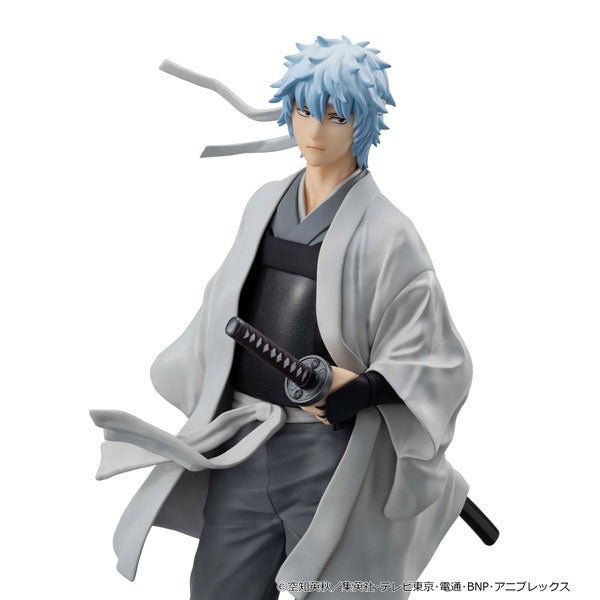
Beyond anime broadcasts and manga reprints, the Joui legacy continues to command massive commercial power. In August 2026, hobby manufacturer MegaHouse officially announced the debut of its GEMCarat line, selecting Sakata Gintoki's wartime persona as the flagship launch piece. Titled "G.E.M.Carat Series Gintama: Sakata Gintoki Ver. Joui Shishi," the figure captures Gintoki during his legendary tenure as the White Demon.
Priced at ¥8,800, the sculpt showcases Gintoki in battle-worn white Joui armor, his cloth headband fluttering as the silver hachigane forehead protector catches light through his unruly silver hair. Distributed through major retail networks such as AmiAmi and Bandai Namco's official Premium Bandai webstore, pre-orders opened in mid-August 2026, with an official shipping window slated for February 2027. Collectors on platforms like X and MFC noted the aggressive pricing, pointing out that MegaHouse designed the GEMCarat line to balance premium detail with shelf-friendly dimensions.
This merchandise push coincides with the promotional rollout for Shin Gekijoban Gintama: Yoshiwara Enjo-hen. Production committees unveiled the third wave of Mubichike advance movie ticket visuals in early 2026, highlighting an eccentric illustration quartet: Katsura Kotaro, the courtesan Tsukuyo, and Elizabeth disguised in full traditional women's attire. Decades after serialization began, the Joui faction remains central to the brand's ongoing financial footprint.
Frequently Asked Questions (FAQ)
Q1: What happens during Katsura's Joui Shishi recruitment exam?
A1: The test parodies standard Japanese civil-service and employment interviews. Rather than testing swordsmanship, Katsura Kotaro and Elizabeth evaluate candidates using written questionnaires, trivia debates regarding action cinema, absurd personality prompts, and casual table games like Uno.
Q2: Why did Sakata Gintoki abandon the Joui Shishi movement?
A2: Following the Kansei Purge and the execution of his teacher Yoshida Shouyou, Gintoki realized that continued armed resistance only brought senseless slaughter. He chose to live quietly as a handyman in Kabukicho, protecting the personal bonds immediately around him rather than fighting to overthrow the Shogunate.
Q3: When does the MegaHouse GEMCarat Shiroyasha figure release?
A3: MegaHouse opened reservations across AmiAmi and Premium Bandai in August 2026 for ¥8,800. Official manufacturing fulfillment and global collector shipments are scheduled to roll out in February 2027.
Q4: Are the Joui Shishi historically accurate?
A4: They are loosely inspired by the historical Ishin Shishi (patriot samurai) of the late Edo period who championed the Sonnō Jōi ("Revere the Emperor, Expel the Barbarian") philosophy. Sorachi exaggerated their activities into satirical guerrilla cells while modeling key characters after real figures like Katsura Kogoro and Takasugi Shinsaku.
The Lasting Cultural Resonance of Gintama's Resistance
The Joui Shishi faction endures because it encapsulates Hideaki Sorachi's storytelling genius: the refusal to separate profound sorrow from outright silliness. In any standard historical drama, a displaced militia coping with military defeat would descend into grim, relentless melodrama. In Gintama, those same traumatized veterans design job applications, squabble over fried tofu, and conduct mock interrogations in cramped Edo backalleys.
Katsura's entrance exams are more than throwaway gags. They symbolize an enduring survival mechanism. By laughing at authority, military decorum, and their own past failures, the characters retain their humanity within an alien-dominated metropolis. With new theatrical releases reigniting cinematic screens and premium figures heading toward display cases through 2027, the Joui Shishi have solidified their place not just as Bakumatsu parodies, but as timeless icons of comedic defiance.