The Ultimate Hanagasa Ondo Guide: Teaching Moves, Rhythms, and Hats to Kids

Every autumn, elementary school sports day grounds across Japan echo with the rhythmic clatter of plastic bells and the call-and-response shouts of "Yasho, Makasho!" What began as a regional laborers' anthem in northern Honshu is now a staple of the elementary PE dance curriculum. As preparations build toward the 64th annual Yamagata Hanagasa Matsuri, scheduled to run from August 5 through August 7, 2026, according to official regional coverage by livedoor ニュース Report, educators around the world are adapting this traditional Japanese straw hat dance for school performances, cultural festivals, and youth physical education.
Teaching dynamic group choreography to seven-year-olds presents obvious classroom challenges. Coordination limits, spatial awareness gaps, and dropped props can derail rehearsals quickly. Yet beneath its visual complexity, this kid friendly Japanese festival dance rests on clean, repetitive patterns. With the right breakdown of rhythmic counts and simplified staging, elementary educators can turn an intimidating 4-minute routine into an accessible performance that builds motor skills and collective pride.
📌 Quick Summary:
- The Movement Foundation: Simplified footwork patterns for children reduce standard adult festival routines down to four foundational weight shifts per eight-count measure.
- Rhythmic Anchors: Hanagasa Ondo musical cues depend strictly on the trademark "Yasho, Makasho" shout, signaling direction pivots and hat-twirl timing.
- Prop Adaptations: Lightweight cardboard or woven paper straw hats with glued paper safflowers prevent fatigue and wrist strain during thirty-minute gym drills.
From Yamagata Parades to the Schoolyard: The Undokai Tradition
Hanagasa Ondo was not initially designed for children. Born out of embankment construction songs sung along the Mogami River during the Taisho era, the piece was formalized into a public parade dance in 1963 to draw tourism to Yamagata Prefecture. The dance pairs celebratory folk singing with flower-adorned conical hats representing the region's historic safflower trade.
Its transition to the elementary school sports day undokai happened organically during the post-war expansion of physical education guidelines. Japanese physical education programs require synchronized folk dance units to teach rhythm counts and synchronization alongside spatial awareness. Hanagasa Ondo struck a balance between athletic movement and accessibility. The tempo sits at a steady 96 to 104 beats per minute, fast enough to keep young dancers energized, yet slow enough that lower-elementary students do not stumble over their feet.
Today, schools across the world turn to the dance as a centerpiece for multicultural showcases and athletic meets. The routine requires minimal gear: a flat surface, an audio player, and a pair of hands gripping a brim.
Breaking Down the Yasho Makasho Chant Timing and Musical Cues
Rhythm confusion causes most mistakes during rehearsals. Children easily lose track of four-beat phrases when listening to unfamiliar folk instrumentation like the shamisen, shakuhachi, and taiko drums. The solution lies in anchoring every movement to the vocal cues embedded in the lyrics.
The heartbeat of the routine is the call-and-response sequence:
Call: "Ha, , Yasho, Makasho!"
Response: "Shan-shan-shan!"
Teachers should teach the vocals before introducing any physical choreography. Have students clap out the three sharp beats of the "Shan-shan-shan" response while seated. This rhythmic pattern represents the sound of the metal rings and bells attached to the hat frame. Once students internalize these auditory markers, they no longer need to count numbers in their heads. When the lead vocalist calls out "Yasho, Makasho," the dancers know instinctively that four steps forward are finishing, a low pivot is beginning, or a hat circle is about to complete.
Step-by-Step Footwork Patterns Tailored for Young Learners
Standard festival variations like the masculine Kamo-ryu feature deep knee drops, squats, and aggressive lunges that quickly tire young legs. The kid-friendly school version strips away deep knee bends in favor of a balanced four-point bounce.
Here is the baseline four-bar phrase used in school field choreography:
Measure 1 (Counts 1, 4): Forward March and Step-Touch
Step forward on the right foot (1), bring the left foot beside it with a light floor tap (2). Step forward on the left foot (3), bring the right foot to a tap (4). Keep knees slightly springy to absorb momentum.
Measure 2 (Counts 5, 8): The Low Sway
Step wide to the right (5), shift upper-body weight right while sweeping the hat outward. Step wide to the left (6), swaying the hat in an arc across the chest. Repeat right (7) and return to center stance (8).
Measure 3 (Counts 1, 4): The Pivot Turn
On the vocal cue "Yasho," plant the right ball of the foot and pivot ninety degrees clockwise (1, 2). On "Makasho," plant the left foot to complete a 180-degree half-turn facing the back of the gym or field (3, 4).
Measure 4 (Counts 5, 8): The Ring Snap
Face backward, jump lightly in place on counts 5, 6, and 7 while pushing the hat skyward on each beat ("Shan! Shan! Shan!"). On count 8, pause, drop the hat to chest height, and prepare to mirror the sequence back toward the audience.
Curriculum Adaptation: Primary Grades vs. Upper Elementary Drills
Children in first grade lack the wrist dexterity and spatial tracking required of fifth-grade performers. Structuring expectations around developmental age prevents rehearsal frustration and ragged field displays.
| Grade Level | Core Movement Goal | Hat Handling Focus | Formation Complexity |
|---|---|---|---|
| Grades 1, 2 (Ages 6, 8) | Forward march, 2-beat weight sway, stationary hops | Two-hand static grip; chest-to-sky pushing only | Static parallel grid; no cross-line transitions |
| Grades 3, 4 (Ages 8, 10) | Directional pivots, cross-step grapevines, synced drops | Two-hand circular rotations, wrist snaps on beat 4 | Grid-to-concentric circles; basic ripple waves |
| Grades 5, 6 (Ages 10, 12) | Dynamic lunges, fast direction reversals, full spins | One-hand twirls, overhead tosses, edge flicking | Interlocking parade drills, counter-marching lines |
Mastering Hanagasa Hat Handling Techniques and DIY Classroom Props
Authentic straw hats (sugegasa) fitted with wooden rings and dried safflowers run between $25 and $40 per unit, an impractical cost for an entire elementary cohort. In Japanese public schools, art classes double as prop workshops.
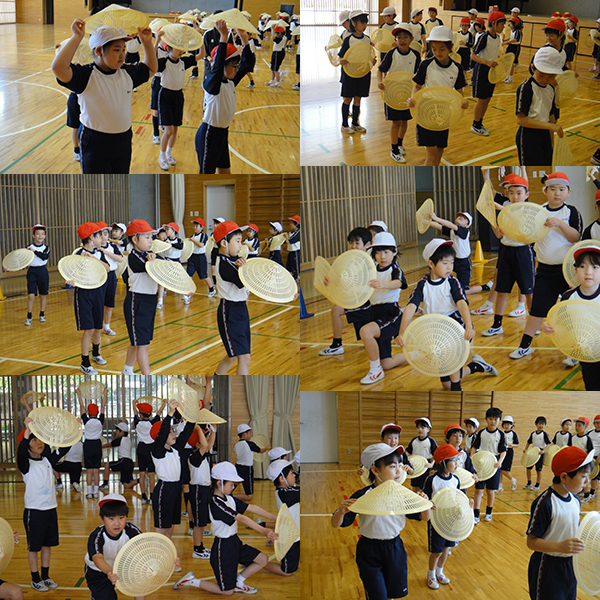
Teachers cut conical discs from heavy craft cardstock or buy cheap paper-straw summer hats in bulk for roughly $2 to $3 each. Students then craft three to five bright red safflowers (benibana) using crumpled tissue paper or folded origami paper, taping them securely around the crown. Adding two small metal craft bells beneath the brim with red yarn replicates the traditional ringing sound without requiring expensive hardware.
Handling the hat requires clean habits:
- The Two-Hand Pinch Grip: Thumbs stay under the rim; fingers rest on top. Never grip the flowers directly, or paper blooms will tear off during mid-dance sweeps.
- The decorative face of the hat must always face the spectator. When bowing or sweeping downward, dancers rotate their wrists outward so the bright red safflowers remain visible from the grandstands.
- When resting between vocal phrases, the hat stays anchored at chest height with elbows winged out. Dropping hands down to the waist destroys formation alignment instantly.
Parade Formation Drills and Field Staging Tactics
Moving eighty children across a school field without traffic jams requires clean parade formation drills. The most reliable staging relies on a 4-line grid converting into a giant central ring.
Begin rehearsals using chalk lines or flat rubber spots spaced exactly 1.5 meters apart. This distance accommodates full arm extensions when the hats sweep out laterally. Run the entire four-minute track with dancers staying on their designated markers until the footwork becomes muscle memory.
To introduce visual drama for spectators, add a ripple wave (sazanami) during the instrumental bridge. Dancers in Row 1 thrust their hats overhead on beat 1, Row 2 on beat 2, Row 3 on beat 3, and Row 4 on beat 4, followed by a synchronized four-count sweep down to the knees. The resulting wave of crimson safflowers looks striking from elevated bleachers while requiring very little complex movement from the children.
Frequently Asked Questions (FAQ)
Q1: What should children wear for an informal school Hanagasa Ondo performance?
A1: A traditional cotton yukata or happi coat over dark shorts works best. For everyday school sports days, a standard white gym uniform paired with a colored headband (hachimaki) and white ankle socks looks sharp and keeps uniform costs at zero.
Q2: How much instructional time is needed to teach the dance from scratch?
A2: Most elementary PE instructors budget eight to ten 45-minute sessions. Spend the first two classes strictly on vocal chants and hand gestures without props, four classes on combining footwork with hats, and the final four on group spacing and field entrances.
Q3: What audio track variation works best for young students?
A3: Use a mid-tempo recording credited to the Yamagata Hanagasa Association or standard school dance anthologies. Avoid modern pop-remix versions; synthetic drum tracks obscure the natural shamisen accents that tell kids when to execute turns.
Bringing the Festival Spirit to Your School Community
Folk dancing endures in physical education because it demands collective responsibility rather than individual stardom. When a sea of red-flowered hats turns in unison across an open athletic field, students experience the satisfaction of synchronized teamwork.
By grounding rehearsals in the authentic cadence of Yamagata's traditions, letting the "Yasho, Makasho" chants lead the feet and keeping prop construction simple, teachers can deliver a vibrant performance that students remember long after sports day finishes.