Toyonaka City Honors Kita-Osaka Shinkin Bank: Corporate Donations in Action
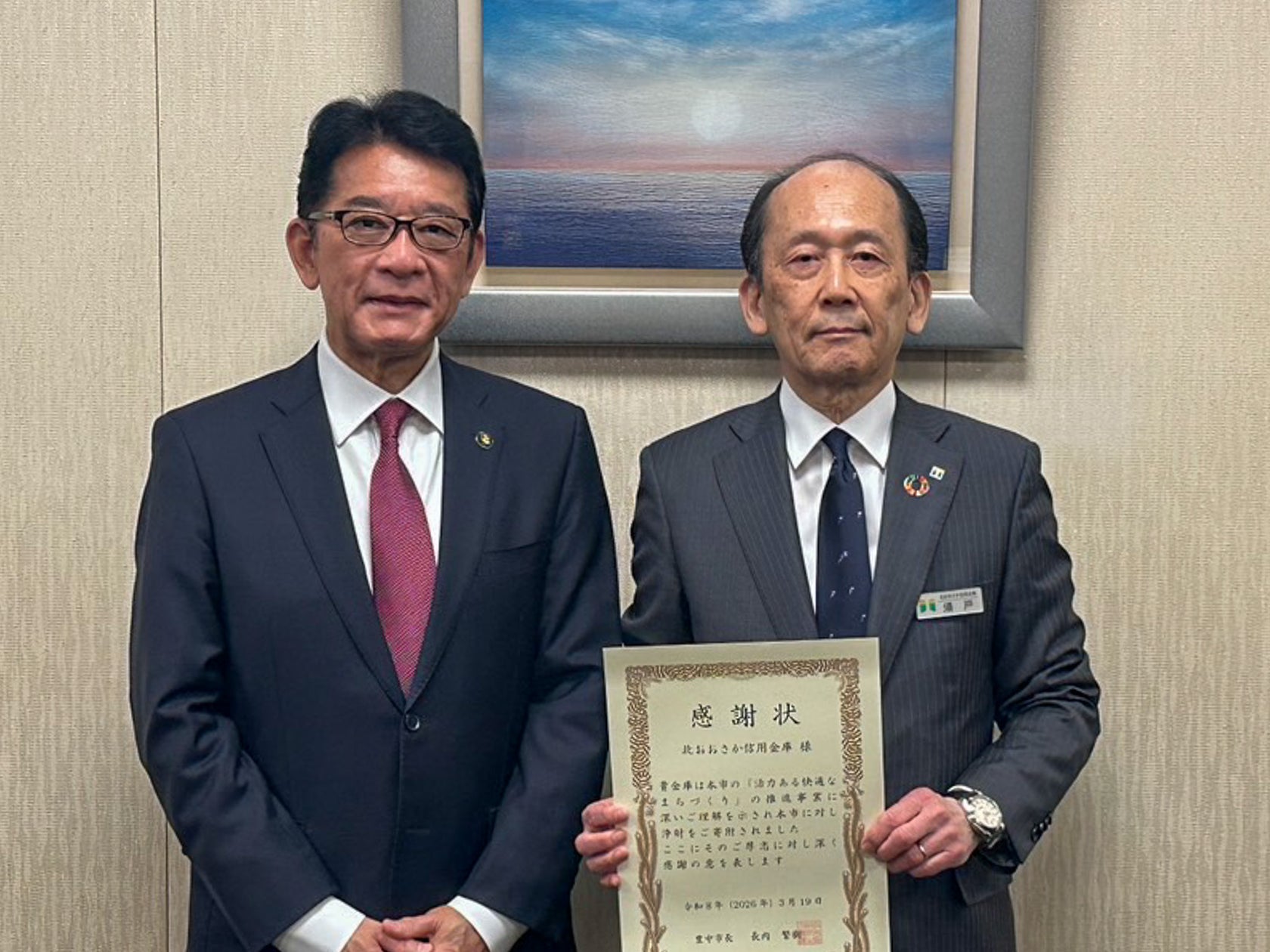
Toyonaka City formally awarded Kita-Osaka Shinkin Bank an official letter of commendation in **March 2026**, acknowledging the financial institution’s decisive contributions toward the completion of Toyonaka Tsubasa Park "ma-zika." The recreational development, situated directly adjacent to Osaka International (Itami) Airport, reached key milestones after the regional credit union directed substantial capital through Japan's Corporate Hometown Tax donation framework. As detailed in the official PR TIMES Report, municipal leaders recognized the Ibaraki-headquartered bank for translating regional financial resources into high-value community infrastructure.
The honor highlights an operational shift among Japan’s *shinkin* banks (credit unions). Facing population consolidation across the Kansai basin, these cooperative lenders are redefining their institutional roles. Kita-Osaka Shinkin Bank has aggressively repositioned itself as an active civic architect, backing municipal green spaces, underwriting decarbonization initiatives for small-to-medium enterprises (SMEs), and forging quadripartite alliances with local universities and private corporations.
📌 Key Takeaways:
- Civic Recognition: Toyonaka City formally awarded Kita-Osaka Shinkin Bank an official commendation in March 2026 for funding Toyonaka Tsubasa Park "ma-zika" through the Corporate Hometown Tax program.
- Industrial Decarbonization: A commercial alliance with NEXYZ.Group delivers zero-initial-cost energy retrofits across northern Osaka, helping regional manufacturers meet strict supply-chain emissions rules.
- Structural Governance: Mid-2026 executive reorganizations across major Kansai hubs ensure long-term oversight of cross-sector public, academic, and municipal development initiatives.
The Civic Mechanics Behind Toyonaka's ma-zika Park Funding
Toyonaka Tsubasa Park "ma-zika" was designed to convert airport-adjacent lands into an energetic public asset where residents gather to view departing aircraft, access community sports facilities, and participate in civic festivals. Yet, municipal budgets face compounding pressures from aging urban infrastructure and ballooning demographic healthcare obligations. Toyonaka Mayor Shigeki Osanai introduced the policy blueprint "Future Creation City Toyonaka, A City Where Tomorrow Is More Exciting" to attract non-traditional corporate capital into local public works.
Kita-Osaka Shinkin Bank intervened by utilizing the Corporate Hometown Tax system (*kigyo-ban furusato nozei*). Under this national Japanese tax mechanism, domestic corporations can donate to designated municipal revitalization projects and receive tax credits offsetting up to roughly **90%** of the donated volume across corporate tax, corporate inhabitant tax, and enterprise tax channels. By directing capital straight into the ma-zika project, the credit union bridged the city's capital gap while anchoring its public standing inside one of its most lucrative commercial territories.
The municipal commendation, presented inside Toyonaka City Hall, recognized not only the fiscal scale of the transfer but also the precedent it set for commercial cooperative banks. The bank demonstrated that local financial institutions can serve as direct infrastructure partners rather than passive lenders watching public amenities stall.
How Corporate Tax Donations Convert into Public Green Spaces
The mechanics of the ma-zika park transaction reveal how modern regional revitalization in Osaka works. Rather than allowing general corporate tax revenues to dissipate into Tokyo's centralized national treasury, the credit union routed designated capital directly to Toyonaka. This ensured that wealth generated by small business deposits in northern Osaka remained physically visible within the community.
Community financial institutions operate under regulatory charters mandating mutual aid and local reinvestment. When Kita-Osaka Shinkin Bank funded the development of park facilities, observation vantage points, and family-oriented amenities at ma-zika, it delivered immediate material returns to its own depositor base. Neighborhood foot traffic has spiked around the park perimeter since early construction phases wrapped up, stimulating micro-retail and weekend hospitality businesses nearby.
This tactical use of the Corporate Hometown Tax acts as a risk-mitigation strategy for community lenders. Thriving public districts preserve local property valuations, encourage younger families to settle in northern Osaka suburbs, and stabilize the retail mortgage portfolios held by the credit union's surrounding branch branches.
Strategic Timeline: Milestones Shaping Northern Osaka's Financial Anchor
Kita-Osaka Shinkin Bank's civic commendation in Toyonaka does not exist in isolation. It marks the culmination of an aggressive two-year push to integrate industrial decarbonization, academic strategy, and regional administrative partnerships across Osaka Prefecture.
| Date | Institutional Initiative | Regional & Operational Impact |
|---|---|---|
| July 2024 | Quadripartite Civic-Academic Accord | Signed an urban longevity agreement with Toyonaka City, Kyoshin Co., and the Graduate School of Project Design to incubate long-term residential solutions. |
| February 2025 | NEXYZ. Decarbonization Partnership | Joined an alliance of 100+ regional institutions to deploy zero-upfront-capital LED and HVAC retrofits for regional SME manufacturers and commercial facilities. |
| March 2026 | Toyonaka Park Commendation | Received formal municipal honors from Mayor Shigeki Osanai for Corporate Hometown Tax donations funding the Toyonaka Tsubasa Park "ma-zika" buildout. |
| July 2026 | Executive Leadership Restructuring | Implemented a 50-person personnel rotation, elevating branch chiefs in Suita and Umeda/Semba to executive officer posts to tighten loan-book governance. |
Financing Decarbonization Across the Kansai SME Corridor
Parallel to its park investments, Kita-Osaka Shinkin Bank enacted a practical green-transition initiative in February 2025 by partnering with NEXYZ.Group. Led by Representative Director Daioh Omae and Group CEO Takami Kondo, NEXYZ. has established energy-saving operational alliances with over **100** regional financial institutions across Japan. Under Chairman Yuji Sudo, Kita-Osaka Shinkin Bank adopted the model to address an urgent pain point for its corporate client base.
Small machine-tool shops, metal processing plants, and commercial warehouses in northern Osaka face intensifying supply-chain mandates from tier-one automakers and global exporters to demonstrate measurable carbon reductions. However, most local SME operators lack the liquid capital to purchase high-efficiency commercial air conditioners, industrial refrigeration, or extensive LED conversions outright. The NEXYZ. alliance provides installation with zero initial capital investment, packaging the equipment costs into manageable service fees offset directly by lowered utility bills.
Kita-Osaka Shinkin Bank’s loan officers act as the frontline distribution mechanism, identifying cash-strained SME clients struggling with bloated energy expenses and introducing the retrofitting program. By removing the upfront liquidity barrier, the bank stabilizes the operating cash flows of its commercial borrowers while driving Scope 1 and Scope 2 emissions cuts across its loan portfolio.
Public-Private Governance and Mid-2026 Leadership Changes
The institutional foundation for these multifaceted municipal investments was formally established in July 2024 through a quadripartite collaboration agreement. The alliance brought together Toyonaka City, education group Kyoshin Co., Kita-Osaka Shinkin Bank, and the Graduate School of Project Design (operated by The Social Design Academy). The initiative established project-planning seminars and entrepreneurial working groups aimed at designing commercial ecosystems that encourage young families and professionals to live continuously within the city limits.
Executing such interconnected civic, industrial, and environmental strategies requires operational discipline. In July 2026, Kita-Osaka Shinkin Bank executed a substantial organizational shake-up involving **50 personnel changes**, according to industry reporting from Nikkin Online. Key branch heads were elevated to corporate officer status, including Atsushi Horie (appointed Executive Officer while retaining leadership of the Suita branch) and Noriyuki Asaki (appointed Executive Officer overseeing both the Umeda and Semba branches). Additionally, senior credit specialist Katsumi Kawamura transitioned to Councilor within the credit division.
These appointments concentrate experienced lending leadership inside the bank's core commercial hubs: Suita, central Osaka's commercial engine in Umeda, and the traditional merchant district of Semba. Placing veteran branch managers on the executive board bridges executive-suite civic strategy with ground-level small business underwriting.
Frequently Asked Questions (FAQ)
Q1: Why did Toyonaka City present a formal commendation to Kita-Osaka Shinkin Bank?
A1: Toyonaka City honored Kita-Osaka Shinkin Bank in March 2026 for making strategic Corporate Hometown Tax donations that funded the construction and civic amenities of Toyonaka Tsubasa Park "ma-zika," a public recreational park located near Osaka International Airport.
Q2: How does the NEXYZ. partnership help Osaka SMEs achieve carbon neutrality?
A2: The agreement allows Kita-Osaka Shinkin Bank's business clients to install commercial LED lighting, high-efficiency HVAC units, and refrigeration equipment with zero upfront capital expenditure. Equipment costs are covered through monthly operational service structures offset by reduced power bills.
Q3: Where is Kita-Osaka Shinkin Bank headquartered, and who runs the institution?
A3: The credit union is headquartered in Ibaraki City, Osaka Prefecture, and is led by Chairman Yuji Sudo. It operates a vast branch network spanning northern Osaka, including major hubs in Toyonaka, Suita, and central Osaka.
Strategic Directions for Regional Finance
The civic commendation in Toyonaka confirms a broader transition in regional Japanese banking. Standard deposit-taking and commercial collateral lending alone no longer provide regional credit unions with durable competitive moats. As demographic shifts consolidate business density, institutions that weave themselves into municipal infrastructure and industrial modernization capture the primary loyalty of local business communities.
By synchronizing park-funding tax credits with comprehensive SME decarbonization and cross-sector academic partnerships, Kita-Osaka Shinkin Bank has constructed a repeatable model for regional economic defense. The physical completion of Toyonaka Tsubasa Park "ma-zika" stands as tangible evidence that civic responsibility and regional balance-sheet preservation can work in unison.