What Was Melorin Q? Complete Guide to Dance Koshien and Taro Yamamoto's Roots

Sunday nights in 1990 delivered an image that burned itself into Japan's collective memory. In front of millions of households watching Nippon TV, a 16-year-old high school student stripped down to tight swimming briefs, greased his chest with cooking oil, slapped his pectoral muscles, and screamed nonsense syllables directly into the camera: "Melorin Q!" The teenager was Taro Yamamoto. The program was Tensai Takeshi no Genki ga Deru Terebi! (Genius Takeshi's Energy-Producing Television), hosted by cultural icon Beat Takeshi. What began as a brazen piece of late-bubble absurdity turned into a defining artifact of Japanese television history.
More than three decades later, that same teenager sits in Japan's National Diet, leading Reiwa Shinsengumi, one of the country's most vocal anti-establishment political parties. The trajectory from oiled variety show oddball to fiery populist lawmaker baffles international observers, yet the throughline is remarkably consistent. To understand Taro Yamamoto's political staying power, one must look directly at the cultural frenzy of the 1990 high school street dance boom, the cutthroat logic of Nippon TV variety shows, and the subversive energy of a catchphrase that refused to die.
📌 Key Takeaways:
- The Genesis: "Melorin Q" debuted during the Summer 1990 season of Dance Koshien on Nippon TV's variety flagship Tensai Takeshi no Genki ga Deru Terebi!
- The Dual Phenomenon: The segment launched authentic street dance acts like the LL Brothers alongside surrealist comic acts like Taro Yamamoto.
- The Modern Consequence: Yamamoto leveraged the extreme stage presence, media mastery, and shameless crowd control perfected as Melorin Q to build Reiwa Shinsengumi into a permanent fixture in Japanese politics.
Golden Age Chaos of Genki ga Deru Terebi and Beat Takeshi
To grasp why Melorin Q detonated across Japanese households, you have to understand the sheer institutional scale of late-Showa and early-Heisei television. In the early 1990s, variety television held a virtual monopoly on national youth culture. Commercial networks enjoyed staggering viewer ratings, with flagship programs routinely pulling 20% to 25% household shares. At the center of this universe stood Beat Takeshi, whose acerbic, boundary-pushing style gave Tensai Takeshi no Genki ga Deru Terebi! its anarchic heartbeat.
The show pioneered reality-adjacent variety programming. Producers sent crews into ordinary towns, pulling everyday citizens, eccentric elderly folk, and uninhibited adolescents directly into the studio spotlight. The barrier between professional entertainer and reckless amateur collapsed entirely. Beat Takeshi functioned as an irreverent ringmaster, encouraging participants to humiliate themselves for laughs while holding up a mirror to the conformist rigidities of Japanese society.
When the show introduced its amateur dance competition segment, it tapped into an emerging subcultural wave. Hip-hop, breakdancing, and New Jack Swing were leaking out of underground clubs in Roppongi and Harajuku into provincial suburbs. Millions of teenagers possessed the energy to emulate what they saw in American music videos, but traditional broadcast media had offered them nowhere to perform. Genki ga Deru Terebi handed them Sunday prime time.
The Birth of Melorin Q in the High School Dance Koshien
Officially titled the Zenkoku Koko Dance Koshien (National High School Dance Koshien), the contest borrowed the romantic branding of Japan's legendary high school baseball tournament. Instead of cleats and dirt, contestants brought boomboxes and tracksuits. The tournament quickly split into two camps: technically gifted dancers who took the art form seriously, and pure visual performance artists whose only goal was to shock the studio audience into hysterics.
Enter Taro Yamamoto, then a high school sophomore from Hyogo Prefecture. Yamamoto possessed none of the fluid isolations or rhythmic discipline required for competitive street dance. Instead, he understood broadcast television instinctively. He walked onto the stage wearing swimming trunks, shaved head, and slick body oil, sometimes brandishing half a melon or smearing white cream across his torso. His choreography was brief and manic, culminating in wide-eyed pelvic thrusts and the frantic chant: "Melorin Q!"
The performance was absurd, grotesque, and instantly magnetic. Nippon TV cameras lingered on Beat Takeshi crying with laughter in the studio booth. Within weeks, middle school and high school schoolyards across Japan were overrun with teenagers mimicking the pose. The chant carried no literal meaning in Japanese; it worked purely as sonic slapstick, an outburst of pure id designed to shatter the stiff expectations placed on Japanese high schoolers.
Street Culture Clash: Serious B-Boys Meets Slapstick Absurdism
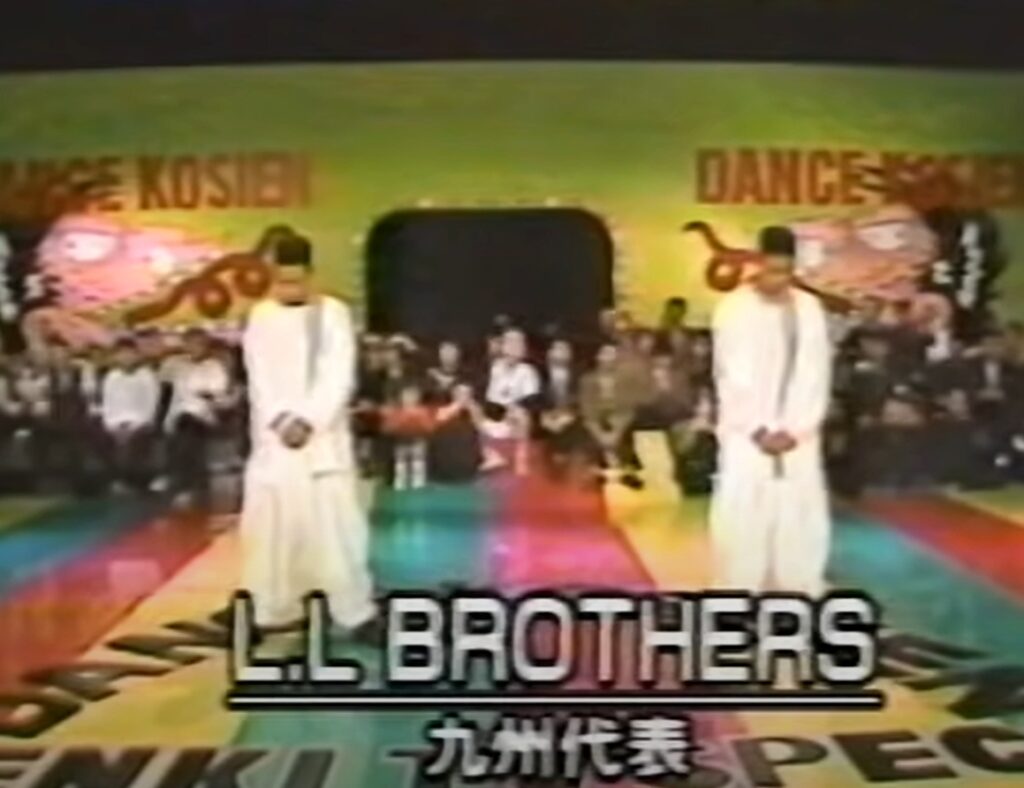
The enduring genius of Dance Koshien lay in its friction. Producers deliberately contrasted unhinged spectacle acts against elite street dancers, forcing them onto the same stage. While Yamamoto was screaming in a Speedo, acts like the LL Brothers (siblings Masahiro and Noriyuki Kawakuji from Fukuoka) were executing razor-sharp New Jack Swing routines inspired by Bobby Brown and Heavy D & the Boyz.
The LL Brothers became national heartthrobs, driving hundreds of thousands of Japanese teenagers to buy baggy trousers, Kangol hats, and import cassettes. They represented technical legitimacy. Yamamoto, competing under ridiculous group names like the "Anarchy Takakada Brothers," represented pure disruptive chaos. This balance propelled the broadcast ratings past 20% throughout late 1990 and 1991.
| Contestant / Act | Style & Signature Identity | Long-Term Cultural Impact |
|---|---|---|
| LL Brothers | Technical New Jack Swing, hip-hop choreography, urban street fashion | Ignited mainstream Japanese dance culture; transitioned into professional music and R&B production |
| Taro Yamamoto (Melorin Q) | Oiled swimsuit, slapstick body humor, absurdist "Melorin Q" catchphrase | Cult variety icon; pivoted to award-winning acting before founding the political party Reiwa Shinsengumi |
| IMPERIAL | Early Japanese B-boying, floor power moves, breakdance battles | Helped lay grassroots foundations for Japan's global dominance in competitive Olympic breaking |
| Miami Face | Gimmick-driven physical comedy paired with basic funk-style popping | Reinforced variety television's tradition of blending subculture with studio ridicule |
The juxtaposition created an unusual feedback loop. Serious street dancers resented the mockery of their craft, yet they acknowledged that the comedic madness brought eyes to their subculture. Millions of viewers tuned in to see if Yamamoto would be disqualified for indecency, and stayed to watch authentic hip-hop choreography they had never encountered before.
The Actor's Pivot: From Shaving Cream to Battle Royale
Most variety show one-hit wonders disappear within twelve months. Yamamoto refused to leave the industry. After graduating high school, he recognized that his Melorin Q persona would quickly turn into a creative dead end. He began taking dramatic acting classes, systematically shedding the caricature while retaining the physical fearlessness that produced it.
By the late 1990s, casting directors realized Yamamoto had uncommon screen presence. He lacked the polished vanity of conventional male idols, bringing an intense, raw grit to supporting roles. In Kinji Fukasaku's iconic 2000 dystopian thriller Battle Royale, Yamamoto delivered a standout performance as Kawada's tough ally, proving he could hold the screen in brutal dramatic cinema.
Mainstream validation followed. He earned prominent roles in high-budget cinema, including the 2004 NHK Taiga drama Shinsengumi!, written by Koki Mitani. He spent nearly two decades as an acclaimed, hard-working character actor. The Melorin Q clips remained stored in network vaults, wheeled out on nostalgia retrospectives as a lighthearted joke. Yamamoto laughed along with the archival footage, confident his career had moved far past the swimming trunks.
Fukushima and the Birth of Reiwa Shinsengumi
Everything cracked wide open on March 11, 2011. The Great East Japan Earthquake, tsunami, and subsequent meltdowns at the Fukushima Daiichi nuclear power plant fundamentally altered Japanese public life. While mainstream talent agencies pressured their rosters to stick to vague, non-controversial messages of recovery, Yamamoto broke ranks entirely.
He publicly attacked the government's handling of radiation data, demanded immediate shutdowns of commercial nuclear reactors, and protested on street corners. The consequences arrived immediately. Talent agencies dropped him. Television networks rescinded drama contracts. Corporate sponsors made it clear that Taro Yamamoto was commercially radioactive. Facing an effective blacklisting from the commercial entertainment machine that made him, Yamamoto chose escalation.
In 2013, he ran for the House of Councillors in Tokyo as an independent, winning a seat with over 666,000 votes. Six years later, in April 2019, he founded Reiwa Shinsengumi, a left-wing populist party centered on progressive taxation, universal basic income policies, and relentless critiques of conservative establishment austerity. His political rallies looked nothing like typical Japanese campaign events. Drawing thousands of disaffected young people, workers, and activists, Yamamoto used unscripted, microphone-in-hand marathons that echoed the raw, unfiltered performance instincts he demonstrated decades earlier on Sunday night television.
Frequently Asked Questions (FAQ)
Q1: What does the phrase "Melorin Q" actually mean in Japanese?
A1: It has no formal definition. Taro Yamamoto invented it as an absurd, nonsensical exclamation during his high school audition for Dance Koshien, pairing the rhythm of the syllables with physical comedy and melon-themed antics.
Q2: Did Taro Yamamoto ever apologize or express regret for the character?
A2: No. While he stepped away from the gimmick to build his acting and political careers, Yamamoto has consistently acknowledged his variety show past with humor, often using his working-class, outsider entertainment roots to contrast himself against elite hereditary politicians.
Q3: How influential was Dance Koshien on modern Japanese street dance?
A3: Enormously influential. The 1990, 1991 broadcasts introduced millions of young people outside major metropolitan areas to American hip-hop dance, paving the way for Japan's world-class competitive breaking and street dance communities.
The Lasting Impact of Taro Yamamoto's Counterculture Trajectory
Contemporary political analysts frequently struggle to categorize Yamamoto's durability. In an establishment dominated by third-generation political dynasties and carefully scripted press conferences, his background reads like satire. Yet the connection between his variety show origins and his legislative tenacity is structural, not accidental.
Melorin Q was an exercise in radical shamelessness. Standing on national television in swimming trunks required an immunity to public embarrassment that few human beings possess. That exact psychological trait enabled Yamamoto to walk into the National Diet, disrupt procedural votes, file censure motions, and speak directly to marginalized voters who feel ignored by polite political discourse. The boy greased in cooking oil and the opposition party leader fighting over economic policy are driven by the same impulse: an absolute refusal to obey the room's unspoken decorum.